A body of work rather than a shelf of novels

Rosemary Sutcliff – historical novelist and children’s book writer – is the object of an essay by John Rowe Townsend in his 1971 book  A Sense of Story —as blog reader and commenter Anne highlights at another post.  She notes that his observation that Rosemary Sutcliff’s books amount to  “a body of work rather than a shelf of novels” is is taken from what she refers to as the essay’s “wonderfully striking and poetic introduction”:

Day to day, minute to minute, second to second the surface of our lives is in a perpetual ripple of change. Below the immediate surface are slower, deeper currents, and below these again are profound mysterious movements beyond the scale of the individual life-span. And far down on the sea-bed are the oldest, most lasting things, whose changes our imagination can hardly grasp at all. The strength of Rosemary Sutcliff’s main work—and it is a body of work rather than a shelf of novels—is its sense of movement on all these scales. Bright the surface may be, and vigorous the action of the moment, but it is never detached from the forces underneath that give it meaning. She puts more into the reader’s consciousness than he is immediately aware of.
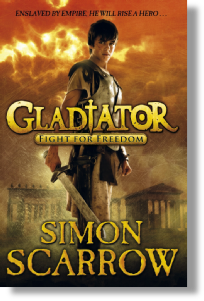
Simon Scarrow dedicates Gladiator Fight for Freedom new book to Rosemary Sutcliff but …

Author Simon Scarrow dedicates to Rosemary Sutcliff his new young adult book Gladiator: Fight for Freedom. I am alerted to this by reader and commenter on this blog ‘JB’ (5 Feb on post here). Thank you JB , for  I was unaware of the dedication – or the book – and am off to get it.

For Rosemary Sutcliffe (sic) who has inspired so many of us to love history.

Oh Dear Sutcliff spelt wrongly again, with an E. In fact JB writes:

… (it) has an interesting plot and a dedication to Rosemary Sutcliffe (sic). Mr Scarrow speaks highly of Miss Sutcliff and whilst I do not blame him for the typo, I do wonder who does his proof reading. It would be the work of a moment to check the spelling of Miss Sutcliff’s surname.

Read More »

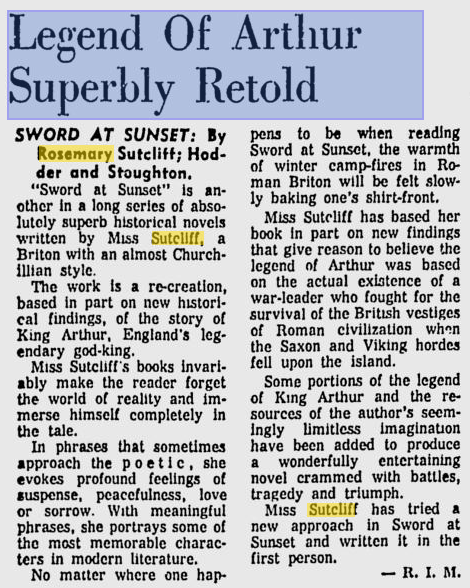
Rosemary Sutcliff history novel Sword at Sunset | Legend of King Arthur superbly retold


Source: Edmonton Journal – Nov 15, 1963

Interview with Jamie Bell, Esca in The Eagle film of Rosemary Sutcliff’s The Eagle of the Ninth

Jamie Bell as EscaThe English co-star of Channing Tatum gives his take as a working-class Briton on The Eagle (film of Rosemary Sutcliff‘s The Eagle of the Ninth) and its filming, interviewed by the San Fransisco Chronicle. Jamie Bell, first noted for his appearance as Billy Elliot when still a young boy, plays Esca, the Brigante slave of Marcus.

There’s something about ‘the lesser people’ – in England, just being a Northerner, you’re straight into a demographic of being working class, no matter what. From the way you sound, to the industry you come from, to the air you breathe, you’re working class. Which I consider something to be proud of, actually, and to embrace.

And these people (the Brigantes) had a way of life, a culture, that is taken away from them, that is stripped, and other people’s values are then pressed onto them. Which is not too dissimilar to things that are happening today; the invasions of different countries and the pressing of democracy on other people who don’t necessarily want it.”

Source: Jamie Bell: ‘Billy Elliot’ trades shoes for sword.

Guardian’s Charlotte Higgins and maybe Rosemary Sutcliff discover 18th century poetic dildos

Rosemary Sutcliff, interested in the bawdy when the mood took her, would surely have shared The Guardian newspaper’s chief arts writer Charlotte Higgins’s delight  in getting published an article about 18th century poetic dildos! (But as a Telegraph reader she would have seen it only if alerted by Guardian reader such as I!)