Rosemary Sutcliff’s Roman Britain historical novels

Rosemary Sutcliff Frontier Wolf  US cover 2008Compelling historical fiction relies on characters welded so smoothly to actual events that the seams are nearly invisible. A smooth blend of fictional and historical figures provides the depth of a documentary with the sweep and emotion of a good yarn. This mixing makes Rosemary Sutcliff‘s Roman Britain novels (The Eagle of the Ninth, The Silver Branch, Frontier Wolf, and The Lantern Bearers, along with the Romano-Celtic Sword at Sunset and Dawn Wind) the great books that they are. Their re-creation of Roman Britain is vivid and exquisitely detailed. The result, novels that convincingly transport the reader back to the Empire, is compelling reading. The family connection of the main characters in all but Sword at Sunset (where the Aquila family plays a minor role) builds on the historical details to create a personal connection between the novels.

via Rosemary Sutcliff, Roman Britain historical novels (with thanks to reader and contributor Anne)
The Eagle | Unlikely BAFTA nominee for labour of love of Rosemary Sutcliff novel?

Rosemary Sutcliff‘s The Eagle of the Ninth became The Eagle film earlier this year. Any chance of a BAFTA? One of the problems on the internet is knowing the authority of particular sites; but my Google alert on Rosemary Sutcliff threw up this comment today at ScreenDaily, which was not encouraging.

Director Kevin Macdonald has shared in two Korda award wins for Touching The Void (2003) and The Last King Of Scotland (2006). Producer Duncan Kenworthy is a Bafta stalwart with multiple nominations to his credit and a best film win for Four Weddings And A Funeral (1994). The adaptation of Rosemary Sutcliff’s 1954 children’s classic The Eagle Of The Ninth may have been a labour of love for both producer and director, but the lack of widespread critical support for the film and a UK release date back in March would seem to work against either of them adding to their Bafta renown this year.

via Rich pickings | Features | Screen.

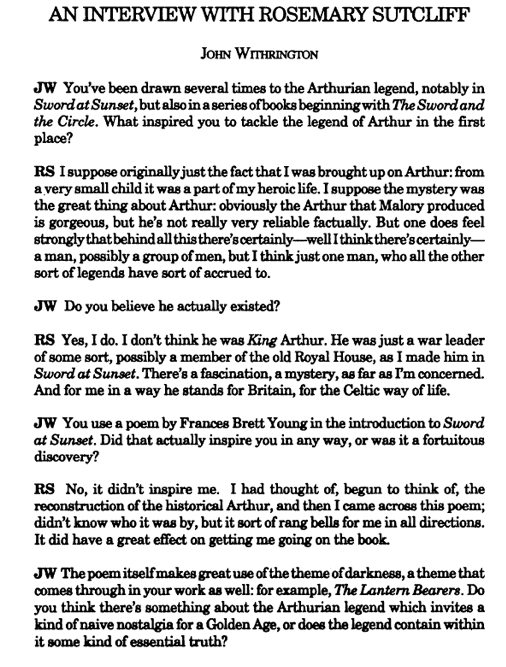
Interview in 1991 with Rosemary Sutcliff by John Withrington about Sword at Sunset and Arthurian legend

I have found a new (to me) interview snippet and will be chasing the full interview. (Any of you readers and contributors got access?)

Sutcliff snippet of interview

Source: Quondam et Futurus, Vol. 1, No. 4, Winter 1991

Rosemary Sutcliff’s Dolphin Ring and fictional Roman Aquila family

In a comment on a recent post yesterday Robert Vermaat points me to a blog post from a few years ago which explores how Rosemary Sutcliff passed a dolphin ring down many generations of  the Aquila family over several books. Thus:
“Marcus took it from him and bent to examine it. It was a heavy signet-ring; and on the flawed emerald which formed the bezel was engraved the dolphin badge of his own family … ”
As to why this was a dolphin, he’s not sure it was ever explained? Does anyone know? The books, by the way, in order of century setting, not order of writing, are:
The Eagle of the Ninth (1954) – set in the 2nd century
The Silver Branch (1957) – 3rd century
Frontier Wolf (1980) – 4th century
The Lantern Bearers (1959) – 5th century
Sword At Sunset (1963) – 5th century
Dawn Wind (1961) – 6th century
Sword Song (1991) – 10th century
The Shield Ring (1956) – 11th century

Rosemary Sutcliff’s Dolphin Ring books | The sequence

A Twitterer, who is “reading Knight’s Fee now” asks “is there a chronology of (Rosemary Sutcliff) books re the family with the dolphin ring?”. I think it goes like this – but do put me right any of you Rosemary Sutcliff experts out there … And does anyone know or recall WHY a dolphin is the image on the ring?

The Eagle of the Ninth (AD 133),
The Silver Branch (about AD 280),
Frontier Wolf (AD 343),
The Lantern Bearers (AD 450),
Sword at Sunset (immediately follows the time of The Lantern Bearers)
and Dawn Wind (AD 577).

The  sequence of stories of the descendants of Marcus Flavius Aquila, hero of The Eagle of the Ninth, continues with Sword Song (about AD 900) and The Shield Ring (about AD 1070).