Rosemary Sutcliff’s The Eagle of the Ninth in twenty languages

This is a fully up to date listing of all nineteen languages that Rosemary Sutcliff‘s The Eagle of the Ninth has been published in, in addition to the OUP editions in English. (This listing is from OUP)

English (UK hardback special edition) – Folio Society
English (audiobook – straight reading) – Naxos Audio Books
English (audio – dramatisation) – BBC/AudioGo
English (India) – Penguin India
English (USA) – Square Fish (an imprint of Farrar, Straus and Giroux).

Brazilian Portuguese – Editora Record
Czech – BB Art
Danish – P. Haase & Sons (out of print)
Dutch– Leopold
German – Verlag Freies Geistesleben
Spanish – Plataforma Editorial
French – Gallimard Jeunesse
Greek – Aiora Press
Hungarian – Alexandra Konyveshaz Kft.
Italian – Arnoldo Mondadori Editore
Japanese – Iwanami (out of print)
Korean – Sigongsa
Polish – Wydawnictwo Telbit
Portuguese – Gradiva Publicacoes
Romanian – Editura Litera International
Russian – Azbooka-Atticus
Serbian – Laguna
Swedish – Forlaget Barnstenen (out of print)
Thai – NanMee Books
Turkish – Ithaki Publishing

(I am in the process of tracking down all the websites for the publishers/foreign editions: all help welcome. Post links at comments please!)

The Eagle film second only to The King’s Speech on Lawton favourability index!

Of course, I have been keen to see how The Eagle film, based upon Rosemary Sutcliff‘s book The Eagle of the Ninth, has been ‘doing’ since its release, and how it has been received. (My amalgam of particularly favourable initial reviews is here – under the title “The Eagle is a ‘rip-snortin’ ‘real winner’ with an ‘unusually strong sense of place …’ “!). Judging by the amount of money being taken at the box office in the USA in its first few days, The Eagle has certainly done less well than various competing films – competing in the sense that they too are in cinemas. But judging by the high popularity of the film once people do see it, maybe that is a result of the marketers not getting enough people to the movie in the first place? And maybe that is a result of  failing to make enough people aware of the film and want to see it in advance of release? And maybe that would not have been the case if they had stuck with the more memorable The Eagle of the Ninth as a title? Read More »

Rosemary Sutcliff writing about war and violence ‘intense, convincing, apparently unrestrained’

Rosemary Sutcliff‘s writing about violence and war, described by The Independent (UK) newspaper obituary on her death in 1992:

…  Sutcliff had an exceptional ability to describe the complexity of army strategies and the details of combat as well as to capture the emotions of fighting on any scale. Her war scenes are intense, convincing and apparently unrestrained, walking a delicate tightrope which prevents them from lapsing into the bloodthirsty. Sutcliff was never sadistic or cruel. She did not whitewash war or violence, but she did not relish it either. She recognised it as part and parcel of our past.

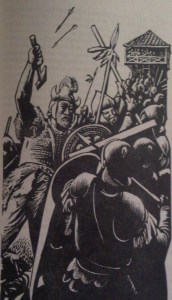
De Adelaar Van Het Negende | The Eagle of the Ninth | Dutch original edition

This is the cover of the 1965 Dutch version of Rosemary Sutcliff‘s acclaimed children’s novel The Eagle of the Ninth. Inside are the same beautiful illustrations by C. Walter Hodges that are evident in all the early editions of the novel. This particular illustration is of Marcus and his Legion, ‘The Fourth Gaulish Auxiliaries of the Second Legion’, breaking formation in their battle with a British tribe.

(Adaptation  of earlier post)

‘Vivid and real’ | Rosemary Sutcliff’s writing | Brian Keaney

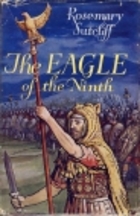
Rosemary Sutcliff's famous novel was first published in the UK in 1954
UK hardback 1954 cover

Of Rosemary Sutcliff’s historical novel The Eagle of the Ninth, writer  Brian Keaney commented on Goodreads:

First published in 1954, The Eagle Of The Ninth was once to be found in every children’s library in the UK. For the last fifteen or twenty years, however, Rosemary Sutcliff’ has been somewhat forgotten as the solid, carefully written style of her books has given way to fiction that thrusts itself more brazenly upon its readers.

Hearing that there was a film coming out in 2011, I thought I would renew my acquaintance and I am very glad that I did. Based upon the mystery of the fate of the Ninth Legion which marched from its station in what is now York some time around AD 117 and was never seen again, this is the story of a young Roman soldier, the son of a centurion of that ill-fated legion, who sets out some eight years later to discover his father’s fate, it is a terrific read.

Rosemary Sutcliff makes the world of Roman Britain as vivid and real as if it were still standing to this day. Her characters are strongly drawn and her observation of nature is wonderfully well conveyed in tightly-written prose. This is a delight to read and a timeless classic