For award-winning, internationally-acclaimed author Rosemary Sutcliff (1920-92). By Anthony Lawton: godson, cousin & literary executor. Rosemary Sutcliff wrote historical fiction, children's literature and books, films, TV & radio, including The Eagle of the Ninth, Sword at Sunset, Song for a Dark Queen, The Mark of the Horse Lord, The Silver Branch, The Lantern Bearers, Dawn Wind, Blue Remembered Hills.
Category: Autobiography & Biography
Posts on the rosemarysutcliff.com weblog about the life and thoughts of Rosemary Sutcliff, including what she wrote and said about writing and her own craft.
Forty-one years ago the Book Marketing Council published a list of who they judged to be the 20 greatest living British authors. None is still alive. The Times – then (and now?) a paper of record – covered the group, but sadly mis-spelled Rosemary Sutcliff as Sutcliffe (sic) with an E.
Rather unsystematically gathering information about my relative, British writer of historical fiction and children’s literature, Rosemary Sutcliff, I have come across online mention of a carefully archived and indexed collection of 33 years correspondence with Rosemary Sutcliff donated to Toronto Public Library by her Canadian friend Christina Duff Stewart. There are 83 letters, 14 Christmas cards, and 7 ‘Round Robins’ of correspondence and also various books given to ‘Chris’ and ‘Christina’ by Rosemary. It’s a veritable treasure trove!
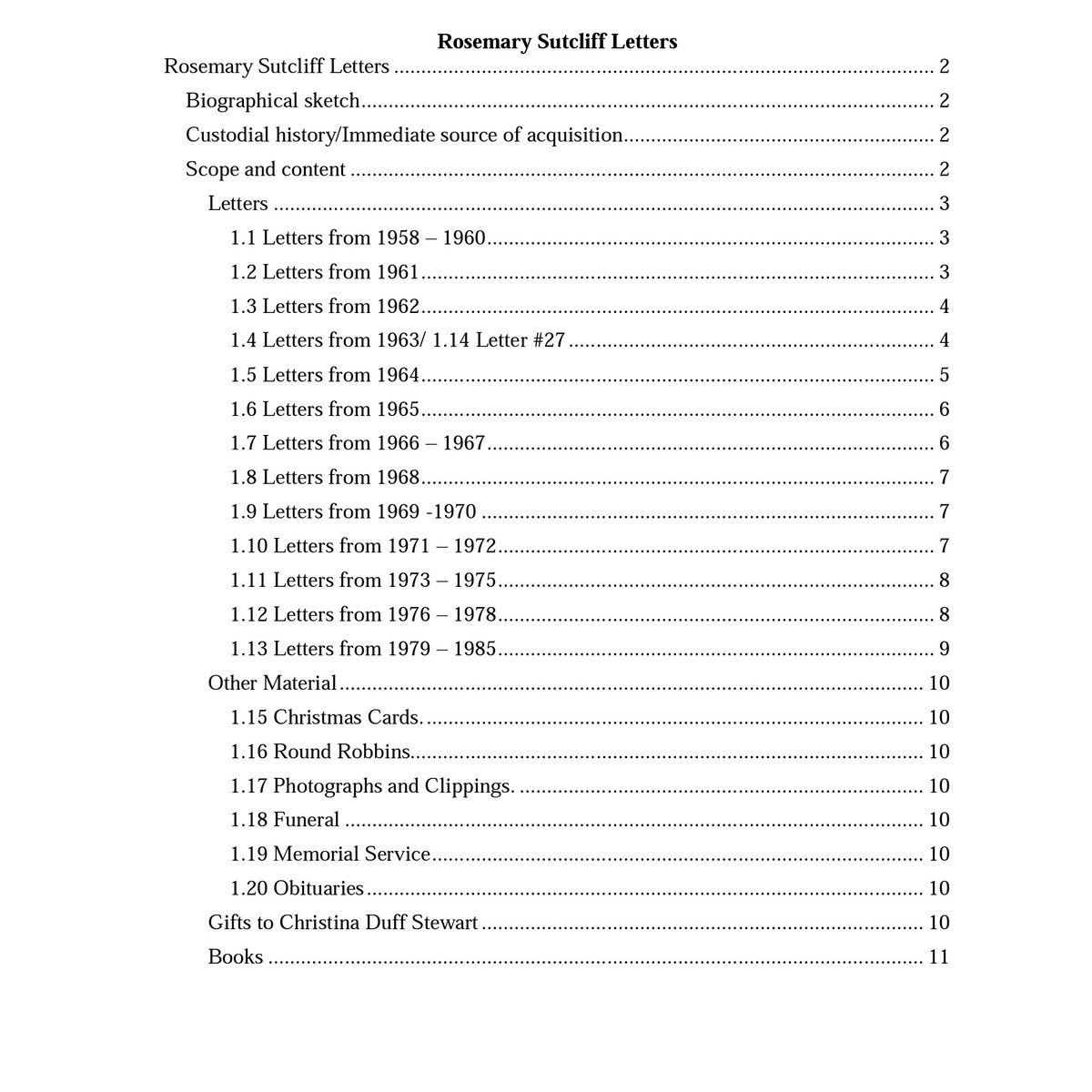
The contents are listed in a document which itself is intriguing. I was moved to learn, for example, that ‘Letter 82’ (of November 16th 1981) has a particular connection to my immediate family.
2-page letter with news of a minor car accident, work on the Bonnie Dundee book, and the birth of Rowan Rosemary Lawton, her godson Anthony’s (me) daughter.
Perhaps influenced by Sutcliff-Lawton genes (Rosemary Sutcliff was my first cousin-once-removed, my great aunt Nessie’s daughter) my daughter who is referred to now a literary agent!
The introduction to the detailed list of contents gives an idea of what is there. Unfortunately in my case to consult the collection in person,, and maybe to obtain copies or at least transcripts, Toronto is about 3,500 miles away from Leicestershire in England where I am writing this
When the BBC adapted and broadcast Rosemary Sutcliff‘s historical novel The Eagle of the Ninth in 1977, the BBC Radio Times wrote about her approach to children, writing, the Romans and her hero Marcus—’part of me was in love with him’.
Her passion for the Romans stemmed from her childhood. Her mother read aloud to her from books like Rudyard Kipling‘s Puck Of Pook’s Hill. His three Roman tales entranced her.
I didn’t read myself till the last possible minute, about nine. I was brought up on Arthur Weigall’s Wanderings In Roman Britain and Wanderings In Anglo-Saxon Britain. He mentions this eagle dug up at Silchester and I’ve been fascinated by it since I was five.
The Radio Times journalist wrote of Rosemary: “She writes, superbly, of adventure, battle, young warriors. Rosemary Sutcliff‘s conversation is rapid and merry and very funny”.
In the BBC TV publicity material she claimed to be completely uneducated.
I left school at fourteen. I haven’t got a very literary or intelligent kind of life. I have very ordinary friends.
In fact, she completed art school and was a successful professional miniaturist in her late twenties when she turned to writing and secured the publication of her first book. It just “happened to be” for children; and most of her books kept on being, theoretically at least, “for children”. But she definitely did not believe in a rigid division between adults’ and children’s books. “When I was a child I was reading Dickens and Beatrix Potter at the same time”. As far as writing goes she did not find it restrictive.
Very occasionally a subject is verboten. And one may have to simplify—no, not that—uncomplicate a very complex emotion. But usually I just write as I want to write.
She said that she did not know all that many children and did not automatically like them .
I like a child or a dog or an adult according to their merits. I am prone to like more dogs on a percentage basis.
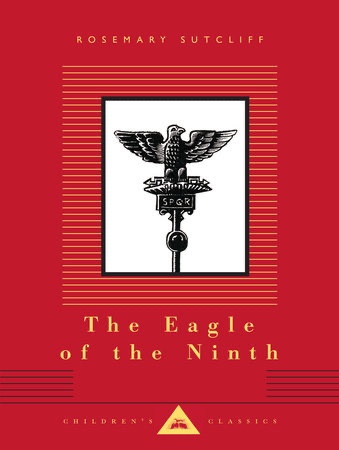
The Eagle Of The Ninth, published in 1954, was one of her favourite books.
I rather wish it weren’t, because it is quite early. I think and hope I have written better since. But it is my best beloved. Part of me was Marcus, and part was in love with him.
When aged only about three she had juvenile arthritis (Still’s Disease) which was another factor in her writing:
I think most children’s writers are writing a chunk of unlived childhood.
When the BBC adapted and broadcast Rosemary Sutcliff‘s historical novel The Eagle of the Ninth in 1977, the BBC Radio Times wrote about her approach to children, writing, the Romans and her hero Marcus—’part of me was in love with him’.
Her passion for the Romans stemmed from her childhood. Her mother read aloud to her from books like Rudyard Kipling‘s Puck Of Pook’s Hill. His three Roman tales entranced her.
I didn’t read myself till the last possible minute, about nine. I was brought up on Arthur Weigall’s Wanderings In Roman Britain and Wanderings In Anglo-Saxon Britain. He mentions this eagle dug up at Silchester and I’ve been fascinated by it since I was five.
The Radio Times journalist wrote of Rosemary: “She writes, superbly, of adventure, battle, young warriors. Rosemary Sutcliff‘s conversation is rapid and merry and very funny”.
In the BBC TV publicity material she claimed to be completely uneducated.
I left school at fourteen. I haven’t got a very literary or intelligent kind of life. I have very ordinary friends.
In fact, she completed art school and was a successful professional miniaturist in her late twenties when she turned to writing and secured the publication of her first book. It just “happened to be” for children; and most of her books kept on being, theoretically at least, “for children”. But she definitely did not believe in a rigid division between adults’ and children’s books. “When I was a child I was reading Dickens and Beatrix Potter at the same time”. As far as writing goes she did not find it restrictive.
Very occasionally a subject is verboten. And one may have to simplify—no, not that—uncomplicate a very complex emotion. But usually I just write as I want to write.
She said that she did not know all that many children and did not automatically like them .
I like a child or a dog or an adult according to their merits. I am prone to like more dogs on a percentage basis.
The Eagle Of The Ninth, published in 1954, was one of her favourite books.
I rather wish it weren’t, because it is quite early. I think and hope I have written better since. But it is my best beloved. Part of me was Marcus, and part was in love with him.
When aged only about three she had juvenile arthritis (Still’s Disease) which was another factor in her writing:
I think most children’s writers are writing a chunk of unlived childhood.






 ROSEMARY SUTCLIFF (1920-92)