The Girl I Kissed at Clusium | Roman Marching Song by Rosemary Sutcliff

Anne wrote long ago at the Tab ‘Write!” above about the song The Girl I Kissed At Clusium. (Write – do use it, so many readers and visitors here are vastly more insightful and knowledgeable about Rosemary Sutcliff than I ).

As for why Rosemary Sutcliff used (Clusium—an ancient Etruscan city, one of the Etrurian confederacy that fought it out with Rome for supremacy in the early days)  for her famous legionary marching song in The Eagle of the Ninth, I think the answer lies in her early schooling. She mentions in her autobiography, Blue Remembered Hills, just how much she and her classmates enjoyed declaiming Macaulay’s stirring poem, ‘Horatius (at the Bridge)’. Who could forget that image of Horatius and his two comrades gallantly holding the Pons Sublicius against the invading army of Lars Porsena, king of Clusium in the late 6th century BC, during the war between Rome and Clusium?

Meanwhile the Tuscan army, right glorious to behold,
Came flashing back the noonday light,
Rank behind rank, like surges bright of a broad sea of gold.
Four hundred trumpets sounded a peal of warlike glee,
As that great host, with measured tread, and spears advanced, and ensigns spread,
Rolled slowly towards the bridge’s head where stood the dauntless Three.
Source

Here are Rosemary Sutcliff’s own words, so you can see the effect Macaulay’s poem had upon her young sensibilities.

We learned verse upon verse of Macaulay’s ‘Lays of Ancient Rome’ and proclaimed them with glorious fierceness, stiffening the sinews, summoning up the blood and lending the eyes a terrible aspect under the beetling brows of imaginary helmets:

‘Lars Porsena of Clusium, by the Nine Gods he swore
That the great house of Tarquin should suffer wrong no more.
By the Nine Gods he swore it, and named a trysting day,
And bade his messengers ride forth,
East and West and South and North,
To summon his array.’

Who were the Nine Gods? What wrong was the great house of Tarquin suffering? We had no idea. But the lines have the true trumpet ring to them yet; the purposeful tramp of a legion’s feet on the march.

The snatches of the legionnaires’ song in The Eagle of the Ninth are

Oh when I joined the Eagles
(As it might be yesterday)
I kissed a girl at Clusium
Before I marched away
A long march, a long march
And twenty years in store
When I left my girl at Clusium
Beside the threshing-floor

The girls of Spain were honey-sweet,
And the golden girls of Gaul:
And the Thracian maids were soft as birds
To hold the heart in thrall.
But the girl I kissed at Clusium
Kissed and left at Clusium,
The girl I kissed at Clusium
I remember best of all

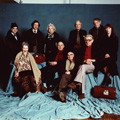
Portraits of Rosemary Sutcliff at The National Portrait Gallery

Portrait of Rosemary Sutcliff by Mark Gerson

I have just discovered, courtesy of Bing search and never found on Google,  two portraits of Rosemary Sutcliff which I had not seen for many a year. They are  at The National Portrait Gallery. I have applied for full size reproduction rights. Meanwhile two thumbnails must suffice. The one below is by Lord Snowden, for the Sunday Times who I think had compiled a list of top twenty authors of the 20th Century

Rosemary Sutcliff in a poprtrait at The National Portrait Gallery

The others in the photo are:

  • Dame Beryl Bainbridge (1932-2010), Novelist and actress.
  • Sir John Betjeman (1906-1984), Poet Laureate, writer and broadcaster.
  • Sir Malcolm Stanley Bradbury (1932-2000), Novelist and critic.
  • Anthony Burgess (John Burgess Wilson) (1917-1993), Novelist and critic; composer.
  • Leon Garfield (1921-1996), Writer.
  • Laurence Edward Alan (‘Laurie’) Lee (1914-1997), Poet and prose writer.
  • Rosamond Nina Lehmann (1901-1990), Novelist.
  • Sir Victor Sawdon (‘V.S.’) Pritchett (1900-1997), Writer and critic.
  • Sir Laurens Jans van der Post (1906-1996), Writer, farmer, explorer and conservationist.

Source: National Portrait Gallery

Google ‘discovers’ Rosemary Sutcliff was on BBC Radio 4’s Desert Island Discs!

For reasons I cannot divine, my Google alert for new items on <Rosmeary Sutcliff> pointed today to a 2011posting at this blog about  her appearance on BBC Radio’s Desert Island Discs! At that time, a recording of Rosemary Sutcliff’s appearance with Roy Plomley was not available for downloading. It is now, here.

In the usual way on this radio programme, Rosemary Sutcliff talked (in October 1983) about her life and work and chose eight records to take to the mythical BBC Radio desert island. She said she chose her music just because she loved it—not everyone does, especially these PR-obsessed days. Her choices were:

  1. Record 1: Dvorak’s New World Symphony, played by the London Symphony Orchestra, by Istvan Kertesz.
  2. Record 2: “Eternal father strong to save” – Hymn.
  3. Record 3: L’Apres-midi d’une Faune by Debussy. Royal Philharmonic conducted by Thomas Beecham.
  4. Record 4: “We’ll Gather Lilacs” sung by Anne Ziegler & Webster Booth.
  5. Record 5: “The Flowers of the Forest” played by the pipes & drums of the 1st Battalion of the Scots Guards.
  6. Record 6: Excerpt from “Under Milk Wood”. Polly Garter’s song.
  7. Record 7: “The Lark Ascending” by Vaughan Williams. The Boyd Kneale Orchestra. With Frederick Grinker.
  8. Record 8: “Jesu Joy of Man’s Desiring” by Bach. Choir of King’s college, Cambridge, conducted by David Willcocks.
  • If she could only take One Record: The Lark Ascending
  • One Luxury for the island: Roy Plomley refused her request to take her beloved dogs. She chose therefore flowers, “delivered daily by bottle”.
  • One Book for the island: “Kim” by Rudyard Kipling.

Read more about Desert Island Discs, and stream the episode, here

Chosen with a poet’s care | The names of Rosemary Sutcliff’s characters | Placidus, Allectus, Evicatos, Tradui

Cover of Margaret Meek's monograph on historical and children’s novelist Rosemary SutcliffAround 1962 Margaret Meek wrote a monograph about Rosemary Sutcliff, only a decade or so into a writing career that was to last for another 30 years.  She spoke of Rosemary choosing names “with a poet’s care”:
Rosemary Sutcliff’s magic has certain recognizable elements; the names of the characters are chosen with a poet’s care, the dogs have a central place and are characterized with the loving attention children recognize and approve. The villains, such as Placidus in The Eagle of the Ninth and Allectus in The Silver Branch are acidly etched, although there is more reliance on traditional enmity and feud than on personal evil to provide the dark side. Episodic characters, singly or in groups, have a miniaturist’s clarity of outline. Pandarus, the gladiator with his rose in the battle, Galerius the surgeon, the garrulous household slaves, soldiers at a firelit cockfight or warriors at a feast, all are equally memorable.

Others more involved in the developing action, commanding officers, wise men of the tribes, outcasts, especially Guern the Hunter, Evicatos of the Spear and Brother Ninnias, have a legendary quality. Tradui the Chieftain at the making of New Spears, Bruni, dressed in the war gear of a Jutish hero dying as the wild geese fly south, blind Flavian, killed at the hands of marauding Saxons, all carry a dignity and heroism that link this series of tales with the legends Miss Sutcliff loves to tell. Indeed, part of the difficulty in evaluating the achievement of these books comes from the thickly woven texture which is as closely wrought as in many adult novels of quality.

  • Source: Margaret Meek (1962). Rosemary Sutcliff. New York: Henry Z. Walck
  • list of most main characters in Rosemary Sutcliff’s novels. re-tellings and books

(First posted 30 March, 2010; revised,  24 March, 2014)

Rosemary Sutcliff followed in Geoffrey Trease’s writing footsteps in the 1950s, but not his political footprints

That Rosemary Sutcliff followed in the footsteps of children’s writer Geoffrey Trease was the accurate claim of an intriguing article a couple of years ago in The Morning Star (the link I had does not now work, but I have found the article— below —on Wayback Machine). I was moved to write to the editor:

Although you carry a fascinating article yesterday (February 25, 2010) by Farah Mendlesohn about Geoffrey Trease, may I correct a couple of errors of fact? If Rosemary Sutcliff (sic) did indeed “follow” in “Trease’s footsteps”, she started following in the 1950s not the 1960s as stated, with her award-winning Lantern Bearers and The Eagle of the Ninth which were both published in that earlier decade.

Furthermore, in all decades her name was spelled without the ‘E’ … As to the detail about Trease, whilst not a matter of fact, I think it interesting that in one respect Rosemary Sutcliff certainly did not follow in his footsteps. I grew up listening to her, as a close relative. I heard how much she treasured Trease’s work, but I do not think that she shared the political leanings that the article explores.

The man who told the people’s stories