“The stories of Finn Mac Cool belong…not to Epic, but to Folklore and Fairytale” |Rosemary Sutcliff on retelling the story of Finn MacCool

Illustration from From The Author's Note to The High Deeds of Finn MacCool by Rosemary Sutcliff

The stories of Finn Mac Cool belong…not to Epic, but to Folklore and Fairytale; and only here and there … something of the Hero Tale remains.

… The stories of the Fianna are full of loose ends and contradictions, and unexplained wisps of strangeness that seem to have drifted in for no especial reason except that they are curious or beautiful and happened to be floating by.

They are stories made simply for the delight of story-making, and I have retold them in the same spirit – even adding a flicker or a flourish of my own from time to time – as everyone who has retold them in the past thousand years or so has done before me.
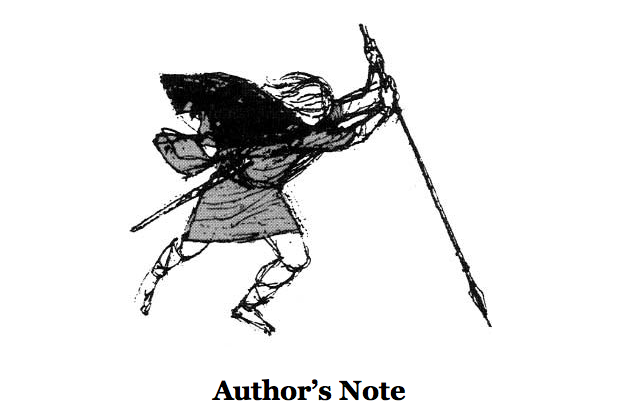
Source: Author’s Note to The High Deeds of Finn MacCool

Rosemary Sutcliff could not read until she was ten or eleven years old

Rosemary Sutcliff could not read until she was ten or eleven years old. Certainly aged nine she saw no point!

My mother in her own splendidly unorthodox fashion, taught me at home, chiefly by reading to me. King Arthur and Robin Hood, myths and legends of the classical world, The Wind in the Willows, The Tailor of Gloucester, Treasure Island, Nicholas Nickleby, Kim, Puck of Pook’s Hill, and Little Women, all at more or less the same time. The result was that at the age of nine I was happily at home with a rich and somewhat indigestible stir about of literature, but was not yet able to read to myself. Why, after all, read to yourself when you can get somebody else to read to you?

Historical novelist Rosemary Sutcliff's mother Nessie Lawton 

Source: Donald R. Gallo (1990) Speaking for Ourselves: Autobiographical Sketches by Notable Authors of Books for Young Adults. National Council of Teachers of English.

Rosemary Sutcliff’s cousin Jack, briefly mentioned in her memoir Blue Remembered Hills, was Air Marshall Sir John Slessor

Air Marshal Sir John Slessor, cousin of Rosemary Sutcliff

A Google alert for “Rosemary Sutcliffe” (wrong spelling, there is no E in Sutcliff of Rosemary Sutcliff, but too many get it wrong …) thew up an intriguing snippet today about one  Air Marshall Sir John Slessor, a cousin of Rosemary Sutcliff (sic):

Marshal of the Royal Air Force Sir John Cotesworth (Jack) Slessor GCB, DSO, MC (3 June 1897 – 12 July 1979) was a senior commander in the Royal Air Force (RAF). A pilot in the Royal Flying Corps during World War I, he held operational commands in World War II and served in the RAF’s most senior post, Chief of the Air Staff, from 1950 to 1952. He was considered a strong proponent of strategic bombing and the nuclear deterrent, and published several books, including an autobiography. He was a cousin of the children’s author Rosemary Sutcliffe who mentions “cousin Jack’s” depression at being turned down for the Army in her memoir Blue Remembered Hills.

I am left wondering if he writes anything about Rosemary Sutcliff in his autobiography. Anyone got access, who can find out?

  • Source of above quote here.
  • Other mis-spellings of Rosemary Sutcliff as Rosemary Sutcliffe (sic) here.

Rosemary Sutcliff on writing Sword at Sunset in the first person

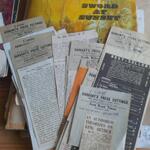
Press cuttings about Historical novel Sword at Sunset by Rosemary Sutcliff

Rosemary Sutcliff once said about writing her Arthurian novel  Sword at Sunset – a bestseller in 1963:

… after I had finished the story I had great difficulty getting back into a woman’s skin, because I had been living as a man for eighteen months, thinking as a man, making love as a man, always looking from a man’s viewpoint. I am always deeply involved in my books. For me the book doesn’t work if I am not. But I have never been as deeply involved as that before or since.

When I started writing Sword at Sunset I made at least three false starts, but I couldn’t think what was the matter. I knew exactly what the story was that I wanted to tell, but it wouldn’t come. Then suddenly the penny dropped: it had to be first-person singular. I had never done first-person singular before, but the moment I started doing it that way it came, like a bird. But I had problems with it: first-person singular is very different from third-person writing, and I had no experience of it at all. But it was the only way it could be written.

I will choose a good story over absolute historical accuracy | Rosemary Sutcliff on writing historical fiction

Since I am a writer, not an historian, I will sacrifice historical accuracy. I really very seldom have to do it, and then it is only a matter of perhaps reversing the order of two events, or something like that. But if it does come to the crunch, I will choose a good story over absolute historical accuracy.

Source: Interview with Rosemary Sutcliff  by Raymond H Thompson (here, on this blog)