Historical novelist and children’s writer Rosemary Sutcliff had a major obituary in The Independent newspaper in 1992

Historical novelist and children’s writer Rosemary Sutcliff‘s obituary in The Independent newspaper by Julia Eccleshare..

Rosemary Sutcliff’s historical novels opened the eyes of a generation of children to the past. They also set a new standard for children’s historical fiction because of their insight, passion and commitment.

Sutcliff was a demanding writer who expected a lot from her readers which is why her books are also wholly satisfying for adults. She evokes time and place with an incredibly sure touch and – once she had found her true voice with The Eagle of the Ninth in 1954 – a sharp ear for the dialogue of the past.Read More »

Academic John Withrington in 1992 said historical novelist and children’s book writer Rosemary Sutcliff combined scholarship with an unsentimental attitude to pain and suffering e.g in Sword at Sunset, and The Shining Company

Academic John Withrington wrote to The Independent (London) newspaper  (August 20, 1992), to comment on their obituary of Rosemary Sutcliff.

Last year I interviewed Rosemary Sutcliff on the Arthurian theme in her fiction. The published text arrived a matter of days before her death and on re-reading the transcript I was reminded of her vitality and enthusiasm, of an honest approach which combined scholarship with an unsentimental attitude to pain and suffering.

As Julia Eccleshare observed of her writing, allusions to historical sources are present but never signposted, the battle narrative magnificent yet never glorifying the strife it depicts. These traits were most apparent perhaps in her adult novel Sword at Sunset, the ‘autobiography’ of King Arthur, and the work of which she was most proud. But as Sutcliff herself acknowledged, she also had “a feeling for the mending side of life”; and whether writing of the physically and emotionally crippled, or, when following in the footsteps of her beloved Kipling, of the healing which happens when clashing cultures learn to live together, her prose was always characterised by compassion.

She felt that as the years progressed she had become a tougher writer, a belief reinforced by a reading of The Shining Company, itself based upon the poem Y Gododdin, which celebrates the annihilation of an army at Catterick in circa AD600 (sacrifice was always a theme which fascinated her). Yet for all her seriousness, she remained a cheerful and remarkably modest author, seemingly surprised by her success. “You’re always terrified that the books you write are going to go downhill,” she once said. It seems unlikely that those books which remain to be published will disappoint.


Newspaper review of The Flower of Adonis by historical fiction writer Rosemary Sutcliff about enigmatic Ancient Greece hero Alkibiades

Poor research: I clipped this from a newspaper in 2010, but I did not note which one!

(But see comments below for more details)

Notes for two ‘unpublished’ works by Rosemary Sutcliff | The Amber Dolphin and The Red Dragon.

In 1966 Rosemary Sutcliff made a donation to the de Grummond Children’s Literature Collection at the University of Southern Mississippi in the USA.  The Sutcliff Collection has a manuscript  and two typescripts for the radio play The New Laird. (Taped in April 1966 and broadcast on 17 May 1966 as part of the BBC Radio Scotland series—Stories from Scottish History. The collection includes a red note-book of research for The Lantern Bearers, and for two unpublished works, The Amber Dolphin and The Red Dragon.

I have never found either published or unpublished the actual stories by those titles. What happened to them may be illuminated by her diaries, which are as yet unpublished. I have not read the notebook at the library.

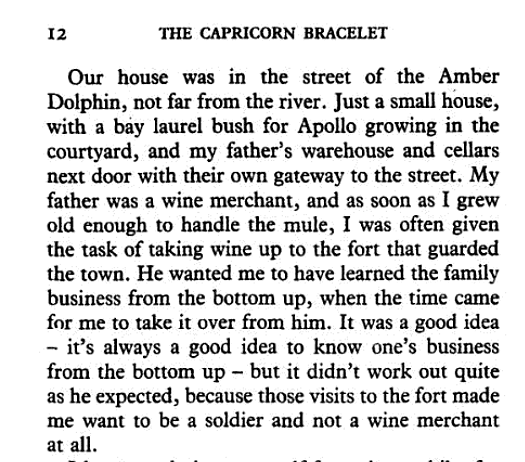
However, The Amber Dolphin may have become The Capricorn Bracelet (1973). For an early paragraph begins:

Excerpt from The Capricorn Bracelet

Roman Marching Song, by Rosemary Sutcliff | The Girl I Kissed At Clusium

Anne wrote long ago at the ‘Write!” tab above about the song The Girl I Kissed At Clusium which features in Rosemary Sutcliff’s historical novel The Eagle of the Ninth. (The tab is for the  many readers and visitors here who are vastly more insightful and knowledgeable about Rosemary Sutcliff than I, and might have something to say which others would read with interest ).Read More »