People and places in Sword at Sunset | Rosemary Sutcliff

I came across this page on the internet about who’s who in Rosemary Sutcliff‘s historical novel and re-telling of the King Arthur legend Sword at Sunset. (Without any apparent context, it intrigued me!)

People

Ambrosius–Aurelius Ambrosius, mentioned in Geoffrey of Monmouth, here Artos’ uncle
Arian–Artos’ first horse; rides him through fiery walls

Read More »

Writing Sword at Sunset was like having the story fed through me | Rosemary Sutcliff

… one day quite suddenly I knew that I was ready (to find and reconstruct Arthur), that the time had come when I really could cope with it. Most of the actual research I did for the book, apart from knowing the Arthurian story from the romance versions, was into Dark Age life and history as far as they were known. Then I worked into this setting the Arthur who seemed to me to carry weight, to be the most likely kind of person. It was very strange because I have never written a book which was so possessive. It was extraordinary–almost frightening.

It took me about eighteen months to write, and it absolutely rode me throughout the entire time. I would take the book to bed with me at night, and work there until I dropped off to sleep about two o’clock in the morning, too tired to see any more. Then I would wake up about six o’clock, still thinking about it. It was addictive. It was almost like having the story fed through to me, at times. I do my writing usually in three drafts, and I would go from the first to the second draft, from the second to the third, and find bits of the book that I had no recollection of having written at all. It was interesting, almost scary, but much of the material had this effect of being almost fed through to me, rather than being the result of my own research.

Source: University of Rochester

Rosemary Sutliff speaks about her approach to Arthurian Legend (1986)

Rosemary Sutcliff was interviewed by Raymond H Thompson (in 1986) for a series of interviews with Arthurian authors.  She spoke of her research, and the influences which led her to her own version of the Arthurian legend in the best-selling Sword at Sunset, first published in 1963.

… I did not discover the historical side of Arthurian legend until I was eighteen or nineteen, when I read two intriguing books by some absolute crackpot called Dayrel Reid: inspired crackpots are very special when you find them. One was called The Battle for Britain in the Fifth Century; the other was called The Rise of Wessex. They dealt with the Dark Ages, but particularly with the Arthurian legend and with the possibilities of an historical Arthur. I was fascinated by this idea, and I set off looking for all the other clues that I could find.  Read More »

Rosemary Sutcliff’s unique gift for character and description in The Lantern Bearers

The Lantern Bearers by Rosemary Sutcliff won the Carnegie Medal in 1959. An American reviewer has said

I discovered Rosemary Sutcliff in my early teens, and she quickly became one of my favorite authors. I can still vividly recapture the magic of reading her books. It was a real pleasure to return to The Lantern Bearers, which I first read when I was about thirteen, and find the magic still intact…

The Lantern Bearers is a wonderful book. Sutcliff possesses a unique gift for character and description, evoking a sense of place and person so intense that the reader can almost see her characters and the world in which they move. She has a matchless ability to establish historical context without a surfeit of the “let’s learn a history lesson now” exposition that mars many historical novels for young people. Her books are never less than meticulously researched, but her recreation of the past is so effortless that one has no sense of academic exercise, but rather of a world as close and immediate as everyday.

…  The Arthurian theme was one of Sutcliff’s favorites: she produced several young adult books on the subject, as well as a beautiful adult novel, Sword at Sunset, to my mind one of the best ever written in this genre. But the Sutcliff‘s Arthur is rooted as much in history as in myth–not just the tragic king of Le Morte d’Arthur or the heroic/magical figure of traditional Arthurian fantasy, but a man who might actually have existed, heir both to the memory of Rome and to the last great flowering of Celtic power in Britain.
…  her enduring popularity … is richly merited: she is, quite simply, one of the best.

Copyright © 1997 Victoria Strauss

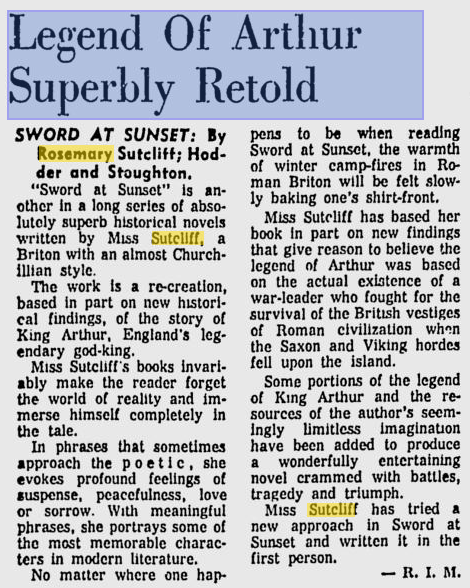
Rosemary Sutcliff history novel Sword at Sunset | Legend of King Arthur superbly retold


Source: Edmonton Journal – Nov 15, 1963