Rosemary Sutcliff interviewed in The Independent newspaper in 1992 by Giselle Greene

It is good to know people are buying and reading Rosemary Sutcliff books (see here), especially on the Kindle. Curiously, the bestselling e-book on Kindle is by Giselle Green, who just before Rosemary’s death in 1992 wrote for The Independent newspaper an insightful article based on an interview at Rosemary’s  home in Walberton.

“It was in the Great fire-hall on Barra, in the Outer Hebrides and a terrible storm was brewing up outside. They had just pulled the wicker-work shutters across the membrane of the windows in case the storm blew its way in, but the draughts were still getting in everywhere. You could hear the booming of the waves pitching against the beach . . . the hangings and skins of sailcloths with dragons painted on them billowed up all over the place as if they would come to life. . .”

Rosemary Sutcliff folds her hands over her chest: ”Then my supper arrived. I looked up into a clear, calm evening, and my first thought was – ‘Thank heavens that awful wind’s gone!’ ” A historical novelist for both children and adults, with 53 books to her credit, it is easy to see how, as one reviewer said: ”For Rosemary Sutcliff the past is not something to be taken down and dusted. It comes out of the pages alive, and breathing now . . .”
Read More »

The enchantments of The Witch’s Brat by Rosemary Sutcliff

Lovel, the crippled hero of Rosemary Sutcliff‘s The Witch’s Brat, is driven from his village in a shower of stones after his grandmother’s death. (The) novel (is) … crammed with careful period detail and research, the painstaking catalogues of herb-lore brought grippingly to life by the characters to whom they bring such danger.

via The enchantments of witch fiction | guardian.co.uk.

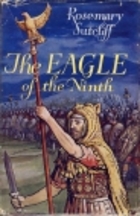
Rereading Rosemary Sutcliff’s The Eagle of the Ninth

Rosemary Sutcliff's famous novel was first published in the UK in 1954Around the time of the release of the film The Eagle, Charlotte Higgins wrote in the Guardian: “Not just a rollicking adventure, Rosemary Sutcliff‘s The Eagle of the Ninth … is a touching true story about love and loyalty”. She enjoyed looking back on a childhood favourite that she had reread many times.

I call it a children’s story; my copy, with its gorgeous line drawings by C Walter Hodges, bears my name on the title page in barely joined-up handwriting. But Sutcliff claimed her books readable by anyone from nine to ninety, and she was right. In an interview in 1992, the year she died, she said: “I don’t write for adults, I don’t write for children. I don’t write for the outside world at all. Basically, I write for some small, inquiring thing in myself.” I have read The Eagle of the Ninth dozens of times; and as the reading self changes, so does the book. When I last read the story, it was the quality of the prose that delighted, the rightness with which Sutcliff gives life to physical sensation. A battle fought through the grey drizzle of a west country dawn is illuminated by “firebrands that gilded the falling mizzle and flashed on the blade of sword and heron-tufted war spear”. Perfect, too, is a set-piece in which Marcus, on a stiflingly hot day, puts his British hunting companion’s chariot-team through their paces. “The forest verge spun by, the fern streaked away between flying hooves and whirling wheels . . . Then, on a word from Cradoc, he was backed on the reins, harder, bringing the team to a rearing halt, drawn back in full gallop on to their haunches. The wind of his going died, and the heavy heat closed round him again. It was very still, and the shimmering, sunlit scene seemed to pulse on his sight.” Sutcliff, tellingly, has those black chariot ponies – “these lovely, fiery little creatures” – descended from the royal stables of the Iceni, the tribe who had almost cast Rome out of Britain. It is a delicately inserted hint of danger to come.

Whole article at Rereading Rosemary Sutcliff’s The Eagle of the Ninth | Books | The Guardian.

Rosemary Sutcliff’s Roman Britain historical novels

Rosemary Sutcliff Frontier Wolf  US cover 2008Compelling historical fiction relies on characters welded so smoothly to actual events that the seams are nearly invisible. A smooth blend of fictional and historical figures provides the depth of a documentary with the sweep and emotion of a good yarn. This mixing makes Rosemary Sutcliff‘s Roman Britain novels (The Eagle of the Ninth, The Silver Branch, Frontier Wolf, and The Lantern Bearers, along with the Romano-Celtic Sword at Sunset and Dawn Wind) the great books that they are. Their re-creation of Roman Britain is vivid and exquisitely detailed. The result, novels that convincingly transport the reader back to the Empire, is compelling reading. The family connection of the main characters in all but Sword at Sunset (where the Aquila family plays a minor role) builds on the historical details to create a personal connection between the novels.

via Rosemary Sutcliff, Roman Britain historical novels (with thanks to reader and contributor Anne)

Arthurian writer and history novelist Rosemary Sutcliff is a spellbinder

Rosemary Sutcliff is a spellbinder. While we read, we believe everything she says. She has hammered out a style that rises and falls like the waves of the sea.

Comment of a US reviewer in 1963, the year that best-seller The Sword at Sunset was published.

Source: Robert Payne in New York Review, May 26, 1963.