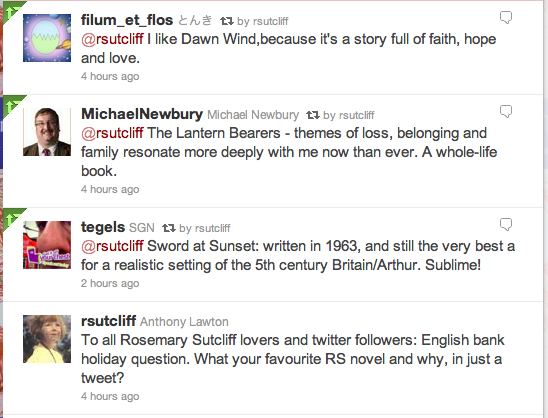
Twitter users report favourite Rosemary Sutcliff books | Dawn Wind, The Lantern Bearers, Sword at Sunset

Posts on rosemarysutcliff.com, Rosemary Sutcliff’s official website, about Literary Criticism, Reviews and Research about her; and about national and international Awards she received.
Is Beric a Briton?: the Representation of Cultural Identity in G.A. Henty’s Beric the Briton (1893) and Rosemary Sutcliff’s The Outcast (1955) is an academic article by Rachel Johnson from 2009. (In: Past Continuous: Historical Fiction for Children, Newcastle University. , October 2009, Newcastle University). There is a copy of the article here. The Abstract summarises the thesis:
This article is an investigation into differences in the representation of cultural identity represented in Beric the Britain by G.A. Henty (1893) and The Outcast by Rosemary Sutcliff (1955). G.A. Henty (1824-1902) and Rosemary Sutcliff (1920-1992) both present narratives of Britain under Roman invasion through the character of a young protagonist, initially perceived in both narratives as the product of a British tribal chieftain’s family with a clear cultural identity. Henty wrote in the second half of the nineteenth century at the height of imperial expansion when the sense of English cultural identity was strong. In contrast, Rosemary Sutcliff, writing post-empire, represents a more complex sense of identity. I investigate the mixed cultural identity of Sutcliff’s protagonist against the foundation of the exclusively British cultural identity of Henty’s Beric, thus foregrounding the increasing destabilization of cultural identity demonstrated in these two texts.
The flurry of attention to The Carnegie Medal has set me re-reading all manner of more extensive pieces on Rosemary Sutcliff’s writing. One such was posted at the extensive historicalnovels.info site whose writer ‘Annis” decided some while back to revisit Rosemary Sutcliff’s “work as an adult and consider what it was about this remarkable woman that enabled her to inspire so many children with an enduring love of history, heroic fantasy, mythology and legend.”.
Ask any baby-boomer who loves historical fiction what inspired their appreciation, and chances are the reply will be, “Well, when I was a kid I read Rosemary Sutcliff’s books”. Out of print for years, Sutcliff’s novels are making a comeback as their original readers reach an age when they can influence the reissue of old favourites.
Returning to a full collection of Google alerts about “Rosemary Sutcliff” I noticed an interesting article in The New York Times which makes reference to Rosemary. Anne Foreman, the author of Georgiana: Duchess of Devonshire,
wrote:
Once upon a time, Henry Treece, Roger Lancelyn Green, Rosemary Sutcliff and Elizabeth George Speare — all authors of historical novels for children — were household names. The genre was so vibrant that writers like Joan Aiken and Susan Cooper could veer into “alternate history” sagas, confident their young readers would have sufficient knowledge to appreciate the subtle interplay of historical “fact” and historical “fiction.”
Then came the downgrading of history from a discipline in its own right to a subset of something vaguer called the humanities. Read More »
Rosemary Sutcliff‘s The Flower of Adonis reviewed in The Times of London in 1969 (before it was behind an electronic paywall!).Read More »
 ROSEMARY SUTCLIFF (1920-92)