It’s International Children’s Book Day today, April 2nd | And Emmylou Harris’s birthday | Anyone notice?

International Children's Books Day Poster 2012

To my shame I had not noticed, to be honest, until now that today is  International Children’s Book Day (ICBD). But since 1967, on or around Hans Christian Andersen’s birthday, 2nd April, ICBD is celebrated to “inspire a love of reading and to call attention to children’s books”. Or at least that is the intention. I cannot say I have until this morning felt my attention called. But celebrate children’s books and inspire a love of books we should! The Day is organised by the International Board on Books for Young People, but there is no mention of it at the IBBY UK website.

Looking back to what I posted two years ago, I am tempted to think nothing much has changed. And to remind you all once again that it is also the birthday of the great Emmylou Harris!

International Children’s Book Day today, is suitable to celebrate  as well as Hans Christian Andersen, whose birthday it is. This year  the international sponsor, Spain, chose the theme ‘Un libro te espera, búscalo!’ which means ‘A book is waiting for you, find it!’. It seems like most people in the UK did not find the day, let alone the waiting book, if the lack of public mention here is an indicator. (Also, for all who share my taste in music, it is the birthday of Emmylou Harris.)


Wood-shore or woodshore or ‘wood shore’ | A Rosemary Sutcliff phrase?

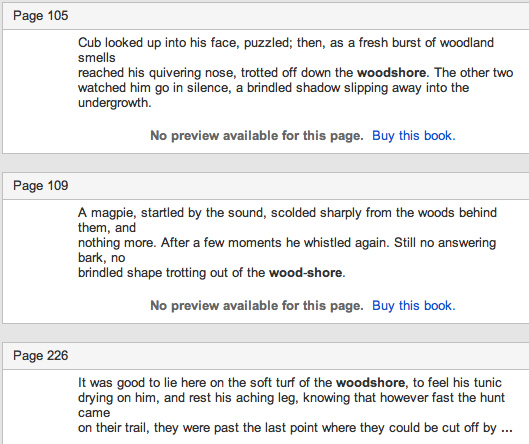
A blog entry elsewhere reminded me of one of the many evocative phrases Rosemary Sutcliff used in her work: ‘wood-shore’. I thought, like Tom Bradman, that it was in Warrior Scarlet. But in fact it appears (?also) in the Lantern Bearers (“Take him out to the wood-shore and bind him to a tree”) and searching Google immediately reveals it, presented as ‘woodshore’, in several places in the paperback OUP edition of The Eagle of the Ninth .

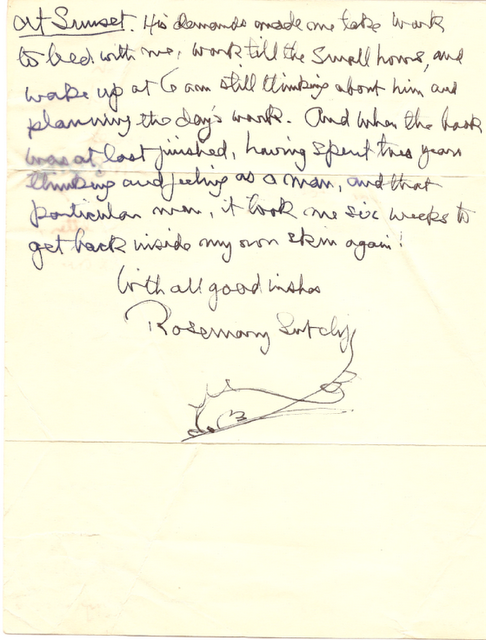
Historical novelist and children’s writer Rosemary Sutcliff’s letter to Helen Hollick

Helen Hollick blogged about historical novelist and children’s writer Rosemary Sutcliff. She includes a photo of part of a letter Rosemary wrote to her. It contains Rosemary Sutcliff’s highly distinctive signature, and is written in her distinctive handwriting.

Part of a etter from Rosemary Sutcliff to Helen Hollick

Source: Helen Hollick’s blog on Rosemary Sutcliff

Rosemary Sutcliff’s Diary for 1992

I have found amongst my books when tidying my study the diary Rosemary Sutcliff was keeping in 1992, the year of her death, 20 years ago now.  She kept a diary every year from 1950 when her first book was published. Mostly it was prosaic, about the days events. Occasionally she wrote about progress of a book, or a particularly interesting visit. Sometimes she described some glory in her much loved garden. I am minded to start posting the daily entries, which start on 29th March, from that date this year, at this blog. What do those who follow this website, and love her work, think?

I have also found her notes about the love of her life – who is referred to in her autobiography of her early years, Blue Remembered Hills. These I will not be publishing, here or anywhere, but they are most touching, especially since when I was young, I met the person in question several times. And I often spoke with Romie (as I knew her) about them.

Rosemary Sutcliff on Wroxeter in Roman Times | Scholarship transmuted into artistry

In her monograph on historical novelist and children’s writer Rosemary Sutcliff, Margaret Meek, commented that “the standard of accredited detail is so high in historical novels, writers have their research material carefully scrutinized by critics”. But, she said, “it is one thing to be accurate about costume and cooking pots, and quite another to make an organic whole in which the accumulated research is assimilated by the reader because of its essential rightness in the situation. Here is Wroxeter when the Romans had left it and later the British warhost had finally been defeated.

‘Owain found himself at the Forum Gate, with its proud inscription to the Emperor Hadrian, and halted there, staring dazedly about him, while Dog stood watching him expectantly and wagging his tail. It was growing dusk, and he thought suddenly—it was a thought that made the sick laughter rise in his throat—that he could sleep in the Basilica tonight, he could sleep in the Palace of Kyndylan the Fair, if he chose, he was free of all Viroconium. But the little low-browed shops in the Forum colonnade seemed to offer a deeper and darker refuge to crawl into. One or two near the gate still had their roofs on them and he turned into the nearest of these. It looked to have been a basket-maker’s shop; everything that could be of use to marauders had been stripped from it, but a broken pigeon basket and a bunch of withies still lay in one corner. The light was going fast, and the back of the shop was already lost in the shadows of the rainy twilight.’

Meek wrote: “Weather and the ruined town all serve to increase Owain’s desolation. The scholarship is transmuted into artistry”.

(Source: “The Historical Novelist: The Light and the Dark.” In Rosemary Sutcliff, pp. 31-50. New York, N.Y.: Henry Z. Walck, Incorporated, 1962.)