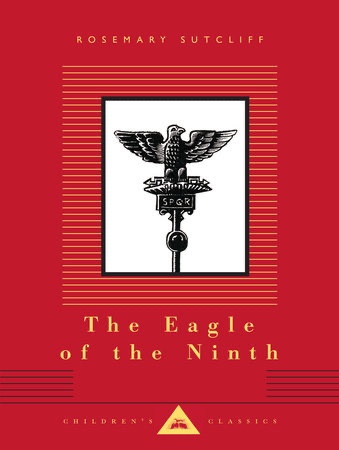
Rosemary Sutcliff spoke in 1977 to BBC Radio Times about her historical novel The Eagle of the Ninth and hero Marcus

When the BBC adapted and broadcast Rosemary Sutcliff‘s historical novel The Eagle of the Ninth in 1977, the BBC Radio Times wrote about her approach to children, writing, the Romans and her hero Marcus—’part of me was in love with him’.

Her passion for the Romans stemmed from her childhood. Her mother read aloud to her from books like Rudyard Kipling‘s Puck Of Pook’s Hill.  His three Roman tales entranced her.

I didn’t read myself till the last possible minute, about nine. I was brought up on Arthur Weigall’s Wanderings In Roman Britain and Wanderings In Anglo-Saxon Britain. He mentions this eagle dug up at Silchester and I’ve been fascinated by it since I was five.

The Radio Times journalist wrote of Rosemary: “She writes, superbly, of adventure, battle, young warriors. Rosemary Sutcliff‘s conversation is rapid and merry and very funny”.

In the BBC TV publicity material she claimed to be completely uneducated.

I left school at fourteen. I haven’t got a very literary or intelligent kind of life. I have very ordinary friends.

In fact, she completed art school and was a successful professional miniaturist in her late twenties when she turned to writing and secured the publication of her first book. It just “happened to be” for children; and most of her books kept on being, theoretically at least, “for children”. But she definitely did not believe in a rigid division between adults’ and children’s books. “When I was a child I was reading Dickens and Beatrix Potter at the same time”. As far as writing goes she did not find it restrictive.

Very occasionally a subject is verboten. And one may have to simplify—no, not that—uncomplicate a very complex emotion. But usually I just write as I want to write.

She said that she did not know all that many children and did not automatically like them .

I like a child or a dog or an adult according to their merits. I am prone to like more dogs on a percentage basis.

The Eagle Of The Ninth, published in 1954, was one of her favourite books.

I rather wish it weren’t, because it is quite early. I think and hope I have written better since. But it is my best beloved. Part of me was Marcus, and part was in love with him.

When aged only about three she had  juvenile arthritis (Still’s Disease) which was another factor in her writing:

I think most children’s writers are writing a chunk of unlived childhood.

Source: Radio Times, September 3, 1977

Kurt Vonnegut’s Eight Tips for Writing Short Stories

Photo of author Kurt Vonnegut
  1. Use the time of a total stranger in such a way that he or she will not feel the time was wasted.
  2. Give the reader at least one character he or she can root for.
  3. Every character should want something, even if it is only a glass of water.
  4. Every sentence must do one of two things–reveal character or advance the action.
  5. Start as close to the end as possible.
  6. Be a sadist. No matter how sweet and innocent your leading characters, make awful things happen to them–in order that the reader may see what they are made of.
  7. Write to please just one person. If you open a window and make love to the world, so to speak, your story will get pneumonia.
  8. Give your readers as much information as possible as soon as possible. To heck with suspense. Readers should have such complete understanding of what is going on, where and why, that they could finish the story themselves, should cockroaches eat the last few pages.

Source: Medium

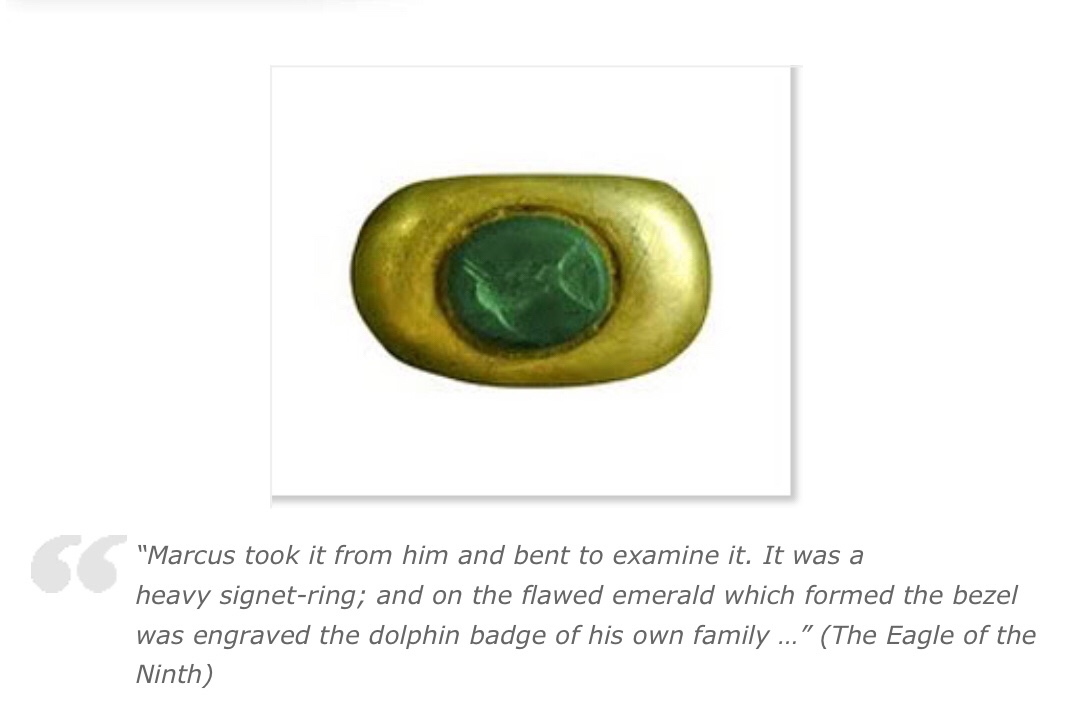
The Dolphin Ring appears in eight award-winning books by Rosemary Sutcliff, world-renowned writer of historical fiction for children and adults

Careful reading of the historical fiction for adults and children of Rosemary Sutcliff (1920-92) reveals that the same Dolphin Ring with a dolphin design on a flawed emerald was the Flavius family signet ring which threads through eight of her novels: The Eagle of the Ninth, The Silver Branch, Frontier Wolf, The Lantern Bearers, Sword at Sunset, Dawn Wind, Sword Song, & The Shield Ring.

Writer of historical fiction Rosemary Sutcliff had a “mystical communion with the past” and an “uncanny sense of place”

Rosemary Sutcliff (1920-1992) had several editors during her long writing career which produced over 60 books. One editor wrote (in a website post that I can no longer trace):

(Rosemary Sutcliff) had, as did Henry Treece, a mystical communion with the past, which enabled her both to recreate tiny details, and to confound military historians with her understanding of the art of battle in any situation she cared to devise. Her sense of place was uncanny, in that she could get no nearer to a site than the seat of a car on an adjacent road. Friends often served as her eyes, and also as her researchers, but it was the conclusions she drew from the evidence, and her re-creations of them, that made her contribution to the literature about the ancient world so distinctive. Where she was simply embellishing recorded history, she was no better than anyone else. She also had one of the rudest senses of humour in anyone I have met.”

The Geography of the stories made by Rosemary Sutcliff | Writer of historical fiction and stories for children, young people and adults

Place matters hugely in the work of  Rosemary Sutcliff. The main settings of her stories include:

The West Country in England
Blood Feud | Brother Dusty-Feet | Outcast | Simon | Sword at Sunset | The Armourer’s House | The Eagle of the Ninth | The Queen Elizabeth Story | Tristan and Iseult
The South Downs in England
Dawn Wind | Flame-Coloured Taffeta | Knight’s Fee | Sun Horse, Moon Horse, | Sword at Sunset | The Eagle of the Ninth | The Lantern Bearers | The Silver Branch | The Witch’s Brat | Warrior Scarlet
London
Brother Dusty Feet | Song for a Dark Queen | The Witch’s Brat
The North Of England
A Circlet of Oak Leaves | Frontier Wolf | Sword at Sunset | Sword Song | The Capricorn Bracelet | The Chronicles of Robin Hood | The Eagle of the Ninth | The Mark of the Horse Lord | The Rider of the White Horse | The Shield Ring | The Shining Company | The Silver Branch
Scotland
A Circlet of Oak Leaves | Bonnie Dundee | Eagle’s Egg | Frontier Wolf| Shifting Sands | Sword at Sunset | Sword Song | The Capricorn Bracelet | The Eagle of the Ninth | The Mark of the Horse Lord | The Shining Company | We Lived in Drumfyvie

Wales
A Circlet of Oak Leaves | Sword at Sunset | Sword Song | The Bridge-Builders | The Chief’s Daughter | The Lantern Bearers | The Shining Company
Ireland
Blood Feud | Sword Song | The High Deeds of Finn Mac Cool | The Hound of Ulster | Tristan and Iseult