
Jane Shuttleworth has sent me a copy of a letter she received from Rosemary Sutcliff when she was younger. Read More »
Category: Influence and Inspiration
Posts at rosemarysutcliff.com about about people — especially authors — who were and are inspired and/or influenced by eminent writer Rosemary Sutcliff
Rosemary Sutcliff’s The Eagle of the Ninth was one of Falco author Lindsey Davis’s top 10 Roman books
Lindsey Davis writes detective novels set in classical Rome, featuring the world of maverick private eye and poet Falco. On the publication in 2009 of the nineteenth of what became a bestselling series of novels known for their meticulous historical detail, she chose Rosemary Sutcliff’s The Eagle of the Ninth as one of her top ten Roman books.
‘Somewhere about the year 117AD, the Ninth Legion, which was stationed at Eboracum, where York now stands, marched north to deal with a rising among the Caledonian tribes, and was never heard of again.’ Hooked? If not, there’s no hope for you. A wonderful novel, for children of all ages.
via Lindsey Davis’s top 10 Roman books | Books | guardian.co.uk
Tony Bradman’s top ten father and son stories include Rosemary Sutcliff’s The Eagle of the Ninth | Children’s books in guardian.co.uk
 Writing at the Guardian Children’s Books site, Tony Bradman selected Rosemary Sutcliff’s 1954 historical novel The Eagle of the Ninth as one of the best stories ‘featuring fathers and sons’.
The Eagle of the Ninth was published in 1954, the year I was born, but I must have read it for the first time when I was 12 or 13, just after my Tolkien phase. Like many other Sutcliff fans, I was gripped by this story of a young man travelling from the soft south of Roman Britain to the wilds beyond Hadrian’s Wall where the Scots were still very independent indeed. Marcus Flavius Aquila is on a mission to find out what happened to his father’s legion, the 9th Hispana, which marched north into the Caledonian mists and was never seen again. Read More »
King Arthur almost killed Rosemary Sutcliff, author of The Sword at Sunset | Letter to Helen Hollick
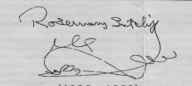 Rosemary Sutcliff was an inspiration for author Helen Hollick, who was well aware of the place of the dolphin signet-ring in Rosemary’s Roman novels, as well as the dolphin in her signature. In her novel Harold the King (entitled I am the Chosen King in the USA) captain of Harold II’s fleet was Eadric, later arrested and imprisoned by Duke William after the English defeat. In her acknowledgements she wrote: ‘The books by the late Rosemary Sutcliff, an historical fiction author sadly missed, have always been an inspiration to me. Her last novel brought the feel of the sea and those beautiful – but deadly – Viking longships to life. As a small personal tribute to her gift of storytelling, Eadric the Steersman’s ship, The Dolphin, is for her.’
I first encountered Rosemary Sutcliff at school when I was about 14. Our English mistress, Mrs Llewellyn, was a real dragon. We were, on the whole, terrified of her. It must have been towards the end of term, I assume she had covered the Curriculum (such as it was back in 1966/7) for we trooped into class and she announced, ‘Settle down, I am going to read you a story for the next few lessons’.
Sitting there, listening enraptured to that story (The Queen Elizabeth Story) my delight was complete. Until then I had basically only read pony stories (I so wanted a pony of my own) but Rosemary Sutcliff transported me into another world of the enchanted past. I had no idea a novel without a single equine in it could be so utterly engrossing.
…
I eventually plucked up courage to write to Rosemary to tell her I was working on an Arthurian novel, how her writing had inspired me, and how the character of Arthur was almost possessing me at times. To my delight I received a letter back, written in her own, somewhat unsteady handwriting – she did, after all have arthritic hands. This is part of what she wrote:“I do hope all goes well with your King Arthur – I know just how you feel about him, he almost killed me when I was writing “Sword at Sunset”. His demands made me take work to bed with me, work till the small hours, and wake up at 6 am still thinking about him and planning the day’s work. And when the book was at last finished, having spent two years thinking and feeling as a man, and that particular man, it took me six weeks to get back inside my own skin again.With all good wishes
Rosemary Sutcliff’s historical fiction took author Geraldine McCaughrean time-travelling
 The prestigious Carnegie Medal was once won by Rosemary Sutcliff, as well as multiple award-winning Geraldine McCaughrean (who has written more than 160 books, from picture books to adult novels). Interviewed at Red House, the web-based, self-styled ‘home of (buying) children’s books’, she spoke of the influence on her of Rosemary Sutcliff’s historical fiction.
Did you have any favourite children’s authors when you were a child and have they influenced your writing at all?
I loved Elyne Mitchell’s Brumby books because I loved all things horsey. One day I shall write a horse book and then all those pony and horse books I read as a child will come into their own.
I also loved Rosemary Sutcliff’s historical fiction – The Eagle of the Ninth, Brother Dusty Feet … – They taught me how a book could take you time travelling to a different age. That must be why I have written so many books set in the past. Adventure is so much easier to come by there.
Rosemary Sutcliff won the Carnegie Medal in 1959, not for either of the books mentioned by McCaughrean, but for The Lantern Bearers. She was runner-up in 1972 with Tristan and Iseult. The Medal is perhaps the UK’s most prestigious prize for writing for children, awarded every year in the UK to the writer of an outstanding book for children. The Library Association started to award the prize in 1936, in memory of the Scottish-born philanthropist Andrew Carnegie (1835-1919), a great supporter of reading and libraries. The medal is now awarded by the Chartered Institute of Library and Information Professionals.
Rosemary Sutcliff also won the Boston-Globe Horn Book Award for Tristan and Iseult in 1972; was highly commended by the Hans Christian Andersen Award in 1974; won The Other Award for Song for a Dark Queen in 1978; and won The Phoenix Children’s Book Award for The Mark of the Horse Lord in 1985, and The Shining Company in 2010
 ROSEMARY SUTCLIFF (1920-92)