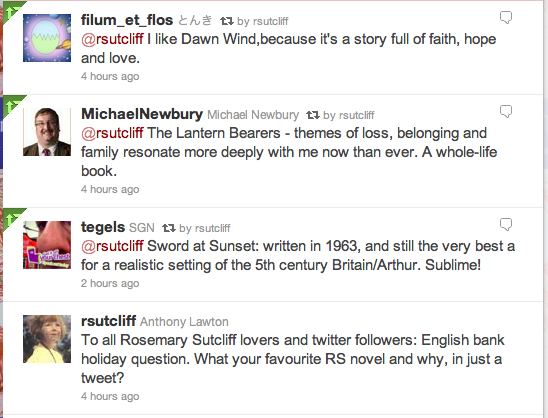
 My father took my sister and me to the library every Saturday. I could hardly wait to get home and start on the giant pile of books … Rosemary Sutcliff’s historical novels were among my favorites … especially Dawn Wind. At the point where Dog dies, I would lock myself in the bathroom and cry my heart out under the mistaken assumption that no one would hear me, when actually my wails probably echoed through the entire house. “She’s reading that stupid book again,” I expect they said downstairs.
Source: Children’s Book Guild – Annette Curtis Klause.
And interesting extracts from a comment (full comment below), about translation into German:
I just reread Dawn Wind in an older German translation titled “Owins Weg in die Freiheit” (Owain’s way to freedom) and came upon some interesting issues. First the translator did a marvellous job, the story not only can be heard while reading but smelt and tasted. He makes me hear the waves crash on the ship-wreck Beornwulf comes home with, smells the burning barley breads and feel the mist creeping over the marshes. Second he doesn’t seem to know some facts about Britain. He constantly translates “corn” by the German “Mais”, whihc is, of course, the meaning the dictionary provides you with but I still believe Sutcliff may have used “corn” and just mean “Korn” (grain, wheat and rye and barley). This leads to the anachronistic scene of a 7th century british village situated behind a corn-field and the british warrior suggesting to draw “stalks of corn/maiz” for the feud between Vadir and Bryni. Also he translates Kyndylan the Fair as Kyndylan the Just, obviously taking the common meaning of “fair”, again provided by the dictionary, as just, reliable. Am I right in assuming that the title “fair” may mean that british leader’s colour of hair rather than his way of life, thus it should translate “Kyndylan der Helle (fair-haired)” or even “the blonde”?


 ROSEMARY SUTCLIFF (1920-92)