Perceptions of King Arthur and other legendary figures

This article about how historians’ perceptions of the ‘legendary figure’ have changed over recent times is behind a pay wall: I am trying to access it. Meanwhile…

Forty years ago both scholarly histories and historical novels had a common view of Arthur: as a historical warrior, whose leadership enabled his people, the native inhabitants of post-Roman Britain, to halt the advancing tide of Anglo-Saxon conquest for about half a century. Nobody was exactly sure when this was, because it had been in the obscure period between 410 and 550, which has left almost no contemporary documents. Nonetheless, there was general agreement that Arthur had flourished somewhere in that time and had been the greatest British personality in it, establishing a fame which laid the basis for the later, more romantic and fantastic, medieval Arthurian legend.

This happy consensus had mostly been produced by the new discipline of archaeology, which had excavated some of the main sites associated with Arthur in that later and fully-developed legend, such as his birthplace at Tintagel and Cadbury Castle in Somerset, which local tradition held had been his court of Camelot. In each case, amid great publicity, spectacular remains had been found of occupation by wealthy people at just the right period. For many, this was enough to establish beyond reasonable doubt that the legend was rooted in historical truth and books such as Geoffrey Ashe’s The Quest for Arthur’s Britain  and Leslie Alcock’s Arthur’s Britain carried this message to a wide readership. It was taken up by historians, who now felt encouraged to reconstruct a story for the years around 500 by combining the meagre early medieval sources with a wealth of much more dubious data from later periods; this approach was epitomised by John Morris’s fat, exciting book, The Age of Arthur . The interest stirred up by scholars resulted in a flood of historical fiction in the 1960s and 1970s. Most was produced by Englishmen, though Englishwomen such as Rosemary Sutcliff and Mary Stewart were among the most prominent authors. All treated Arthur as a historical character in a post-Roman setting, with realistic British landscapes and careful use of historical and archaeological data.
Source: Signposts: King Arthur | History Today.

A Crown of Wild Olive | Rosemary Sutcliff story of the Greek Olympics

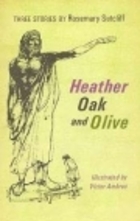
Omnibus book of Rosemary SutcliffRosemary Sutcliff children’s book and story A Crown of Wild Olive (The Truce of the Games) tells the story of the Olympics.In fact, it is the newer title of a book originally published as The Truce of the Games. The tale is of two athletes from different ways of life who discover the meaning of friendship as they compete against each other in the ancient Olympic games. A Crown of Wild Olive was published in the collection Heather, Oak, and Olive  (1972).
The Eagle of the Ninth by Rosemary Sutcliff currently published in thirteen languages

Rosemary Sutcliff’s historical novel The Eagle of the Ninth is currently ‘in print’  in English throughout the world published by OUP (Oxford University Press), and in twelve other languages (Language -Publisher):

Dutch – Facet
French – Gallimard
German – Freies Geistesleben
Greek – Aiora
Japan – Iwanami Shoten
Korean – Sigongsa
Portuguese – Gradiva
Portuguese (Brazil) – Record
Romanian – Literar
Russian – Azbooka
Spanish – Plataforma
Swedish – Barnstenen
Turkish – Ithaki


King Arthur almost killed Rosemary Sutcliff, author of The Sword at Sunset | Letter to Helen Hollick

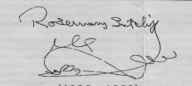
Historical novelist  and children's author Rosemary Sutcliff's signatureRosemary Sutcliff was an inspiration for author Helen Hollick, who was well aware of the place of the dolphin signet-ring in Rosemary’s Roman novels, as well as the dolphin in her signature. In her novel  Harold the King (entitled I am the Chosen King in the USA) captain of Harold II’s fleet was Eadric, later arrested and imprisoned by Duke William after the English defeat. In her acknowledgements she wrote: ‘The books by the late Rosemary Sutcliff, an historical fiction author sadly missed, have always been an inspiration to me. Her last novel brought the feel of the sea and those beautiful – but deadly – Viking longships to life. As a small personal tribute to her gift of storytelling, Eadric the Steersman’s ship, The Dolphin, is for her.’

I first encountered Rosemary Sutcliff at school when I was about 14. Our English mistress, Mrs Llewellyn, was a real dragon. We were, on the whole, terrified of her. It must have been towards the end of term, I assume she had covered the Curriculum (such as it was back in 1966/7) for we trooped into class and she announced, ‘Settle down, I am going to read you a story for the next few lessons’.

Sitting there, listening enraptured to that story (The Queen Elizabeth Story) my delight was complete. Until then I had basically only read pony stories (I so wanted a pony of my own) but Rosemary Sutcliff transported me into another world of the enchanted past. I had no idea a novel without a single equine in it could be so utterly engrossing.

I eventually plucked up courage to write to Rosemary to tell her I was working on an Arthurian novel, how her writing had inspired me, and how the character of Arthur was almost possessing me at times. To my delight I received a letter back, written in her own, somewhat unsteady handwriting – she did, after all have arthritic hands. This is part of what she wrote:
“I do hope all goes well with your King Arthur – I know just how you feel about him, he almost killed me when I was writing “Sword at Sunset”. His demands made me take work to bed with me, work till the small hours, and wake up at 6 am still thinking about him and planning the day’s work. And when the book was at last finished, having spent two years thinking and feeling as a man, and that particular man, it took me six weeks to get back inside my own skin again.
With all good wishes

Rosemary Sutcliff’s The Eagle of the Ninth | A source of ‘enjoyment and provocation’

I am not persuaded that this commentator correctly characterises Esca’s relationship with Marcus in Rosemary Sutcliff’s The Eagle of the Ninth. Rosemary’s view of the slave-master relationship is not a ‘romantic’ one. Nor did the film The Eagle ‘fail’, although it was not as successful in the eyes of all the critics and with audiences as was intended by the makers! But there is ‘a lot of … provocation’ to be gained from the comments as well as the book!

I love ancient Roman history but Sutcliff writes so clearly and articulately that I don’t think a young reader, without knowledge of this period, is at a real disadvantage, except maybe in terms of their interest. Americans are predominantly interested in American history, of course, and there is a long and very rich tradition of children’s American historical fiction. A lot of it focuses on the slave experience, but Eagle takes the opposite view. Here, perhaps, is where the book might run into trouble with a non-British readership: Esca, Marcus’ slave, is written quite romantically, as a devoted indentured servant who would follow his owner to the ends of the earth. This is very out of sync with most modern literature (for obvious reasons) and really dates the book. It is a unique challenge for young readers to imagine this story from Esca’s perspective, and I think a really valuable exercise. The somewhat-recent film version starring Channing Tatum and Jamie Bell is decidedly not child-friendly but at the same time works to rectify these elements.

I truly believe that this element of the book should not stop modern readers from enjoying this text. Maybe it’s a bit optimistic of me, but I really do think that there’s a lot of enjoyment and provocation to be gained from this book and I hope that the failure of the film (well… I liked it… no one else did) doesn’t dissuade you from enjoying it. ★ ★ ★ ★ /5

Source: presenting… books!