A chiff-chaff in Rosemary Sutcliff’s historical novel Dawn Wind

Chiffchaff (illustration from RSPB)

As he did so, there was a small fluttering in the heart of some overgrown bushes beside the gap in the wall. His heart lurched unpleasantly, and then steadied as a chiff-chaff darted out, and the fluttering was explained.

From Dawn Wind by Rosemary Sutcliff

Rosemary Sutcliff’s recreation of the past is effortless | Returning to The Lantern Bearers

The Lantern Bearers by historical novelist and children’s writer Rosemary Sutcliff, first published in 1959, won the prestigious  Carnegie Medal that year. An American reviewer wrote some twenty years later …

I discovered Rosemary Sutcliff in my early teens, and she quickly became one of my favorite authors. I can still vividly recapture the magic of reading her books. It was a real pleasure to return to The Lantern Bearers, which I first read when I was about thirteen, and find the magic still intact. … The Lantern Bearers is a wonderful book. Sutcliff possesses a unique gift for character and description, evoking a sense of place and person so intense that the reader can almost see her characters and the world in which they move. She has a matchless ability to establish historical context without a surfeit of the “let’s learn a history lesson now” exposition that mars many historical novels for young people. Her books are never less than meticulously researched, but her recreation of the past is so effortless that one has no sense of academic exercise, but rather of a world as close and immediate as everyday.

…  The Arthurian theme was one of Sutcliff’s favorites: she produced several young adult books on the subject, as well as a beautiful adult novel, Sword at Sunset, to my mind one of the best ever written in this genre. But the Sutcliff’s Arthur is rooted as much in history as in myth–not just the tragic king of Le Morte d’Arthur or the heroic/magical figure of traditional Arthurian fantasy, but a man who might actually have existed, heir both to the memory of Rome and to the last great flowering of Celtic power in Britain.
…  her enduring popularity … is richly merited: she is, quite simply, one of the best.

Copyright © 1997 Victoria Strauss

(First posted, April 29th, 2009)

Rosemary Sutcliff’s historical novel for children The Lantern Bearers won The Carnegie Medal in 1959

Cover of Japanese Edition of The Lantern Bearers

Rosemary Sutcliff won the Library Association Carnegie Medal in 1959 for her historical novel for children (“aged 8 to 88” in her view) The Lantern Bearers. The Medal is awarded every year in the UK to the writer of an outstanding book for children. First awarded to Arthur Ransome for Pigeon Post, the medal is now awarded by CILIP: The Chartered Institute of Library and Information Professionals. Both the Carnegie Medal and its sister award, the Kate Greenaway Medal are awarded annually. The 2012 shortlist was recently announced, and the winners will be named on Thursday 14th June.

The Library Association started the prize in 1936, in memory of the Scottish-born philanthropist Andrew Carnegie (1835-1919), a self-made industrialist who made his fortune in steel in the USA. The winner now receives a golden medal and some £500 worth of books to donate to a library of their choice. Rosemary Sutcliff also won or was nominated for many other awards in the UK and USA. (She won other awards in translation). She

Full list of Carnegie Medal winners here

Spanish translations of Rosemary Sutcliff historical novels

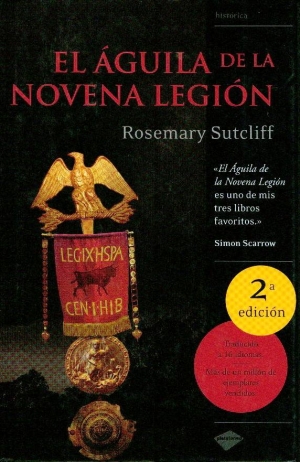
“La trilogía sigue el hilo conductor de los miembros de una misma familia de soldados romanos en Britania, pero, lógicamente, en distintas épocas, siglos II, III y IV d. C., por lo que en sí están concebidas como novelas completamente independents.” A Spanish language post points to Rosemary Sutcliff’s novels published in Spanish, with striking covers, El Aguila de la Novena Legion (The Eagle of the Ninth), El Usapardor del Imperio (The Silver Branch) and Los Guardianes de la Luz (The Lantern Bearers).

Aguila de la Novena Legion coverEl Usurpador del Imperio by Rosemary Sutcliff

Sword Song was a Rosemary Sutcliff title long before Bernard Cornwell used it too! Shame on him!

It has always annoyed me that Bernard Cornwell and his publishers considered it acceptable to call his 2008 novel of Saxon England ‘Sword Song’, when that had been the title Rosemary Sutcliff had chosen for her final historical novel ten years earlier! It shows a disappointing lack of respect by one writer of another in the same genre, historical fiction.

Rosemary Sutcliff’s Sword Song was  a novel set in Viking times. It was in handwritten manuscript form on her desk when she died. I recall transcribing it from her elphin-scrawl handwriting. It was intriguing painstakingly to follow the story of Bjarni as he was cast out of the Norse settlement in the Angles’ Land for an act of oath-breaking, to spend five years sailing the west coast of Scotland and witnessing the feuds of the clan chiefs living there.

I was pleased that in The Times newspaper, in August 1997, Sarah Johnson  called the opening of Sword Song a ‘stunner’: ‘beat that Melvin Burgess!’ she wrote. However she found the story ‘meandering’. But I loved that meandering, in and out of the Dublin slave market, for example.

 Rosemary Sutcliff’s … posthumously published Dark Ages saga Sword Song is packed with precisely described Viking sea battles and sacrifices in a linguistic smorgasbord of thongs, thralls and fiery-bearded men. I was never a Sutcliff fan as a child, tiring too quickly of the sun glinting off the halberds of people with names that sound like Haggis Bogtrotterson, but the opening of Sword Song is a stunner: a sixteen-year-old boy is exiled from his settlement for the manslaughter of a monk who had kicked his dog. Beat that, Melvin Burgess.

Regrettably, the story quavers thereafter, meandering around the coast of Britain as young Bjarni sells his fighting skills to one fiery-beardy after another, but the dense historical detail and rich colours are all still there.

Source: The Times, August 23, 1997