Life will go on and is well worth the struggle | Faith from Rosemary Sutcliff

Responding to an earlier post quoting Margaret Meek on  in her eponymous monograph about historical novelist and doyen of children’s literature  Rosemary Sutcliff, reader and regular commenter Anne (much more knowledgeable than me about the details of Rosemary’s work. and commentary upon it) posted:

It seems appropriate to add this piece from another critical essay, this one by May Hill Arbuthnot and Zena Sutherland:

The theme of all (Sutcliff’s) stories, as Margaret Meek points out, is “the light and the dark. The light is what is valued, what is to be saved beyond one’s own lifetime. The dark is the threatening destruction that works against it.” In The Lantern Bearers… the blackness of despair is concentrated in the heart of Aquila, a Roman officer….

No briefing of these stories can give any conception of their scope and power, and when young people read them they live with nobility… Nevertheless, these are difficult books, not because of vocabulary problems, but because of the complexities of the plots in which many peoples are fighting for dominance.

Fortunately, Dawn Wind …, one of the finest of the books, is also the least complex. Chronologically it follows The Lantern Bearers, but it is complete in itself and will undoubtedly send some readers to the trilogy. For the fourteen-year-old hero Owain, the light of the world seems to have been extinguished. He finds himself the sole survivor of a bloody battle between the Saxons and the Britons in which his people, the Britons, were completely destroyed. In the gutted remains of the city from which he had come, the only life the boy finds is a pitiable waif of a girl, lost and half-starved. At first Owain and Regina are bound together in mutual misery, but eventually they are united in respect and affection. So when Regina is sick and dying, Owain carries her to a Saxon settlement, even though he knows what will happen to him. The Saxons care for the girl but sell Owain into slavery…. After eleven years, he is freed and sets out at once to find his people and Regina, who has never doubted he would come for her.

So life is not snuffed out by the night. A dawn wind blows and two people start all over again with those basic qualities that have always made for survival…. Rosemary Sutcliff gives children and youth historical fiction that builds courage and faith that life will go on and is well worth the struggle.

Source: May Hill Arbuthnot and Zena Sutherland, “Historical Fiction: ‘The Lantern Bearers’ and ‘Dawn Wind’,” in their “Children and Books”, pub. Scott, Foresman and Company, 1972, pp. 508-9
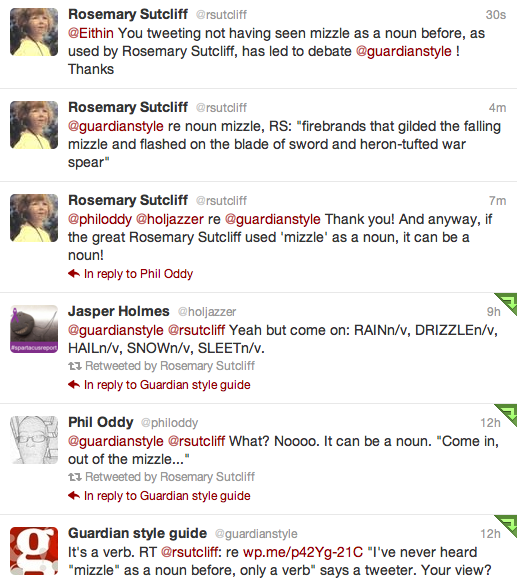
Can mizzle be a noun as well as a verb? | Twitter debate!

As highlighted by Charlotte Higgins in the Guardian last year, Rosemary Sutcliff once wrote  in her great historical novel and classic of children’s literature The Eagle of the Ninth about a ‘ battle fought through the grey drizzle of a west country dawn (which) is illuminated by “firebrands that gilded the falling mizzle and flashed on the blade of sword and heron-tufted war spear” ‘. I drew attention to this article once again with a post last week. Someone tweeted in response that they were surprised to come across ‘mizzle’ as a noun. Hence this set of tweets  in the  last 24 hours (read from the bottom):

On Mizzle in Rosemary Sutcliff's writing

Rosemary Sutcliff had the eye of a painter of miniatures

Rosemary Sutcliff crafted her historical novel The Eagle of the Ninth from two starting points: a small bronze eagle found at Silchester, which is now in Reading Museum; and the unknown fate of the Roman Ninth Legion, which, based in York, had apparently vanished from the historical record in the early years of the 2nd century. Written, as always, “for children aged 8 to 88” The Eagle of the Ninth is about a young centurion, Marcus Aquila, who takes up his first command on the edges of the Roman empire in south-west Britain. Severely injured during a fight with local warriors who have been inflamed by a travelling druid, he has to give up his military career. However, he  hears rumours of sightings of  the standard of his father’s lost legion – the eagle of the ninth –  north of Hadrian’s wall. He realises that if he can find it, he will restore the honour of his disgraced father and the legion he commanded.

Last year, at the time of the release of the film The Eagle, Charlotte Higgins, chief arts writer of The Guardian newspaper, wrote a long, affectionate article about her children’s favourite.

… In an interview in 1992, the year she died, she said: “I don’t write for adults, I don’t write for children. I don’t write for the outside world at all. Basically, I write for some small, inquiring thing in myself.” I have read The Eagle of the Ninth dozens of times; and as the reading self changes, so does the book. When I last read the story, it was the quality of the prose that delighted, the rightness with which Sutcliff gives life to physical sensation. A battle fought through the grey drizzle of a west country dawn is illuminated by “firebrands that gilded the falling mizzle and flashed on the blade of sword and heron-tufted war spear”. Read More »

The New York Public Library recommends historical fiction by Rosemary Sutcliff

Regular commenter on this blog about historical fiction and children’s literature great, Rosemary Sutcliff, Anne finds it “a pleasant surprise to see Rosemary Sutcliff’s novels recommended as cool teenage reads in the New York Public Library’s Stuff For the Teen Age blog”. (Thank you, Anne, for pointing to this at the You Write! tab and page). It starts:

Who says that all historical fiction is dull and boring? If done correctly, historical fiction is not dull at all. It’s time travel in a book. Who hasn’t imagined being transported back through time to experience what life was like during a different period in history? I particularly love reading stories that are completely out of my realm of knowledge and experience and have a sense of the romantic about it—novels about war, warriors and (ahem) gladiators tend to fit that bill.

One of the more well known authors of this type of historical fiction is Rosemary Sutcliff, a British author who primarily wrote stories set during Roman-occupied Britain circa 1st-5th centuries. Despite being set almost 2000 years ago, her books are still filled with ideas that we can all relate to today: belonging, honor, family, loyalty and pride. More interesting for us, her books are also filled with plenty of bloody battles, dirty fights, searing betrayal and love.

Source: Historical Fiction Part 1: Gladiators, Roman Soldiers and Slaves | The New York Public Library

Rosemary Sutcliff historical novel Brother Dusty Feet on BBC Radio

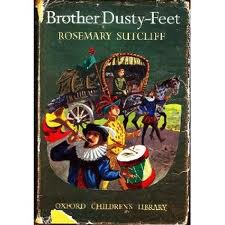
Brother Dusty Feet historical fiction by Rosemary Sutcliff original UK coverRosemary Sutcliff‘s Bother Dusty Feet is coming to radio in the UK and on the internet. Along with his faithful dog Argos, eleven-year-old orphan Hugh Copplestone decides to leave his Aunt and Uncle’s house after one beating too many, and marches off to Oxford to seek his fortune and the New Learning. When he meets a group of strolling players along the way, Hugh joins them and becomes part of their acting troupe. He walks “with his legs straight and his shoulders back as the Players taught him”. Or as The Radio Times says:

Set in the days of the first Queen Elizabeth, Rosemary Sutcliff’s children’s novel, written in 1952, has more than a touch of ‘lashings of ginger beer’ and Wizard of Oz innocence about it. Young Hugh, an orphan, is bound for the dreaming spires of Oxford, with only his beloved dog and the stars for company, when he meets a kindly band of travelling  players, and joins them on a series of adventures and derring-do. Shaun McKenna’s adaptation is full of fanciful myths, legends and encounters with historical heroes. The whole family will be eager to find out if young Hugh finds his rainbow, somewhere along the dusty roads of southern England.

To discover what the New Learning was Read More »