Rosemary Sutcliff’s The Lantern Bearers | Folio Society edition a Christmas present for friends or family?

The Folio Society’s beautiful version of Rosemary Sutcliff’s award-winning historical novel The Lantern Bearers is the latest of  their wonderful reproductions of Rosemary Sutcliff novels. Perhaps a fitting present for someone this Christmas – it can be ordered online?

Winner of the prestigious Carnegie Medal in 1957, The Lantern Bearers is, in some people’s eyes, the best and  most thoughtful of Rosemary Sutcliff’s Eagle of the Ninth Chronicles. Penelope Lively’s, who knew Rosemary well, and spoke at the memorial service we organised for her way back in 1992, has written a special new introduction. She comments:

It is a work of her maturity, one in which she had already honed all her signature skills – her power of narrative, of pace, her way with characters, the rich evocations of a Britain that is gone but that she had recreated. It is full of the creamy surf of meadowsweet alongside crimson cloaks flying in the wind …

This edition is illustrated by the award-winning Russian artist, Roman Pisarev.

Source: The Lantern Bearers by Rosemary Sutcliff | The Folio Society.

Rosemary Sutcliff on writing the story of King Arthur

Historical and children’s fiction author Rosemary Sutcliff wrote a book for adults (as opposed to children) about King Arthur – Sword at Sunset – a best seller in the UK in 1963. She said twenty years later:

I had determined from the time that I was very young that there was a real person there, and that I would love to find and reconstruct that person. […] Most of the actual research I did for the book (Sword at Sunset), apart from knowing the Arthurian story from the romance versions, was into Dark Age life and history as far as they were known. Then I worked into this setting the Arthur who seemed to me to carry weight, to be the most likely kind of person. It was very strange because I have never written a book which was so possessive. It was extraordinary–almost frightening. […] I would take the book to bed with me at night, and work there until I dropped off to sleep about two o’clock in the morning, too tired to see any more. Then I would wake up about six o’clock, still thinking about it. It was addictive. It was almost like having the story fed through to me, at times. I do my writing usually in three drafts, and I would go from the first to the second draft, from the second to the third, and find bits of the book that I had no recollection of having written at all.

Source: From Raymond H. Thompson’s interview with Rosemary Sutcliff  in August 1986

.

Review of The Lantern Bearers with ‘wilfull missing’ Aquila

Rosemary Sutcliff‘s book, the award winning The Lantern Bearers set blogger and reviewer Sam Hawken writing about her again:

I’ve written about the Roman Britain Trilogy before, reviewing both The Eagle of the Ninth and The Silver Branch. If you go back and read those reviews, you’ll see that I have nothing but praise for the writing of Rosemary Sutcliff even when her plotting let me down. I can’t think of any other writer whose work I’ve read recently who has similar power to evoke sense of place. I’ve never been to the regions Sutcliff writes about, but I can feel like I’ve been there because of her ability to engage with colors and smells and sounds to create a living tapestry of the senses.

Writing in the ’50s, she had the insight of someone from the Roman Britain period and that’s why, whatever my issues with The Silver Branch, the second in the trilogy, I think Sutcliff was a truly great author.You’ll be pleased to know that The Lantern Bearers is a much more assured piece of work than The Silver Branch. I tend to think that Sutcliff wasn’t totally in love with her story the second time around and that showed. This time, however, she’s clearly attached to the period and the characters.

I loved The Eagle of the Ninth because it was a rip-roaring adventure tale with all the trappings of fine literature. The Lantern Bearers is a much more sophisticated offering and Sutcliff’s gifts are in full flower.The action picks up some 150 years after the conclusion of The Silver Branch and the time of the Roman occupation of Britain has come to an end. Young cavalryman Aquila is ordered, along with the rest of the Eagles, to return to Italy to bolster the Roman defenses against another barbarian incursion. Aquila, born and bred in the Down Country of Britain, is less than thrilled with this turn of events and, in an act of defiance, goes “wilfull missing” when it’s time to ship off. He is of Britain, he says, and will not go.

via Sam Hawken » The Lantern Bearers.

The enchantments of witch fiction | Rosemary Sutcliff’s Witch’s Brat

Lovel, the crippled hero of Rosemary Sutcliff’s The Witch’s Brat, is driven from his village in a shower of stones after his grandmother’s death.  Both novels are crammed with careful period detail and research, the painstaking catalogues of herb-lore brought grippingly to life by the characters to whom they bring such danger.

via The enchantments of witch fiction | Books | guardian.co.uk.

Rosemary Sutcliff’s The Lantern Bearers | The new Folio Society edition

The Folio Society have now added The Lantern Bearers to their wonderful reproductions of Rosemary Sutcliff novels.
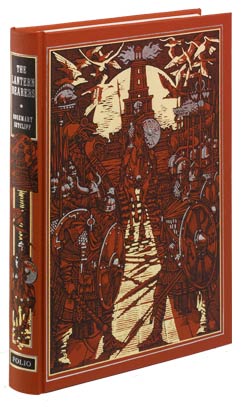
The Folio Society writes of the book:

Rome – beset by barbarian hosts at her very gates – has all but abandoned the far-flung province of Britain. And there too, barbarian forces gather on all sides. In the East, Vortigern the Fox, has invited a Saxon war-band to his shores, granting them land, in return for their help in throwing off the yoke of Rome. Everywhere the rule of law and the fragile peace between the tribes is disintegrating, while the Saxon sea wolves raid deeper each year. Young Aquila, a commander in the Auxiliary Cavalry, is the son of a cultured and Romanised family – yet when the call comes for the last of the legions to leave Britain, he learns that in the end ‘he belonged to Britain’. And so he deserts the Eagle and returns to his family – but the storm he knew was gathering comes faster than they could imagine. Raiders kill his father, burn the farm and Aquila is carried off as a slave – not even knowing what has become of his beautiful, beloved sister Flavia. In the years that follow, Aquila will face great hardship and heartbreak, yet he will also find a leader to follow and a cause he can believe in. As his father once told him: ‘It is not so easy to kill a cause that men are prepared to die for.

‘I sometimes think that we stand at sunset … It may be that the night will close over us in the end, but I believe that morning will come again… We are the Lantern Bearers, my friend; for us to keep something burning, to carry what light we can forward into the darkness and the wind’

Winner of the Carnegie Medal, The Lantern Bearers is in many ways the most thoughtful of Rosemary Sutcliff’s Eagle of the Ninth Chronicles. In Penelope Lively’s specially commissioned introduction, she comments, ‘it is a work of her maturity, one in which she had already honed all her signature skills – her power of narrative, of pace, her way with characters, the rich evocations of a Britain that is gone but that she had recreated. It is full of the creamy surf of meadowsweet alongside crimson cloaks flying in the wind.’ It is also the book in which a truly British mythology begins to take shape. In the figures of Ambrosius and Artos, the two leaders fighting to hold back the Barbarian tide, Sutcliff has utilised a germ of the Arthur-legend. Penelope Lively comments, ‘this smoke-signal from a legend of the Dark Ages is one of the inspired touches that lends an extra veracity’. This edition is illustrated with beautifully composed, richly symbolic drawings from the award-winning Russian artist, Roman Pisarev, that capture the excitement of Sutcliff’s tale, from the heat of battle to the last transports slipping out of the harbour of Rutupiae.

Source: The Lantern Bearers | The Folio Society.