
Interview here in The Times newspaper with your blog’s author – about Rosemary Sutcliff, the book The Eagle of the Ninth and the film The Eagle.
Category: Novels, Stories & Books
Rosemary Sutcliff was an internationally renowned writer of historical novels, for children, young adults and adults. She also wrote stories for children. This category compiles the posts on this blog by title.
The symbolism of The Eagle of the Ninth | What happened to the ninth legion: Part IX?
Last week I met Professor Michael Fulford of Reading University archaeology department, who introduced me (and a crowd of film journalists covering The Eagle film) to some Roman history at Silchester – Calleva in Rosemary Sutcliff‘s The Eagle of the Ninth historical novel for children (of all ages!). I asked him for his take on the fate of the ninth legion, and he has written to me (with permission to reproduce his words – thank you Michael):
At the time Rosemary Sutcliff wrote The Eagle of the Ninth it was the general view that legio IX Hispana, based at York (Eburacum) had somehow come to grief in northern Britain. There was no specific evidence for a disastrous battle but the record of the legion stopped with an inscription of AD 107-8, commemorating the construction of a building by the legion within the fortress at York.
Since the 1950s further evidence of the fate of the legion has come to light. There is a tile and a mortarium (specialist pottery vessel) from the legionary fortress at Nijmegen in the Netherlands, each stamped by the legion (LEG VIIII; LEG VIIII HIS), which date to the early 2nd century. There are also inscriptions of NCOs and officers of the legion whose career profiles are such that the legion must have still been in existence in the 120s, ie after work started on the construction of Hadrian’s Wall in Britain. Although there can be no certainty about this until more evidence emerges, it is likely that, after a period in lower Germany (at Nijmegen), the legion was transferred to the East. If it was not destroyed in the war against the Jews later in Hadrian’s reign, it might have met its fate in the war against Parthia in the early 160s. The historian Cassius Dio mentions an unnamed legion which was destroyed at the siege of Elegeia in Armenia in 161.
Even if we can no longer associate the loss of the Ninth with Britain, the story, The Eagle of the Ninth can be seen to be symbolic of the fairly constant struggle between Rome and the tribes of northern Britain, from the time of the 1st century governors like Petilius Cerealis and Agricola onwards, through the construction of Hadrian’s Wall, the later building of the Antonine Wall between Clyde and Forth, the return to the previous frontier line, and so on.
Is The Eagle from Silchester (inspiration for Rosemary Sutcliff’s The Eagle of the Ninth) the eagle standard of the ninth legion??
 A great visit to Silchester yesterday, organised for journalists covering The Eagle film … I saw for the first time the Silchester Eagle, in the museum in nearby Reading. It was smaller than I imagined. It was the artefact that, with the mystery of the disappearance of the ninth legion from military records, stimulated Rosemary Sutcliff to imagine her bestselling The Eagle of the Ninth historical novel. Read More »
Rosemary Sutcliff’s The Eagle of the Ninth in twenty languages
This is a fully up to date listing of all nineteen languages that Rosemary Sutcliff‘s The Eagle of the Ninth has been published in, in addition to the OUP editions in English. (This listing is from OUP)
English (UK hardback special edition) – Folio Society
English (audiobook – straight reading) – Naxos Audio Books
English (audio – dramatisation) – BBC/AudioGo
English (India) – Penguin India
English (USA) – Square Fish (an imprint of Farrar, Straus and Giroux).
Brazilian Portuguese – Editora Record
Czech – BB Art
Danish – P. Haase & Sons (out of print)
Dutch– Leopold
German – Verlag Freies Geistesleben
Spanish – Plataforma Editorial
French – Gallimard Jeunesse
Greek – Aiora Press
Hungarian – Alexandra Konyveshaz Kft.
Italian – Arnoldo Mondadori Editore
Japanese – Iwanami (out of print)
Korean – Sigongsa
Polish – Wydawnictwo Telbit
Portuguese – Gradiva Publicacoes
Romanian – Editura Litera International
Russian – Azbooka-Atticus
Serbian – Laguna
Swedish – Forlaget Barnstenen (out of print)
Thai – NanMee Books
Turkish – Ithaki Publishing
(I am in the process of tracking down all the websites for the publishers/foreign editions: all help welcome. Post links at comments please!)
‘Vivid and real’ | Rosemary Sutcliff’s writing | Brian Keaney
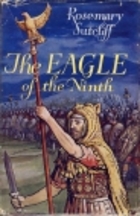
Of Rosemary Sutcliff’s historical novel The Eagle of the Ninth, writer Brian Keaney commented on Goodreads:
First published in 1954, The Eagle Of The Ninth was once to be found in every children’s library in the UK. For the last fifteen or twenty years, however, Rosemary Sutcliff’ has been somewhat forgotten as the solid, carefully written style of her books has given way to fiction that thrusts itself more brazenly upon its readers.
Hearing that there was a film coming out in 2011, I thought I would renew my acquaintance and I am very glad that I did. Based upon the mystery of the fate of the Ninth Legion which marched from its station in what is now York some time around AD 117 and was never seen again, this is the story of a young Roman soldier, the son of a centurion of that ill-fated legion, who sets out some eight years later to discover his father’s fate, it is a terrific read.
Rosemary Sutcliff makes the world of Roman Britain as vivid and real as if it were still standing to this day. Her characters are strongly drawn and her observation of nature is wonderfully well conveyed in tightly-written prose. This is a delight to read and a timeless classic
 ROSEMARY SUTCLIFF (1920-92)