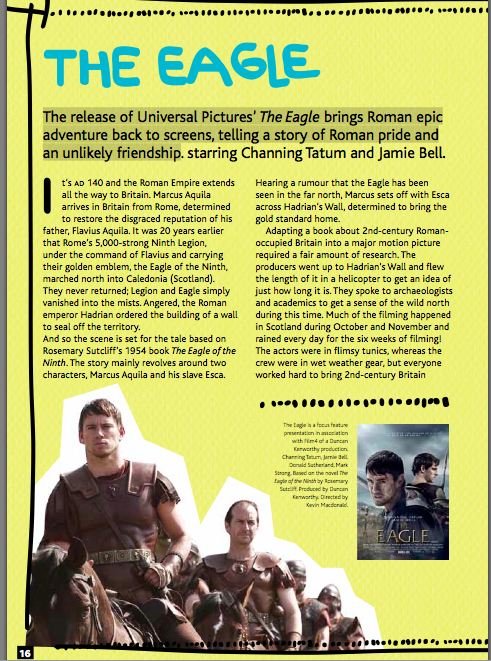
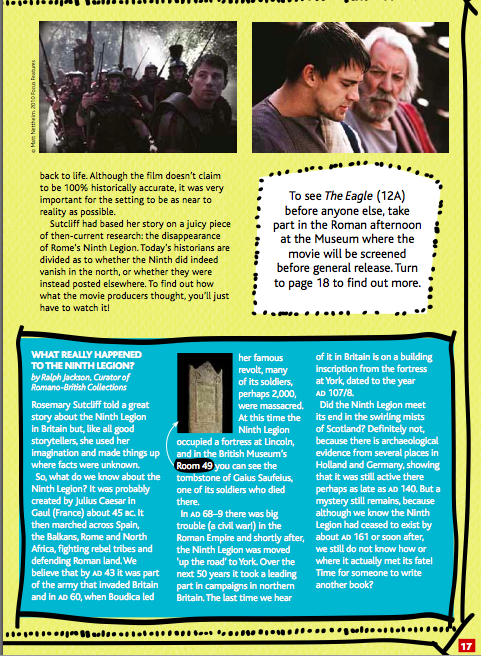
Source: Remus – Magazine for the Young Friends of the British Museum

Rosemary Sutcliff was an internationally renowned writer of historical novels, for children, young adults and adults. She also wrote stories for children. This category compiles the posts on this blog by title.
Rosemary Sutcliff’s novels and children’s books were highlighted by Alan Myers who compiled an A to Z of the many writers who had a significant connection with the North-East of England. By 2008 (when I first posted this) I thought it had disappeared from the web but no, it is here.
One of the most distinguished children’s writers of our times, (some of ) Rosemary Sutcliff’s … books … (are now) considered classics. She sets several of her best-known works in Roman and Dark Age Britain, giving her the opportunity to write about divided loyalties, a recurring theme. The Capricorn Bracelet comprises six linked short stories spanning the years AD 61 to AD 383, and Hadrian’s Wall features in the narrative.
The Eagle of the Ninth (1954) is perhaps her finest work and exemplifies the psychological dilemmas that Rosemary Sutcliff brought to her novels. Read More »
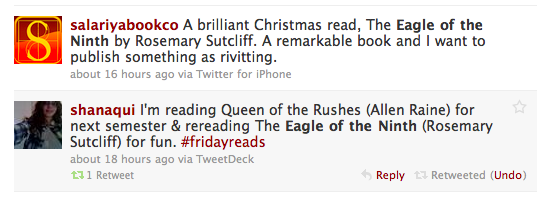
Happily Twitter users sometimes (and increasingly) mention reading and enjoying Rosemary Sutcliff’s The Eagle of the Ninth. Most recently, for example, shanaqui (‘I read a lot’) and salariyabookco (an award winning independent book publisher). We are trying to encourage the use of the hashtag #teotn for both the book and the film. Maybe one day – when the film comes out? – it will even ‘trend‘! Meanwhile please spread the word to encourage reading of The Eagle of the Ninth, wherever, and hashtag or not!
Carlo Rotella writes in the Boston Globe about buying for her children for Christmas “generations-tested” books, including Rosemary Sutcliff’s classic historical novel The Eagle of the Ninth:
… my daughters, being kids, are into Christmas, and I have some other gift-giving obligations, so every year on the Saturday morning before Christmas I come down off the mountain and make a trip downtown to buy presents. My main destination is a bookstore, and as soon as I get there I start feeling better about things. The place is always packed during the days before Christmas with a crowd that radiates excitement and contentment, and that itself is encouraging. People still read, and still regard the giving and receiving of books as something special.
And the old long-haul reliables I remember from childhood, generations-tested books you can read to your kids when they’re little and they can then read for themselves and go on rereading into adolescence and beyond, are still for sale, often in fine new editions: books like Scott O’Dell’s “Island of the Blue Dolphins,” Laura Ingalls Wilder’s Little House books, John Dennis Fitzgerald’s Great Brain books, Mark Twain’s “Huckleberry Finn,” J.R.R. Tolkien’s “The Hobbit,” Rosemary Sutcliff’s Roman adventure “The Eagle of the Ninth,” Harper Lee’s “To Kill A Mockingbird,” Charles Portis’s great comic Western “True Grit.”
Award winning children’s novelist Rosemary Sutcliff lived most of her life in Sussex. Some of her stories are set in the county and mention the South Downs, a large protected area of Sussex countryside. I discovered that she is in the ‘featured writers’ section of www.southdownsonline.org, along with H.G Wells, Rudyard Kipling and Virginia Woolf.
For much of her adult life she lived in Walberton. The remains of Iron Age forts, Roman villas and Norman castles in the county inspired her to set many of her stories in Sussex.
Warrior Scarlet is set in the Iron Age. Some of the action takes place near Cissbury Ring. At one point, the hero, Drem, fails his test to become a warrior and is sent off to be a shepherd. Sheep on the Downs were looked after in a very similar way until about 100 years or so ago. The South Downs Society paid for the restoration of a traditional wheeled shepherd’s hut in 1980 and for a shepherd’s room in 1989, both at the Weald and Downland Museum.
In The Witch’s Brat the hero is thrown out of his tribe and walks along the South Downs to Winchester. Here he finds shelter in the New Minster, better known as Winchester Cathedral. He ends up in London where he helps with the setting up of St. Bartholomew’s hospital.
 ROSEMARY SUTCLIFF (1920-92)