I have found an article from 1982—which is new to me— by ex-MP and Minister Roy Hattersely about Arthurian legend, and Rosemary Sutcliff ’s The Road to Camlann.

- Source: The Guardian, Nov 20, 1982
- More about The Road to Camlann

Rosemary Sutcliff was an internationally renowned writer of historical novels, for children, young adults and adults. She also wrote stories for children. This category compiles the posts on this blog by title.
I have found an article from 1982—which is new to me— by ex-MP and Minister Roy Hattersely about Arthurian legend, and Rosemary Sutcliff ’s The Road to Camlann.
Within our family I always knew my relative and god-mother (and in later adult years close friend) Rosemary Sutcliff as ‘Romie’ and spelled it like that. But just today I realise she spelled it Romey (sic), as I used a brief note she wrote me and my family when she gave me a copy of The Shining Company. The letter itself reveals her preference for the American edition of the book.

In earlier times The Carnegie Medal used to have “commended” and “highly commended” books each year, as well as a winner—I do not think it does now.
Rosemary Sutcliff was awarded the medal in 1959 for The Lantern Bearers. But she was several times commended too. In:
1954 for The Eagle of the Ninth
1956 for The Shield Ring
1957 for The Silver Branch
And highly commended in:
1971 for Tristan and Iseult
Joe Abercrombie is a writer of fantasy novels for adults, including the First Law Trilogy (The Blade Itself, Before They Are Hanged, and Last Argument of King). He has now turned his attention to ‘young adults’, with his first YA fantasy book Half a King.
On bookseller Waterstones blog he comments that after writing several fantasy novels for adults he “felt the need to try my hand at something at least slightly different”. He turned to a novel for young adults. He was influenced by Rosemary Sutcliff whose books were “full of authenticity, honesty, moral ambiguity, shocks and tough choices. These were not books that ever preached, or talked down to their audience”.
I was at a ‘zany zone’ with my children one day…soft play, ball bath, slides, you know the type of thing. There happened to be a boy with a malformed hand there, who was having some trouble joining in fully with the rest. I was thinking how tough that must be. Then I started thinking how much tougher it would be in the medieval sort of world I tend to work in. Especially in a Viking or a Saxon inspired world, where fighting in the shield wall was at the heart of their culture. Where standing strong with your brothers, and holding a shield for the man at your shoulder, was the mark of being a man. And that was the seed for Half a King.
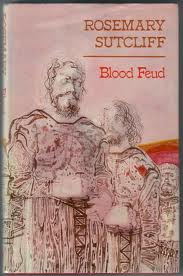
… My main touchstones in the young adult arena were things I read and loved when I was younger – notably Rosemary Sutcliff’s historical books (Blood Feud especially) and John Christopher’s post-apocalyptic The Sword of the Spirits. These were books full of authenticity, honesty, moral ambiguity, shocks and tough choices. These were not books that ever preached, or talked down to their audience. I started from the standpoint that young adults are, above all, adults. Just young ones. What they want to read isn’t radically different from what old adults (like me) want to read. People in that 12-18 age range are dealing with serious issues of sex, money, identity, responsibility. The last thing they want to be is talked down to. What adult does?
So my aim was not to pull the teeth of my existing style, but to modify it for a new audience, a younger adult audience, but also a wider adult audience who might have found themselves turned off by the big size of some of the fantasy out there. To write something shorter, tighter, more focused, perhaps a smidge less cynical and pessimistic. A slap in the face on every page. No wasted space. Simpler in its narrative, perhaps, but certainly not simpler in the way it was written or in the themes that it tackles. Something a little less explicit in the sex, violence and swearing but absolutely with the edges left on, with the same shades of grey, moral complexity, shocks and challenges, visceral action, and rich vein of dark humour that I fondly imagine my other books have offered. Whatever I came up with, I wanted it to retain the strength of my other work, to bring new readers to that work, and absolutely to appeal to the readers I already had.
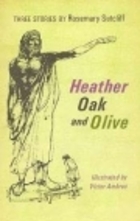
A Crown of Wild Olive was the new title given to the Rosemary Sutcliff story The Truce of the Games (1971) when it was re-published ,in 1972 in the USA, in an omnibus collection of stories Heather, Oak and Olive. That collection also included two other stories: The Chief”s Daughter and A Circlet of Oak Leaves.
 ROSEMARY SUTCLIFF (1920-92)