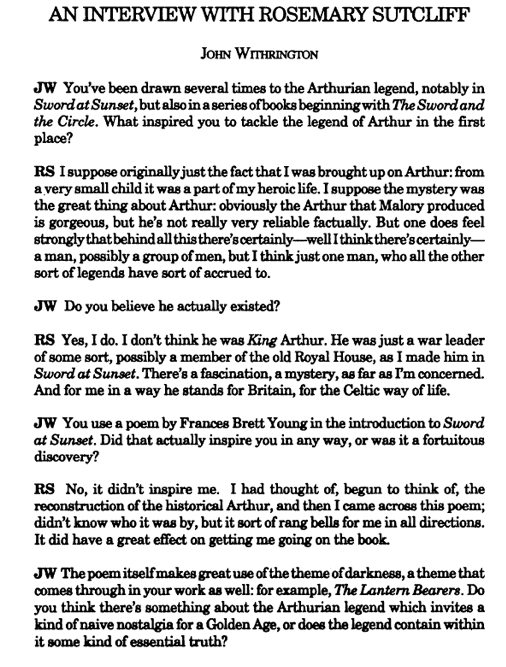
I have found a new (to me) interview snippet and will be chasing the full interview. (Any of you readers and contributors got access?)

Posts at www.rosemarysutcliff.com on Sword at Sunset, the novel about King Arthur —in the form of an autobiography—by historical novelist Rosemary Sutcliff (1990-92)
I have found a new (to me) interview snippet and will be chasing the full interview. (Any of you readers and contributors got access?)
“Marcus took it from him and bent to examine it. It was a heavy signet-ring; and on the flawed emerald which formed the bezel was engraved the dolphin badge of his own family … ”
A Twitterer, who is “reading Knight’s Fee now” asks “is there a chronology of (Rosemary Sutcliff) books re the family with the dolphin ring?”. I think it goes like this – but do put me right any of you Rosemary Sutcliff experts out there … And does anyone know or recall WHY a dolphin is the image on the ring?
The Eagle of the Ninth (AD 133),
The Silver Branch (about AD 280),
Frontier Wolf (AD 343),
The Lantern Bearers (AD 450),
Sword at Sunset (immediately follows the time of The Lantern Bearers)
and Dawn Wind (AD 577).
The sequence of stories of the descendants of Marcus Flavius Aquila, hero of The Eagle of the Ninth, continues with Sword Song (about AD 900) and The Shield Ring (about AD 1070).
Historical and children’s fiction author Rosemary Sutcliff wrote a book for adults (as opposed to children) about King Arthur – Sword at Sunset – a best seller in the UK in 1963. She said twenty years later:
I had determined from the time that I was very young that there was a real person there, and that I would love to find and reconstruct that person. […] Most of the actual research I did for the book (Sword at Sunset), apart from knowing the Arthurian story from the romance versions, was into Dark Age life and history as far as they were known. Then I worked into this setting the Arthur who seemed to me to carry weight, to be the most likely kind of person. It was very strange because I have never written a book which was so possessive. It was extraordinary–almost frightening. […] I would take the book to bed with me at night, and work there until I dropped off to sleep about two o’clock in the morning, too tired to see any more. Then I would wake up about six o’clock, still thinking about it. It was addictive. It was almost like having the story fed through to me, at times. I do my writing usually in three drafts, and I would go from the first to the second draft, from the second to the third, and find bits of the book that I had no recollection of having written at all.
Source: From Raymond H. Thompson’s interview with Rosemary Sutcliff in August 1986
.

Eric Eller described himself as a ‘recovering chemical engineer’. Of Sword at Sunset he wrote:
… Rosemary Sutcliff‘s Sword at Sunset stands out for its raw emotion and storyline stripped down to the essentials … This novel makes other versions, no matter how much fantasy and magic are injected, pallid by comparison. Other authors have recreated a gritty, ‘realistic’ Arthur since Sutcliff introduced the idea more than forty years ago, but this first attempt at that take on the Arthurian legend still stands out as the best.
(A post from four years ago)

 ROSEMARY SUTCLIFF (1920-92)