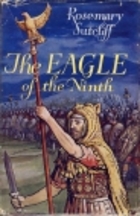
The ‘Inside A Dog’ blog enthuses about old favourite Rosemary Sutcliff


Groucho Marx, Sig Ruman and Margaret Dumont

Groucho Marx  once said: ‘Outside of a dog, a book is a man’s best friend. Inside a dog, it’s too dark to read!’. Hence one blog about books:  Inside a Dog. The blog’s author recently caught up with The Eagle film in Australia, which prompted him to enthuse about Rosemary Sutcliff  “all over again”.

Today I finally got to see the movie based on Rosemary Sutcliff’s The Eagle Of The Ninth. That’s made me think about her books all over again – I love them!  I think she’s the greatest writer of historical fiction for children and teens in the twentieth century. In fact, judging by what I’ve read in the last eleven years, maybe the best of this century too.

Source: Rosemary Sutcliff – an old favourite | Inside A Dog.

Rereading Rosemary Sutcliff’s The Eagle of the Ninth

Rosemary Sutcliff's famous novel was first published in the UK in 1954Around the time of the release of the film The Eagle, Charlotte Higgins wrote in the Guardian: “Not just a rollicking adventure, Rosemary Sutcliff‘s The Eagle of the Ninth … is a touching true story about love and loyalty”. She enjoyed looking back on a childhood favourite that she had reread many times.

I call it a children’s story; my copy, with its gorgeous line drawings by C Walter Hodges, bears my name on the title page in barely joined-up handwriting. But Sutcliff claimed her books readable by anyone from nine to ninety, and she was right. In an interview in 1992, the year she died, she said: “I don’t write for adults, I don’t write for children. I don’t write for the outside world at all. Basically, I write for some small, inquiring thing in myself.” I have read The Eagle of the Ninth dozens of times; and as the reading self changes, so does the book. When I last read the story, it was the quality of the prose that delighted, the rightness with which Sutcliff gives life to physical sensation. A battle fought through the grey drizzle of a west country dawn is illuminated by “firebrands that gilded the falling mizzle and flashed on the blade of sword and heron-tufted war spear”. Perfect, too, is a set-piece in which Marcus, on a stiflingly hot day, puts his British hunting companion’s chariot-team through their paces. “The forest verge spun by, the fern streaked away between flying hooves and whirling wheels . . . Then, on a word from Cradoc, he was backed on the reins, harder, bringing the team to a rearing halt, drawn back in full gallop on to their haunches. The wind of his going died, and the heavy heat closed round him again. It was very still, and the shimmering, sunlit scene seemed to pulse on his sight.” Sutcliff, tellingly, has those black chariot ponies – “these lovely, fiery little creatures” – descended from the royal stables of the Iceni, the tribe who had almost cast Rome out of Britain. It is a delicately inserted hint of danger to come.

Whole article at Rereading Rosemary Sutcliff’s The Eagle of the Ninth | Books | The Guardian.

Rosemary Sutcliff’s Dolphin Ring and fictional Roman Aquila family

In a comment on a recent post yesterday Robert Vermaat points me to a blog post from a few years ago which explores how Rosemary Sutcliff passed a dolphin ring down many generations of  the Aquila family over several books. Thus:
“Marcus took it from him and bent to examine it. It was a heavy signet-ring; and on the flawed emerald which formed the bezel was engraved the dolphin badge of his own family … ”
As to why this was a dolphin, he’s not sure it was ever explained? Does anyone know? The books, by the way, in order of century setting, not order of writing, are:
The Eagle of the Ninth (1954) – set in the 2nd century
The Silver Branch (1957) – 3rd century
Frontier Wolf (1980) – 4th century
The Lantern Bearers (1959) – 5th century
Sword At Sunset (1963) – 5th century
Dawn Wind (1961) – 6th century
Sword Song (1991) – 10th century
The Shield Ring (1956) – 11th century

Rosemary Sutcliff’s Dolphin Ring books | The sequence

A Twitterer, who is “reading Knight’s Fee now” asks “is there a chronology of (Rosemary Sutcliff) books re the family with the dolphin ring?”. I think it goes like this – but do put me right any of you Rosemary Sutcliff experts out there … And does anyone know or recall WHY a dolphin is the image on the ring?

The Eagle of the Ninth (AD 133),
The Silver Branch (about AD 280),
Frontier Wolf (AD 343),
The Lantern Bearers (AD 450),
Sword at Sunset (immediately follows the time of The Lantern Bearers)
and Dawn Wind (AD 577).

The  sequence of stories of the descendants of Marcus Flavius Aquila, hero of The Eagle of the Ninth, continues with Sword Song (about AD 900) and The Shield Ring (about AD 1070).

US School guides summer reading of Rosemary Sutcliff’s The Eagle of the Ninth

I found that a US School – St Sebastian’s in Needham, MA – was encouraging summer reading of Rosemary Sutcliff’s children’s historical novel  The Eagle of the Ninth. I was delighted of course, but wondered if the questions would encourage an emotional and reflective, as well as descriptive, reaction to the novel. Am I being churlish?

History 8 – Summer Reading Guide

The Eagle of The Ninth by Rosemary Sutcliff Where does this historical novel take place?

What are the modern day countries that the story takes place in?

In your atlas find each of the places mentioned in the List of Place-Names at the back of the book.

How does these locations relate to the Roman Empire?

Who are the characters in this novel?

How do they fit in to the Roman Empire?

What are some differences between the Roman occupiers and the native residents of the north and the south?

If you have seen the movie, what differences are there from the book?