The The Oxford Encyclopedia of Children’s Literature from 2006 has a long entry on Rosemary Sutcliff. It suggests that The Mark of the Horse Lord (published in 1966) is her finest historical fiction in the eyes of many people.

The The Oxford Encyclopedia of Children’s Literature from 2006 has a long entry on Rosemary Sutcliff. It suggests that The Mark of the Horse Lord (published in 1966) is her finest historical fiction in the eyes of many people.
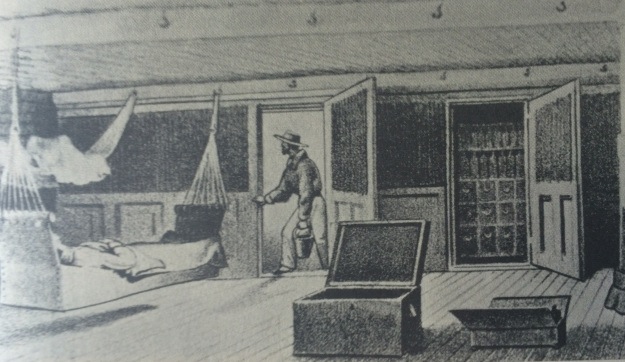
Reading Philp Larkin’s poem Toads, from 1955, I wondered at the term ‘loblolly men’ in one verse:
Lots of folk live on their wits:
  Lecturers, lispers,
Losels, loblolly-men, louts-
  They don't end as paupers;

Lots of folk live up lanes
  With fires in a bucket,
Eat windfalls and tinned sardines-
  they seem to like it.
In the 18th century, crews of British Royal Navy ships usually included ‘loblolly men’—surgeon’s mates, young men who helped the surgeons by collecting amputated limbs, hauling the buckets of tar used to cauterise stumps, and spreading sand to soak up blood. They were also responsible for feeding sick and wounded sailors a thick meat and vegetable porridge known as ‘loblolly’— hence their name. All this Rosemary Sutcliff’s beloved father, a Commodore in the Royal Navy, could have told me, as she could have. Today, I just have Google for the picture and the Oxford English Dictionary (OED).
The OED defines ‘loblolly’ as
Thick gruel or spoon-meat, freq. referred to as a rustic or nautical dish or simple medicinal remedy … Hence, a ship-doctor’s medicines.
I am embarking on a hunt got all the maps that appear in Rosemary Sutcliff books, of all types. I hope readers can help ….

Source: Paul Dry Books

 ROSEMARY SUTCLIFF (1920-92)