
Publishers Farrar, Straus and Giroux produced a teachers’ and readers’ guide about the books of Rosemary Sutcliff (that they pubished!). It is undated, covering ” the award-winning trilogy set in Roman Britain as well as Outcast, The Shining Company, Sword Song, Tristan and Iseult, and Warrior Scarlet”. The historical novels of Rosemary Sutcliff, it says:Read More »
Richard III was a man of ‘wit and courage, but malicious, wrathful, envious & froward (sic)’| Sir Thomas More on Richard Crookback, in 1557

I cannot recall what Rosemary Sutcliff thought about or indeed knew of Richard III— last week it was reported his remains will now be re-buried in Leicester Cathedral, his skeleton having been found under a car park in Leicester City. Over 500 years ago Sir Thomas More was not over flattering.Read More »
Rosemary Sutcliff was ‘Of the Minstrel Kind’, and a writer with a distinctive view of her readers

Rosemary Sutcliff was the subject of a fascinating, insightful article (‘Of The Minstrel Kind’) in the children’s literature magazine Books for Keeps. First published only in print form, it has for some time been reproduced online.
Margaret Meak was paying tribute to a seventy-year-old Rosemary.
I met Rosemary Sutcliff for the first time thirty years ago in a London hospital where she was recovering from an operation. Read More »
Rosemary Sutcliff’s mother had Second Sight, a “thing which one expects of a Celt more than a Saxon”

I have tracked down a long-out-of-print, brief story by Rosemary Sutcliff which is new to me. In a 1967 Bodley Head collection The House of the Nightmare and Other Eerie Tales, chosen by Kathleen Lines, The Man Who Died at Sea is a story about Rosemary Sutcliff’s mother (my great-aunt) and her Second Sight. I am going to re-produce it here on the blog over several posts. It starts:
My mother was not quite like most people’s mothers. She came, as far as anybody knew, of good hard-headed North Country Saxon on both sides, but should by rights have been Irish or Highland Scots. She had what people called the ‘Celtic temperament’, up one instant and down the next, and making sure that my father and I were up and down with her. When she was down, it was as though a brown fog hung over the whole house, and when she started going up again, it was as though the sun had come out and the birds started singing. Living with her had never a dull moment, but it could be rather unnerving, for she had, unquestionably, a touch of the Second Sight, another thing one expects of a Celt more than a Saxon.
She saw our beloved old dog lying in his accustomed lace before the hall fire, six or so weeks after he died; and she heard things—the same old dog padding around the house, even years later; footsteps and voices that weren’t there for other people; and occasionally she knew that certain things were going to happen, but they happened often enough for my father and I not to like it very much when she predicted something bad. (It generally seems to be future trouble and not rejoicings, that shows itself to the person with Second Sight.)
To be continued…..
Historical novelist Elizabeth Goudge introduces Rosemary Sutcliff’s historical novel The Rider of the White Horse
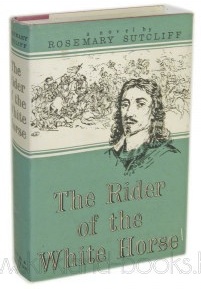
There can be nothing nicer than being asked to write an introduction to a favourite book, but at the same time it is a difficult task. It is like being asked to describe the charm of a face you love. If you did not love the face so much, and even more the person behind the face, it would be easy. But as things are, what can you possibly say? I can only say, baldly and inadequately, that I love this book. It may not be such a great book as Sword at Sunset but it has qualities of poignancy and gentleness that make it unforgettable.
A Rosemary Sutcliff historical novel which was written for adults was The Rider of the White Horse, set in the English Civil War, about Sir Thomas Fairfax and his wife. This is the first paragraph of the introduction by the renowned historical novelist Elizabeth Goudge. Read More »
 ROSEMARY SUTCLIFF (1920-92)