“I had a lonely childhood and growing-up time” | Children’s book writer and historical novelist Rosemary Sutcliff

Books for Keeps Issue  64 (1990) Cover

Margaret Meek, an academic at The Institute of Education in London, wrote a monograph about Rosemary Sutcliff, and later, a tribute to her on her 70th birthday in Books for Keeps, in 1990.

Theres a revealing paragraph in the collection of stories which (Rosemary Sutcliff) edited with Monica Dickens, Is Anyone There?, where she says: `I had a lonely childhood and growing-up time. My parents loved me and I loved them, but I could never talk to them about the problems and fears and aching hopes inside me that I had most need to talk about to someone. And there was no one else.’

Writers cannot be convivial people in work time; their chosen craft is a solitary one. But to be cut off in childhood from the society of the school playground, where the gossipy tales are told, is a particular deprivation. Rosemary Sutcliff could never have been a chatty novelist. Yet her experience of being read to throughout her childhood by a sympathetic adult (her mother) bears out everything that has been researched or said about reading stories to children. If you want to understand where Rosemary Sutcliff, as a novelist, `comes from’, read The Jungle Books, Kim and The Just So Stories, preferably aloud.

… To read Rosemary Sutcliff is to discover what reading is good for. So this anniversary and this accomplishment make me ask what might be the contemporary appeal or, more simply, the enduring attraction of the historical novels for the young. After all, much has clearly changed in children’s books and reading since television became their more immediate storyteller, and novelists, now more matey and informal, adopted a more elliptical vernacular prose, in which the readers’ ease is more visible than the challenge to read … (Her) first page swings the characters into action in a situation as clear as a television image. The names of the people and places set the rules of belonging; the relations between the sexes are formally arrayed; the battles are long and fierce. Readers who are unaccustomed to the building up of suspense in poised sentences may need a helping hand …  the best way into a Sutcliff narrative, a kind of initiation, is to hear it read aloud. Then you know what the author means when she says she tells her tales `from the inside’.

Source: Books For Keeps, Issue 64.
The likes of Rosemary Sutcliff I have never found anywhere else | Thoughts on reading The Flowers of Adonis

From Rosemary Sutcliff fan Anjy  Roemelt (posted at the Facebook page for Rosemary Sutcliff): I started reading Rosemary Sutcliff’s The Flowers of Adonis today and within three pages it had me caught by the neck and submerged into the old Sutcliff magic. I have so often already thought ‘this is her best book, this will be […]

The Eagle or The Eagle of the Ninth? | International titles of 2011 film of Rosemary Sutcliff’s The Eagle of the Ninth

Recent showings on Film 4 in the UK of ‘The Eagle’ film, based on Rosemary Sutcliff’s historical novel The Eagle of the Ninth, have reminded me of my frustration and disappointment that the film was not itself called The Eagle of the Ninth. For many months during filming and productionthe it had the full title, but after test-marketing in the USA, the US film studio Focus Features insisted on shortening the title – because US audiences seemed to think The Eagle of the Ninth might be about golf! (I am not joking).

At the time I wrote that I chose to believe that the studio knew its business and its market, although the subsequent  failure of their marketing in the US  lead me to wonder a little more. The (standard) contract for the book rights gave those of us responsible for Rosemary Sutcliff’s book no veto or locus in the decision.

In many, but not all, countries the title was a full translation of the original title. In others, of ‘The Eagle’. So far I think I have found:

Brazil: A Aguia da Nova

Bulgaria: Орелът 

Croatia: Orao

Finland: Kotka

France: L’ Aigle de la Neuvième Légion

Germany: Der Adler der Neunten Legion

Greece: O aetos tis aftokratorias

Hungary: A sas

Iceland: Örninn

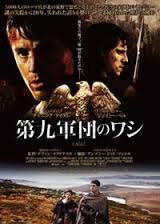
Japan: 第九軍団のワシ /

Lithuania: Devintojo legiono erelis

Poland: Dziewiaty legion

Portugal: A Águia da Nona Legião

Romania: Acvila legiunii a IX-a

Russia: Орел Девятого легиона

Spain: El águila de la novena legión

Japanese Film poster for The Eagle of the Ninth 第九軍団のワシ :

An auditor audits The Eagle film of Rosemary Sutcliff’s historical novel The Eagle of the Ninth

Twitter on The Eagle film

The film The Eagle was recently shown on the Film 4 TV channel in  the UK .  There are many posts about the film – starring Channing Tatum and Jamie Bell,  directed by Kevin MacDonald, and produced by Duncan Kenworthy – on this blog, and also a  tabbed page about it ( tab above or click here).

Image

Chronicler of Occupied Brittania | Rosemary Sutcliff’s life and work | Obituary from The Guardian newspaper

Let us not be solemn about the death of Rosemary Sutcliff CBE, who has died suddenly, aged 72, despite the progressively wasting Still’s disease that had been with her since the age of two. She was impish, almost irreverent sometimes, in her approach to life. Her favourite author was Kipling and she once told me she had a great affection for The Elephant’s Child – because his first action with his newly acquired trunk was to spank his insufferably interfering relations.

But it was Kipling’s deep communion with the Sussex countryside and its history that was her true inspiration. Settled as an adult in Arundel, Rosemary shared with him his love for his county as well as his vision of successive generations living in and leaving their mark upon the landscape.

Rosemary Sutcliff, at the peak of her form in her ‘Roman’ novels, was without doubt an historical writer of genius, and recognised internationally as such. Read More »