Sword in the Circle, Arthurian book by Rosemary Sutcliff, “pretty much formed” the character of A Book Worm blogger

US Rosemary Sutcliff The Sword and the Circle 1994

The author of the blog  A Book Worm, has posted at the You Write tab on this blog:

My first Sutcliff book was The Sword in the Circle, which I was given while on holiday in Tintagel back in 1985. I was four and it was my first ‘grown-up’ book. I loved it then and love it still. For a decade or so I reread it and the other books that make up the Arthur trilogy, every couple of months.

I loved all of the Sutcliff books I came across but it was this one that pretty much formed much of my character. I still re-read the book from time to time, and it still has the same impact on me now as it did back when I was younger. I will be forever grateful to Rosemary Sutcliff for writing such amazing books. In fact there is a special thank you to here on my blog.

Now might have to just dig out my copy of Blood Feud, haven’t read that one in a while……
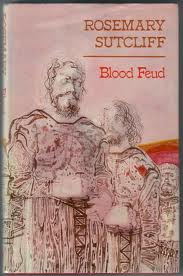
Rosemary Sutcliff historical and children’s book and novel Blood Feud cover

Rosemary Sutcliff was a miniaturist painter and reviewer wrote: “The Chief’s Daughter is a miniature in prose” | The Times, 1967

The Chief's Daughter by Rosemary Sutcliff cover

Rosemary Sutcliff  was a miniaturist before she became an author and The Chief’s Daughter is a miniature in prose, a very short story in which the lines are  neat, bold and clear, the characters lightly brushed in but arresting. Set in ancient Wales it tells how a chieftain’s daughter frees an Irish slave boy destined for sacrifice and how he in his turn unwittingly in his turn saves her  from dying in his place. The story was originally in a volume of tribute by many children’s authors to the memory of Eleanor Farjeon;  now, as a fully illustrated book in a series designed
for seven year olds, The Chief’s Daughter will
deservedly reach a far larger number of young readers.

Source: The fantastic living force of landscape by Elaine Moss; The Times, December 2, 1967, p 23.

Rosemary Sutcliff’s Chess Dream In A Garden | Covered in Once Upon A Bookshelf about ‘vintage kids books’.

Cover of Chess Dream in a Garden by Rosemary Sutcliff and Ralph Thompson

I LOVE books. I love gardens too, especially mysterious old gardens with twisty turning paths and strange statuary and secret grottoes of flowers. I love history and old things, especially the sort of old things one finds in the poky corners of antique shops and in dusty old attics. And I love things that smack of magic, be it fairy tale transformations or quirky oddness a la Wonderland. When I find a book that combines all of those things in one place, well, let’s just say I am one happy, happy bookworm.

Chess Dream In A Garden is just that sort of book. For starters, it was written by Rosemary Sutcliff, which rocketed it to the top of my TBR list by that virtue alone. She is That Sort of Writer. If you aren’t acquainted with her work already, I highly recommend it. She wrote historical fiction, mostly focusing on Roman era Britain, and her ability to bring the past to life is uncanny. Her books are not always easy reads (they use challenging vocabulary and poetic imagery), but they are the sort that engulf and engross the reader and cause you to lose yourself in a world of the author’s making. Despite their antiquitous subject matter, she injects them with deeper, timeless themes of the universal human struggles of personality and power that make them relevant and relatable to modern readers.  Although most of them are classified as kid lit, they are equally enjoyable to adults.

via Chess Dream In A Garden | Once Upon A Bookshelf.

Modern Times are a Hindrance | Rosemary Sutcliff on Writing Historical Fiction

Sadly stuck behind their pay-wall are The Times Archives. In January 1983, within a long interview by Caroline Moorehead, Rosemary Sutcliff said of actually visiting battle sites:

“Modem times are a hindrance. The natural features of the land have been lost.”

Mind you, such research trips would anyway always have been a major project for her, given her severe physical disabilities. Some other quotes from Rosemary Sutcliff from the article are:

On writing her memoirs Blue Remembered Hills:

l happened to have a winter free. I was in between books. And being an only child, with far older cousins, who else is there to remember? And it was a happy childhood.

On periods of history she avoided:

I can’t get inside the medieval skin. I find the complete permeation of religious life too much for a free-thinker like myself, and beyond the eighteenth century is too cloak and dagger for my taste.

On when she wrote:

I hit that sudden post-war flowering of children’s literature and the golden age of –  the Oxford University Press.

On her rocking horse, Troubador:

About 15 years ago I decided that I was old enough, ugly enough, and successful enough, to indulge my eccentricities.

One of Rosemary Sutcliff's eccentricities | Her rocking horse Troubador
One of Rosemary Sutcliff’s eccentricities was supporting a rocking-horse maker (who went bust!)

Some of 10 Quotations from Writers about Writing at Interesting Literature blog

A few days ago, over at the blog Interesting Literature: A Library of Literary Interestingness (?!), these quotations in particular from  ‘10 Great Quotations from Writers about Writing’  appealed to me:

Being a writer is a very peculiar sort of a job: it’s always you versus a blank sheet of paper and quite often the blank piece of paper wins. (Neil Gaiman)

A writer is someone for whom writing is more difficult than it is for other people. (Thomas Mann)

Better to write for yourself and have no public, than to write for the public and have no self. (Cyril Connolly)

I think the hardest thing about writing is writing. (Nora Ephron)

I recall again here that, amongst many interesting comments about writing, Rosemary Sutcliff once said: “The only thing more frightful than writing is not writing”.

More quotes on this blog here


.