Rosemary Sutcliff’s novels relevant to contemporary politics and society?

How relevant are Rosemary Sutcliff’s novels to contemporary politics and society?

Screenshot 2016-07-13 10.50.40

John Fitzgerald writes a piece about the referendum, about which he himself says (in his own words, in a comment elsewhere here)

It’s written from a pro-Leave standpoint and is quite religious in its outlook … So, it won’t be everyone’s cup of tea, but I hope it goes to show just how relevant RS’s novels are to contemporary politics and society.

Source: Londinium: The Fourth Rome? Guest Post by John Fitzgerald

Midsummer’s Eve | Rosemary Sutcliff’s Official Birthday | Obscured 2016 by EU Referendum!

Rosemary Sutcliff's mother Nessie Lawton

Rosemary Sutcliff always remarked on Midsummer’s Eve (June 23rd) in her diary. She called it her official birthday; so she had two birthdays a year, like Paddington Bear and the Queen. It was also the birth day of her mother. Here in the UK we largely missed Midsummer’s Eve this year, with the EU Referendum looming, and the turmoil in the wake of the resul

1988 June 23rd Thursday … There’s another blackbird’s nest in the front garden, in place of the one the ginger cat took.

1989 June 23rd Friday … Started to watch last day of Ascot, but of course it disappeared – industrial action …

1991 June 23rd Sunday. Midsummer’s Eve—Cold as winter, and pouring with rain all day.

1992 June 23rd Tuesday. Midsummer’s Eve. My Official Birthday. Mummy’s birthday … Went and stood out in the garden for a few minutes before bed. Was lovely, smelling of grass & night scented flowers.

June 23rd 1992 Diary entry Rosemary Sutcliff

… The may all coming out along the lanes … (Rosemary Sutcliff’s Diary, 10/5/88)

Hawthorn or may tree blossomMay 10th Tuesday. Went along for the ride when Ray took Mrs Prosser home. The may all coming out along the lanes. Joan collecting my earrings and a white shirt for dying grey in Chichester today. Should be back in half-an-hour or so.
© Anthony Lawton 2012

The may refers to the  ‘may tree’, or hawthorn. The blossom appears on the tree at the beginning of May in the south of England. According to the Royal Horticultural Society, “until the calendar was changed in 1752, hawthorn would be in flower for May Day, which used to be 11 days later than it is now”.

At  the May Day celebrations people and houses used to be decked with may blossoms or boughs (‘bringing home the may’) which were traditional decorations, associated with the woodland spirit known as the Green Man.

I think of her writing this always in bed at night – I sometimes sat there when she did, as I recall. However, maybe my memory plays tricks, for this entry is apparently written during the day (‘Joan will be back’, from shopping, ‘in half-an-hour or so).

… heard the first cuckoo of the year … (Diary, 23/4/88)

April 23rd Saturday. The most lovely day. Joan and I wearing our red roses for St George went for a run and the first picnic tea of the year under Amberley Castle, heard the first cuckoo of the year. Walked around the garden after we got back.

© Anthony Lawton 2012

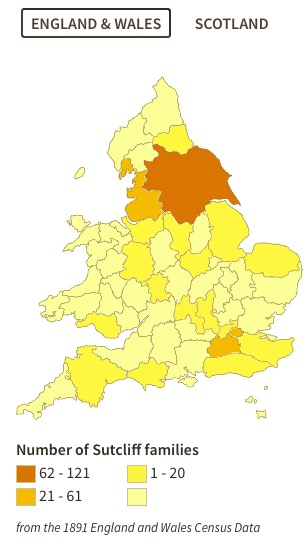
Sutcliffs originally from West Yorkshire | But NB Rosemary Sutcliff the eminent author has no ‘E’

Sutcliff families lived mainly in the North in the 1890s in England and Wales. (Courtesy Ancestry). With an ‘e’, Sutcliff is a place-based name from any of the three places in West Yorkshire called Sutcliffe. The name is  from the Old English suð ( = ‘south’) + clif ( = ‘riverbank’, ‘slope’, and ‘cliff’).

Screenshot 2016-04-15 04.20.34