Recent Twitter post @FurnissLawton (my daughter, a literary agent) commented “How authors used to collect press cuttings @rsutcliff‘s ‘Sword at Sunset’ 1963″ with a picture pic.twitter.com/ZzpHjur2ay
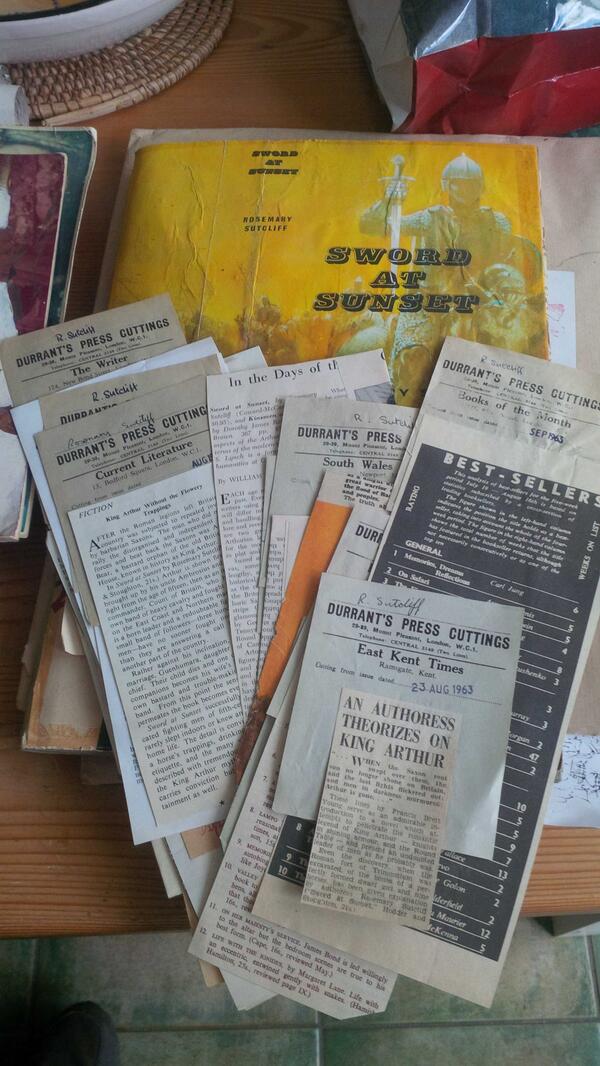

Recent Twitter post @FurnissLawton (my daughter, a literary agent) commented “How authors used to collect press cuttings @rsutcliff‘s ‘Sword at Sunset’ 1963″ with a picture pic.twitter.com/ZzpHjur2ay
Rosemary Sutcliff’s historical novel for children (“of all ages 8 to 88”) Dawn Wind is being republished. The cover proofs arrived recently. Happily OUP are able to use the original Charles Keeping picture.

Dawn Wind involves the last Roman-British wearer of the dolphin ring which features in several Rosemary Sutciff historical novels. Owain is the only survivor of a Viking raid and the great battle of Aquae Sulis. Just fourteen years old, his father and brother die at the battle but he eventually makes his way to a peaceful Saxon settlement where he is made thrall to a Saxon family. Travelling there he meets a half-wild girl whom he cares for but is forced to leave behind when she falls ill. They meet up again after many years apart, still so in tune with each other that they are able to understand each other’s wordless messages. During his years of service he discovers understanding and even friendship, and loyalty for the people who were once his enemies. His freedom earned, he shoulders the weight of the Saxon household rather than betray a promise to his former master.
 Rosemary Sutcliff children’s book and story A Crown of Wild Olive (The Truce of the Games) tells the story of the Olympics.
 In fact, it is the newer title of a book originally published as The Truce of the Games. The tale is of two athletes from different ways of life who discover the meaning of friendship as they compete against each other in the ancient Olympic games. A Crown of Wild Olive was published in the collection Heather, Oak, and Olive (1972).
 The Lantern Bearers by historical novelist and children’s writer Rosemary Sutcliff, first published in 1959, won the prestigious Carnegie Medal that year. An American reviewer wrote some twenty years later …
I discovered Rosemary Sutcliff in my early teens, and she quickly became one of my favorite authors. I can still vividly recapture the magic of reading her books. It was a real pleasure to return to The Lantern Bearers, which I first read when I was about thirteen, and find the magic still intact. … The Lantern Bearers is a wonderful book. Sutcliff possesses a unique gift for character and description, evoking a sense of place and person so intense that the reader can almost see her characters and the world in which they move. She has a matchless ability to establish historical context without a surfeit of the “let’s learn a history lesson now” exposition that mars many historical novels for young people. Her books are never less than meticulously researched, but her recreation of the past is so effortless that one has no sense of academic exercise, but rather of a world as close and immediate as everyday.
… The Arthurian theme was one of Sutcliff’s favorites: she produced several young adult books on the subject, as well as a beautiful adult novel, Sword at Sunset, to my mind one of the best ever written in this genre. But the Sutcliff’s Arthur is rooted as much in history as in myth–not just the tragic king of Le Morte d’Arthur or the heroic/magical figure of traditional Arthurian fantasy, but a man who might actually have existed, heir both to the memory of Rome and to the last great flowering of Celtic power in Britain.
… her enduring popularity … is richly merited: she is, quite simply, one of the best.Copyright © 1997 Victoria Strauss
(First posted, April 29th, 2009)
Rosemary Sutcliff often said that she ‘wrote books for children aged 8 to 88’.
… W.H. Auden wrote that ‘there are good books which are only for adults, because their comprehension presupposes adult experiences, but there are no good books which are only for children’. In this sense, it is natural for children’s books to become adult books if they are any good; since all adults have been children, books for and about children are always potentially for and about adults too. (Hugh Haughton)
 ROSEMARY SUTCLIFF (1920-92)