“The stories of Finn Mac Cool belong…not to Epic, but to Folklore and Fairytale” |Rosemary Sutcliff on retelling the story of Finn MacCool

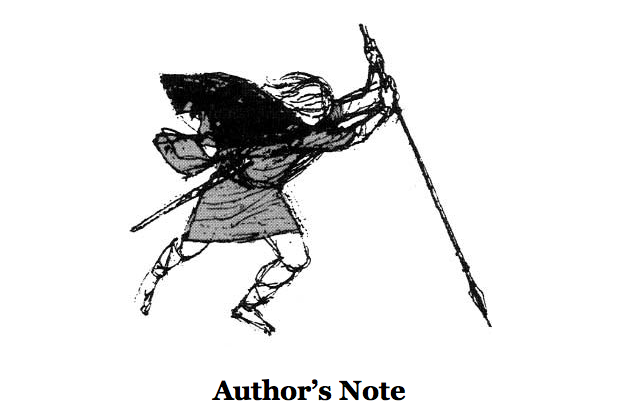
Illustration from From The Author's Note to The High Deeds of Finn MacCool by Rosemary Sutcliff

The stories of Finn Mac Cool belong…not to Epic, but to Folklore and Fairytale; and only here and there … something of the Hero Tale remains.

… The stories of the Fianna are full of loose ends and contradictions, and unexplained wisps of strangeness that seem to have drifted in for no especial reason except that they are curious or beautiful and happened to be floating by.

They are stories made simply for the delight of story-making, and I have retold them in the same spirit – even adding a flicker or a flourish of my own from time to time – as everyone who has retold them in the past thousand years or so has done before me.

Source: Author’s Note to The High Deeds of Finn MacCool

Dawn Wind (by historical novelist and children’s writer Rosemary Sutcliff) |Reprint reviewed in Historical Novels Review

Over at Twitter I am tracking down people who can say #Ireadsutcliff , and their favourite(s). Merrian Weymouth in Australia favours —possibly— Dawn Wind, which was recently reprinted. The Historical Novel Society had this to say of it:

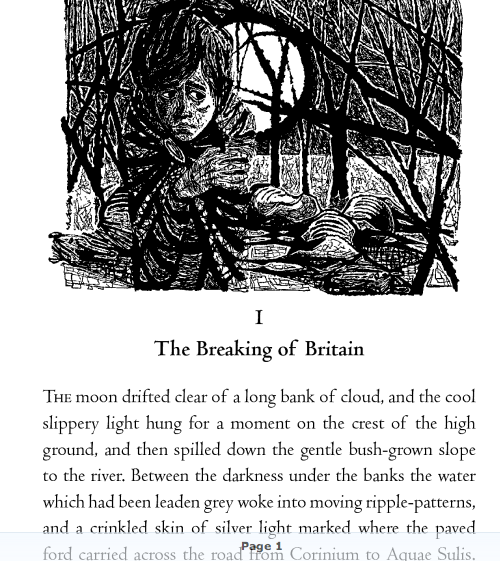
First published in 1961, this reprint keeps its original charm by reproducing the black and white illustrations by Charles Keeping. Dawn Wind represents historical fiction at its best. It was written by an author who delighted readers with her detailed and atmospheric stories. It is equally suitable for both young adult and adult readers. A thoroughly enjoyable book.

The novel starts:

The first paragraph of Rosemary Sutcliff’s Dawn Wind

Rosemary Sutcliff’s thank-you address to the American Children’s Literature Association in Arbor, Michigan, 19th May 1985 | For the Phoenix Award for The Mark of the Horse Lord

Rosemary Sutcliff sent an address to the Children’s Literature Association in Arbor, Michigan, 19th May 1985 when she received the Phoenix Award for The Mark of the Horse Lord. This is an excerpt.

The Mark of the Horse-Lord  is one of my best-beloved books, amongst my own, and has remained so warmly living in my mind, though I have never re-read it, that when I heard that it had won an award for a book published twenty years ago, my first thought was “How lovely!! But my second was, ‘But it can’t be anywhere near twenty years old; it’s one of my quite recent books; there must be some mistake!” And I made all speed to get it out of the bookcase and look at the publication date, to make sure. And having got it out, of course I started reading it again.

Re-reading a book of my own is for me (and I imagine for most authors) a faintly nerve-wracking process, Read More »

“I had a lonely childhood and growing-up time” | Children’s book writer and historical novelist Rosemary Sutcliff

Books for Keeps Issue  64 (1990) Cover

Margaret Meek, an academic at The Institute of Education in London, wrote a monograph about Rosemary Sutcliff, and later, a tribute to her on her 70th birthday in Books for Keeps, in 1990.

Theres a revealing paragraph in the collection of stories which (Rosemary Sutcliff) edited with Monica Dickens, Is Anyone There?, where she says: `I had a lonely childhood and growing-up time. My parents loved me and I loved them, but I could never talk to them about the problems and fears and aching hopes inside me that I had most need to talk about to someone. And there was no one else.’

Writers cannot be convivial people in work time; their chosen craft is a solitary one. But to be cut off in childhood from the society of the school playground, where the gossipy tales are told, is a particular deprivation. Rosemary Sutcliff could never have been a chatty novelist. Yet her experience of being read to throughout her childhood by a sympathetic adult (her mother) bears out everything that has been researched or said about reading stories to children. If you want to understand where Rosemary Sutcliff, as a novelist, `comes from’, read The Jungle Books, Kim and The Just So Stories, preferably aloud.

… To read Rosemary Sutcliff is to discover what reading is good for. So this anniversary and this accomplishment make me ask what might be the contemporary appeal or, more simply, the enduring attraction of the historical novels for the young. After all, much has clearly changed in children’s books and reading since television became their more immediate storyteller, and novelists, now more matey and informal, adopted a more elliptical vernacular prose, in which the readers’ ease is more visible than the challenge to read … (Her) first page swings the characters into action in a situation as clear as a television image. The names of the people and places set the rules of belonging; the relations between the sexes are formally arrayed; the battles are long and fierce. Readers who are unaccustomed to the building up of suspense in poised sentences may need a helping hand …  the best way into a Sutcliff narrative, a kind of initiation, is to hear it read aloud. Then you know what the author means when she says she tells her tales `from the inside’.

Source: Books For Keeps, Issue 64.

Chronicler of Occupied Brittania | Rosemary Sutcliff’s life and work | Obituary from The Guardian newspaper

Let us not be solemn about the death of Rosemary Sutcliff CBE, who has died suddenly, aged 72, despite the progressively wasting Still’s disease that had been with her since the age of two. She was impish, almost irreverent sometimes, in her approach to life. Her favourite author was Kipling and she once told me she had a great affection for The Elephant’s Child – because his first action with his newly acquired trunk was to spank his insufferably interfering relations.

But it was Kipling’s deep communion with the Sussex countryside and its history that was her true inspiration. Settled as an adult in Arundel, Rosemary shared with him his love for his county as well as his vision of successive generations living in and leaving their mark upon the landscape.

Rosemary Sutcliff, at the peak of her form in her ‘Roman’ novels, was without doubt an historical writer of genius, and recognised internationally as such. Read More »