To read Rosemary Sutcliff is to discover what reading is good for

… The Shining Compan(1990) … (is)  a vintage volume, the work of a writer who has a distinctive view of her readers, a view which many may not know that they can have of themselves. To read Rosemary Sutcliff is to discover what reading is good for.

…. this accomplishment make me ask what might be the contemporary appeal or, more simply, the enduring attraction of the historical novels for the young. After all, much has clearly changed in children’s books and reading since television became their more immediate storyteller, and novelists, now more matey and informal, adopted a more elliptical vernacular prose, in which the readers’ ease is more visible than the challenge to read.But, given her isolation, Rosemary Sutcliff needs her readers. Like her characters they people her world, so she devises means of coming close to them and drawing them into the worlds she makes out of the dark places in history.

Sometimes the trick is a first-person narrative: `I am – I was – Prosper, second son to Gerontius, lord of three cantrefs between Nant Ffrancon and the sea.’ Or there’s a dedication, `For all four houses of Hilsea Modern Girls’ School, Portsmouth (my school) who adopted me like a battleship or a regimental goat.’ The first page swings the characters into action in a situation as clear as a television image. The names of the people and places set the rules of belonging; the relations between the sexes are formally arrayed; the battles are long and fierce. Readers who are unaccustomed to the building up of suspense in poised sentences may need a helping hand. Again, the best way into a Sutcliff narrative, a kind of initiation, is to hear it read aloud. Then you know what the author means when she says she tells her tales `from the inside’.

Source: Margaret Meek in Books for Keeps, Issue 64Reproduced with permission.

The spellbinding storytelling in the historical novels of Rosemary Sutcliff

Margaret Meek paid tribute to Rosemary Sutcliff in her 70th year with an insightful reflection on her personality and her work. (Margaret Meek wrote a monograph about Rosemary Sutcliff in the 1960s).

The sharing of storytelling that writers do with readers is the dialogue of imagination. Rosemary Sutcliff lives, grows and acts and suffers in her stories. The worlds created in her imagination have had to stand in for the world of much everyday actuality. From her therefore we can learn what the imagination does, and how it allows us all to explore what’s possible, the realm of virtual experience. Read More »

Rosemary Sutcliff’s recreation of the past is effortless | Returning to The Lantern Bearers

The Lantern Bearers by historical novelist and children’s writer Rosemary Sutcliff, first published in 1959, won the prestigious  Carnegie Medal that year. An American reviewer wrote some twenty years later …

I discovered Rosemary Sutcliff in my early teens, and she quickly became one of my favorite authors. I can still vividly recapture the magic of reading her books. It was a real pleasure to return to The Lantern Bearers, which I first read when I was about thirteen, and find the magic still intact. … The Lantern Bearers is a wonderful book. Sutcliff possesses a unique gift for character and description, evoking a sense of place and person so intense that the reader can almost see her characters and the world in which they move. She has a matchless ability to establish historical context without a surfeit of the “let’s learn a history lesson now” exposition that mars many historical novels for young people. Her books are never less than meticulously researched, but her recreation of the past is so effortless that one has no sense of academic exercise, but rather of a world as close and immediate as everyday.

…  The Arthurian theme was one of Sutcliff’s favorites: she produced several young adult books on the subject, as well as a beautiful adult novel, Sword at Sunset, to my mind one of the best ever written in this genre. But the Sutcliff’s Arthur is rooted as much in history as in myth–not just the tragic king of Le Morte d’Arthur or the heroic/magical figure of traditional Arthurian fantasy, but a man who might actually have existed, heir both to the memory of Rome and to the last great flowering of Celtic power in Britain.
…  her enduring popularity … is richly merited: she is, quite simply, one of the best.

Copyright © 1997 Victoria Strauss

(First posted, April 29th, 2009)

Rosemary Sutcliff’s Roman Britain novels are historical fiction at its best, a seamless blend of fiction with history

Rosemary Sutcliff’s Roman Britain series is historical fiction at its best – excellent historical details, interesting characters, compelling stories, and a seamless blend of fiction with history. Though ostensibly for young adults, these books are excellent for adults. Sutcliff successfully brings the struggle between Rome and the barbarians to life, covering the back-and-forth battle under changing circumstances and across the centuries. Through this, her concern with how her youthful main characters address the first difficult times of their lives links the books together. Their availability varies, but these novels are well worth the effort to track down. The strategic and tactical concerns of each successive defender of civilized Britain, as he struggles to hold back the dark, gives the series an epic sweep that makes the books hard to put down. Dive into any of these books for a first-rate historical recreation, with living, breathing characters who will leave you as passionately wedded to the defense of Britain as they are.

Source: Rosemary Sutcliff | Roman Britain historical novels | The Green Man Review

Michael Rosen drank in Rosemary Sutcliff’s classic The Eagle of the Ninth in two ways

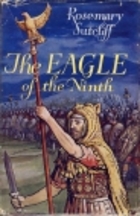
Rosemary Sutcliff's The Eagle of the Ninth Original UK Book Cover 1954 Michael Rosen (writer – for children mostly – poet, performer, broadcaster and university professor) commented last year in The Guardian newspaper about Rosemary Sutcliff and her classic historical novel for children and young people The Eagle of the Ninth:

Interesting that she was writing about the end of an empire at the end of …an empire. And does the search for the lost legion echo/refract (Joseph) Conrad’s Heart of Darkness?

Some of us drank in The Eagle of the Ninth two ways: once as a BBC Children’s Hour serial and second time as the book. I can remember hurrying to get home to hear it – moody, dangerous, mysterious – a quest for something real but long gone, a possible solution to an unsolved story…and somehow it had something to do with events that happened a long time ago just where you walked when we were on holiday: on moors, or on wet fields where we were camping. The book made a connection for me between a past and that particular present.

Source: Guardian newspaper editorial ‘In praise of’ Rosemary Sutcliff