Rosemary Sutcliff’s historical novel ‘Bonnie Dundee’ | American 1985 Review

In a brief review in The Dallas Morning News in 1985 (12 May)  Cherie Clodfelter commented that the historical novel for children and young adults, Bonnie Dundee by Rosemary Sutcliff (published in USA by Dutton) was:

… historical fiction at its very best, a blend of fact and fiction. The writing style is immensely informative and engrossing, although the American teenager may lack the knowledge of British history to appreciate the complicated plot and the Scottish idiom. John Graham of Claverhouse (called Bonnie Dundee by his followers) was a Scottish Royalist who died fighting to keep the House of Stuart on the throne. Both the legendary leader whom King James entitled the Viscount Dundee and the period of history where battle was both elegant and horrible is carefully developed to maintain the pace of a suspenseful adventure story.

Life will go on and is well worth the struggle | Faith from Rosemary Sutcliff

Responding to an earlier post quoting Margaret Meek on  in her eponymous monograph about historical novelist and doyen of children’s literature  Rosemary Sutcliff, reader and regular commenter Anne (much more knowledgeable than me about the details of Rosemary’s work. and commentary upon it) posted:

It seems appropriate to add this piece from another critical essay, this one by May Hill Arbuthnot and Zena Sutherland:

The theme of all (Sutcliff’s) stories, as Margaret Meek points out, is “the light and the dark. The light is what is valued, what is to be saved beyond one’s own lifetime. The dark is the threatening destruction that works against it.” In The Lantern Bearers… the blackness of despair is concentrated in the heart of Aquila, a Roman officer….

No briefing of these stories can give any conception of their scope and power, and when young people read them they live with nobility… Nevertheless, these are difficult books, not because of vocabulary problems, but because of the complexities of the plots in which many peoples are fighting for dominance.

Fortunately, Dawn Wind …, one of the finest of the books, is also the least complex. Chronologically it follows The Lantern Bearers, but it is complete in itself and will undoubtedly send some readers to the trilogy. For the fourteen-year-old hero Owain, the light of the world seems to have been extinguished. He finds himself the sole survivor of a bloody battle between the Saxons and the Britons in which his people, the Britons, were completely destroyed. In the gutted remains of the city from which he had come, the only life the boy finds is a pitiable waif of a girl, lost and half-starved. At first Owain and Regina are bound together in mutual misery, but eventually they are united in respect and affection. So when Regina is sick and dying, Owain carries her to a Saxon settlement, even though he knows what will happen to him. The Saxons care for the girl but sell Owain into slavery…. After eleven years, he is freed and sets out at once to find his people and Regina, who has never doubted he would come for her.

So life is not snuffed out by the night. A dawn wind blows and two people start all over again with those basic qualities that have always made for survival…. Rosemary Sutcliff gives children and youth historical fiction that builds courage and faith that life will go on and is well worth the struggle.

Source: May Hill Arbuthnot and Zena Sutherland, “Historical Fiction: ‘The Lantern Bearers’ and ‘Dawn Wind’,” in their “Children and Books”, pub. Scott, Foresman and Company, 1972, pp. 508-9

Rosemary Sutcliff had the eye of a painter of miniatures

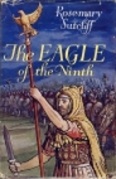
Rosemary Sutcliff crafted her historical novel The Eagle of the Ninth from two starting points: a small bronze eagle found at Silchester, which is now in Reading Museum; and the unknown fate of the Roman Ninth Legion, which, based in York, had apparently vanished from the historical record in the early years of the 2nd century. Written, as always, “for children aged 8 to 88” The Eagle of the Ninth is about a young centurion, Marcus Aquila, who takes up his first command on the edges of the Roman empire in south-west Britain. Severely injured during a fight with local warriors who have been inflamed by a travelling druid, he has to give up his military career. However, he  hears rumours of sightings of  the standard of his father’s lost legion – the eagle of the ninth –  north of Hadrian’s wall. He realises that if he can find it, he will restore the honour of his disgraced father and the legion he commanded.

Last year, at the time of the release of the film The Eagle, Charlotte Higgins, chief arts writer of The Guardian newspaper, wrote a long, affectionate article about her children’s favourite.

… In an interview in 1992, the year she died, she said: “I don’t write for adults, I don’t write for children. I don’t write for the outside world at all. Basically, I write for some small, inquiring thing in myself.” I have read The Eagle of the Ninth dozens of times; and as the reading self changes, so does the book. When I last read the story, it was the quality of the prose that delighted, the rightness with which Sutcliff gives life to physical sensation. A battle fought through the grey drizzle of a west country dawn is illuminated by “firebrands that gilded the falling mizzle and flashed on the blade of sword and heron-tufted war spear”. Read More »

Dogs in the historical novels of Rosemary Sutcliff

Thinking of both historical fiction and dogs put Katherine Langrish, author of fantasy novels for young adults, in mind of Rosemary Sutcliff. Katherine believes that dogs in books are a “Good Thing”. She also believes that Rosemary Sutcliff “must easily win the title of Britain’s most loved writer of junior historical fiction”.

… Rosemary Sutcliff, whose books I devoured as a child …  loved dogs, and there is a noble dog in many of her books: Whitethroat in Warrior Scarlet, Argos in Brother Dusty Feet.  But for me the most iconic is Dog in Dawn Wind,  the young war-hound that the boy Owain finds by moonlight on the ruins of the battlefield:

…it was something alive in the cold echoing emptiness of a dead world. It stood with one paw raised, looking at him, and Owain called, hoarsely, with stiff lips and aching throat: ‘Dog! Hai! Dog!’ … [It] came, slowly and uncertainly… once it stopped altogether; then it finished at the run and next instant was trembling against his legs. He was a young dog; the beautiful creamy hair of his breast-patch was stained and draggled, and his muzzle bloody in the moonlight… ‘Dog, aiee, dog, we are alone then. There’s no one else. We will go together, you and I.’

The brilliance of the writing is to show us, in the lonely and innocent terror of the dog and what he has been made to do, the full dreadfulness of war.
This is used with Katherine’s permission (thank you!). She wonders also in an email to me  if “perhaps Rosemary wrote about dogs as a way of owning them …”. Actually, Rosemary always owned dogs.
(Original post in March, 2010 First Revision 14 Feb 2012. List below added 10 March 2014))
  • Brother Dusty-Feet: Hugh runs away from home to protect Argos.
  • The Eagle of the Ninth:  Cub is Esca’s tame wolf cub.
  • The Silver Branch: Curoi’s hound is called Cullen.
  • Outcast: Canog is a mistreated mongrel owned by  Beric, whose childhood dog was Gelert.
  • The Lantern Bearers: Artos’s dog Cabal.
  • Warrior Scarlet: Whitethroat; Fand the Beautiful.
  • The Bridge-Builders: Math, a Hibernian wolfhound.
  • Knight’s Fee: Joyeuse.
  • Dawn Wind: Dog, a survivor of Owain’s Last Stand.
  • Blood Feud: Brindle is a cattle dog.
  • Bonnie Dundee: Caspa.
  • The Shining Company: Gelert.
  • Sword Song: Bjarni murders a man for kicking Astrid, and Hugin follows him home from Dublin.

The Eagle of the Ninth | Rosemary Sutcliff | Library of Libation review

David Urbach (a ‘liker’ over at Rosemary Sutcliff’s Facebook page  – do join him and click the like button there!) alerted me to a 10/10 review by someone he considers “perceptive”,  of Rosemary Sutcliff‘s classic of historical fiction and children’s literature, The Eagle of the Ninth. It makes interesting reading, and I am intrigued to learn of the reaction of others who know Rosemary’s work well.  Read More »