Rosemary Sutcliff’s autobiography Blue Remembered Hills recalls service life

Cover of autobiography Blue Remembered Hills by Rosemary Sutcliff At the start of last year I posted about historical novelist and children’s writer Rosemary Sutcliff‘s autobiography Blue Remembered Hills. I noted that a reviewer on the Amazon site – intriguingly at Leicester University in the town where I write this – wrote a decade ago:  

This is a fascinating book on several levels. First it is the story of a young girl, an only child born in 1920, growing up with middle-class parents, but in a fashion which combined the usual practices and mores of the time with the unusual. As she was crippled (her word) at the age of three, her mother insisted on bringing her up herself rather than delivering her to a nanny, and, due in part to her disabilities, and the long periods of treatment made necessary, she had little formal education. However, she discovered books at an early age, initially through being read to, and was a consummate observer of both people and landscape, particularly on a small scale – the play of light on a dagger blade, the petals of a flower.

Second, it is story of the development of a writer, up to the time her first book was accepted for publication (what a pity she stopped there – I wanted her to go on!)

Third, for me as the child of Service parents (father in the RAF) it is the best representation I have ever seen of the life of the Service child. Rosemary’s father was a naval officer, and she, like me, absorbed unconsciously the traditional values and mores of the British Armed Services while moving every two or three years according to her father’s postings. These values, which have a timelessness about them, in particular the reciprocal loyalties of officer to man and man to officer, the duty of an officer towards his men, come through very clearly in all her fiction. As with all her books, the descriptions are superb (she trained as a miniature painter.

The fourth element, I suppose, relates to the disability and her acceptance of it, in an atmosphere very different from that of today. She says that her mother in particular sought as far as possible to bring her up as a normal child, and so she never really thought of herself as crippled, even though in practical terms she was quite badly disabled. I was lucky enough to correspond with her, and to meet her on one occasion before she died, and I was quite surprised to see how disabled she actually was – she was a person who was incredibly alive.

Sources: I prefer reading: Blue remembered hills – Rosemary Sutcliff and here on Amazon

The enchantments of The Witch’s Brat by Rosemary Sutcliff

Lovel, the crippled hero of Rosemary Sutcliff‘s The Witch’s Brat, is driven from his village in a shower of stones after his grandmother’s death. (The) novel (is) … crammed with careful period detail and research, the painstaking catalogues of herb-lore brought grippingly to life by the characters to whom they bring such danger.

via The enchantments of witch fiction | guardian.co.uk.

Rosemary Sutcliff’s Blood Feud historical novel was TV series The Sea Dragon

Blood Feud coverI have been researching the Rosemary Sutcliff  historical novels and retellings for children’s books which have been turned into TV and radio programmes. Sea Dragon was a version of Blood Feud made for TV in 1990. The TV series gets an average  8.1 (of 10) rating from users at ImDB. The essence of the plot is this: sold into slavery to the Northmen (Norsemen) in the tenth century, a young Englishman becomes involved in a blood feud which leads him to Constantinople and a totally different way of life.

The United States newspaper the Washington Post commented, when the book was first published in 1976, that:

Sutcliff’s gift is to recreate an era, in this case the 10th-century voyages of the Northmen and the rise of Byzantium, so convincingly that her readers accept without question the different mores of another time. The violence of the blood feud between two families set off by an accidental killing seems inevitable. No writing down here, no anachronisms, just a glorious sense of history, a sense of knowing how it was.

The Director of the TV film was Icelander Ágúst Guðmundsson; the adaptor David Joss Buckley. The lead actors were Graham McGrath (as Jestyn), Bernard Latham (as Gyrth) and Janek Lesniak (as Thormod). Other cast members were: Baard Owe as Haki; Øystein Wiik as Thraud; Pat Roach as Aslak; Trine Pallesen as Ayrun; Lisa Thorslunde as Thormod’s Mother; Eiry Palfrey as Sister Gytha; Holly Aird as Ffion; Lasse Spang Olsen as Herulf; Martin Spang Olsen as Anders; and  Anna Massey (who sadly died  in 2011) as the  Prioress.

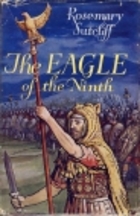
Rereading Rosemary Sutcliff’s The Eagle of the Ninth

Rosemary Sutcliff's famous novel was first published in the UK in 1954Around the time of the release of the film The Eagle, Charlotte Higgins wrote in the Guardian: “Not just a rollicking adventure, Rosemary Sutcliff‘s The Eagle of the Ninth … is a touching true story about love and loyalty”. She enjoyed looking back on a childhood favourite that she had reread many times.

I call it a children’s story; my copy, with its gorgeous line drawings by C Walter Hodges, bears my name on the title page in barely joined-up handwriting. But Sutcliff claimed her books readable by anyone from nine to ninety, and she was right. In an interview in 1992, the year she died, she said: “I don’t write for adults, I don’t write for children. I don’t write for the outside world at all. Basically, I write for some small, inquiring thing in myself.” I have read The Eagle of the Ninth dozens of times; and as the reading self changes, so does the book. When I last read the story, it was the quality of the prose that delighted, the rightness with which Sutcliff gives life to physical sensation. A battle fought through the grey drizzle of a west country dawn is illuminated by “firebrands that gilded the falling mizzle and flashed on the blade of sword and heron-tufted war spear”. Perfect, too, is a set-piece in which Marcus, on a stiflingly hot day, puts his British hunting companion’s chariot-team through their paces. “The forest verge spun by, the fern streaked away between flying hooves and whirling wheels . . . Then, on a word from Cradoc, he was backed on the reins, harder, bringing the team to a rearing halt, drawn back in full gallop on to their haunches. The wind of his going died, and the heavy heat closed round him again. It was very still, and the shimmering, sunlit scene seemed to pulse on his sight.” Sutcliff, tellingly, has those black chariot ponies – “these lovely, fiery little creatures” – descended from the royal stables of the Iceni, the tribe who had almost cast Rome out of Britain. It is a delicately inserted hint of danger to come.

Whole article at Rereading Rosemary Sutcliff’s The Eagle of the Ninth | Books | The Guardian.

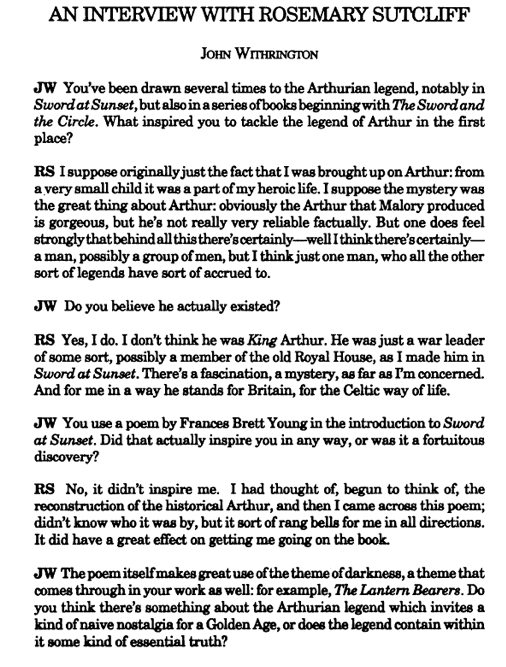
Interview in 1991 with Rosemary Sutcliff by John Withrington about Sword at Sunset and Arthurian legend

I have found a new (to me) interview snippet and will be chasing the full interview. (Any of you readers and contributors got access?)

Sutcliff snippet of interview

Source: Quondam et Futurus, Vol. 1, No. 4, Winter 1991