Poor research: I clipped this from a newspaper in 2010, but I did not note which one!
(But see comments below for more details)


Poor research: I clipped this from a newspaper in 2010, but I did not note which one!
(But see comments below for more details)
In 1966 Rosemary Sutcliff made a donation to the de Grummond Children’s Literature Collection at the University of Southern Mississippi in the USA. The Sutcliff Collection has a manuscript and two typescripts for the radio play The New Laird. (Taped in April 1966 and broadcast on 17 May 1966 as part of the BBC Radio Scotland series—Stories from Scottish History. The collection includes a red note-book of research for The Lantern Bearers, and for two unpublished works, The Amber Dolphin and The Red Dragon.
I have never found either published or unpublished the actual stories by those titles. What happened to them may be illuminated by her diaries, which are as yet unpublished. I have not read the notebook at the library.
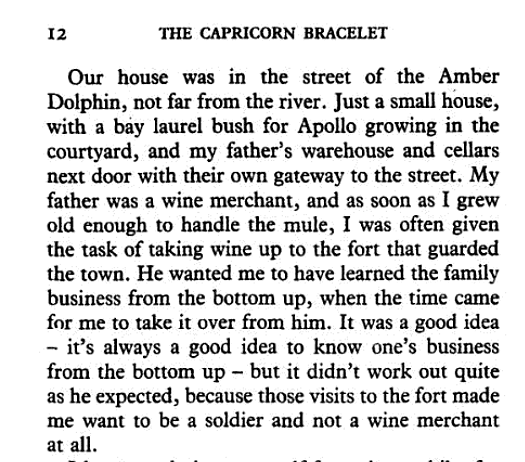
However, The Amber Dolphin may have become The Capricorn Bracelet (1973). For an early paragraph begins:
There can be nothing nicer than being asked to write an introduction to a favourite book, but at the same time it is a difficult task. It is like being asked to describe the charm of a face you love. If you did not love the face so much, and even more the person behind the face, it would be easy. But as things are, what can you possibly say? I can only say, baldly and inadequately, that I love this book. It may not be such a great book as Sword at Sunset but it has qualities of poignancy and gentleness that make it unforgettable.
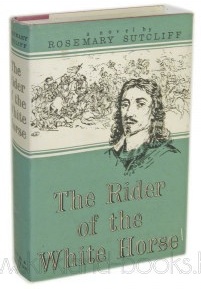
A Rosemary Sutcliff historical novel which was written for adults was The Rider of the White Horse, set in the English Civil War, about Sir Thomas Fairfax and his wife. This is the first paragraph of the introduction by the renowned historical novelist Elizabeth Goudge. Read More »
Veronica Horwell wrote about the life and writing of historical novelist and writer for children and young adults Rosemary Sutcliff with affectionate insight in The Guardian newspaper shortly after her death in 1992.
Rosemary Sutcliff did not spare the child, the raven and the wolf gorging on the battlefield dead. No softening, or cheapening, of violence. When you opened her books, you went easily with her into the days she described so immediately: she noticed the rhythms of rain on glass as children do, felt the same warm amazement at snow. You might not know what was this cake called a barley bannock they seemed always to eat in her books, but you recognised the domestic concentration at dinner-cooking time.
And then you would gulp her titles—“Please Miss, have you got any more by ‘er?”—past bedtime, in the last of the summer afterglow. You were caught: and she did not let you off the actual shape of life and death. The fear, the physical pain, the disappointments, the ageing, the dying. (There was an afternoon, I remember, when the brutal end of the Norseman warrior Ari Knudson of The Shield Ring bleached out the heat of a holiday sun, and another, bleaker, when nothing seemed real but the Roman legionary, turned renegade, speaking his very last Latin words and saluting The Eagle of the Ninth before fading into another misty life.)
She did not assume you were ever too young to know the powerful, if frightening, truth—that nothing iswholly new, even the brief freshness of a new generation; that continual change, but also repetition, are history. We do not tell children these things so much now: we do not recount the generations. But reading her, you waited excitedly for that Roman ring with a dolphin cut in its emerald which runs in a thread of lineal descent from book to book, from life to life.So history was lives? It was always different, always the same, and the pattern only visible after? Those who read Sutcliff don’t recall formally learning about the gods Adonis, Mithras, Lugh of the Shining Spear and the Christos: we seem always to have known them. Years of art history never made as clear as she did, in two pages, the difference in the souls of cultures between the rigid ornament of Rome and the Celtic patterns that flow and whorl like life itself. You had access through her, as never since through the heritage industry, into time past when it was time present. When the archaeologist Catherine Hills once noted that the battered Roman eagle found at Silchester was probably awaiting the contempt of the scrap furnace, she did sadly, almost apologetically. For her, as for the rest of us, he seemed a talisman of the knowledge of that departed civilisation, restored to his story by Sutcliff. And the Sutcliff story was, as legends are, almost closer to a truth.

Rosemary Sutcliff’s books are popular in Japan, (although I am not always accurate in judging which cover is which book—on Twitter today I have been told that what I, via Google, thought was The Mark of the Horse Lord was actually The Lantern Bearers …).
I am reminded that I was surprised to discover a few years ago that Her Imperial Majesty The Empress Michiko of Japan linked Rosemary Sutcliff, J.R.R. Tolkien, C.S.Lewis, and Philippa Pearce in the same breath in her keynote speech to the 26th (2001) Congress of the International Board on Books for Young People (IBBY).
Keep linking children and books…Books are children’s valuable friends and are a help to them. So that children have firm roots within themselves; so that children have strong wings of joy and of imagination; so that children know love, accepting that at times love calls for pain; so that children see and face the challenge of life’s complexities, fully taking on the life given to each, and finally, upon this earth which is our common home, become, one day, true instruments of peace.
 ROSEMARY SUTCLIFF (1920-92)