
Tag: History
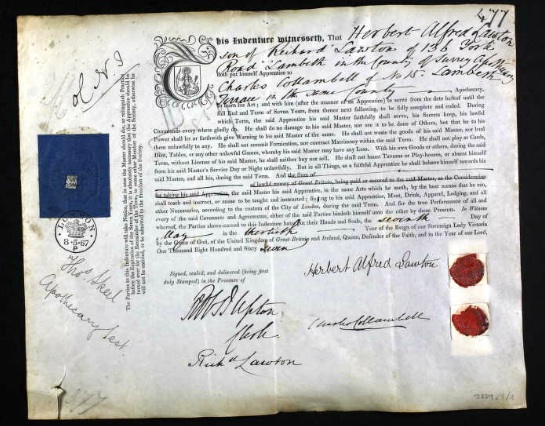
Rosemary Sutcliff’s grandfather apprenticed and qualified as an Apothecary in the 1800s
Today’s diary entry by author Rosemary Sutcliff refers to her mother. Coincidentally, I have today come across a copy of the original document which records the indenture as an apprentice apothecary of Rosemary Sutcliff’s grandfather (and my great grand-father), Dr Herbert Alfred Lawton (born 1851, died 1903).
How does the fall of the Roman Empire throw light upon our current crises?
Historian and broadcaster Michael Wood has been musing about whether the time Britain slid into chaos at the end of the Roman Empire is also a distant mirror of our present crises. (Thank you Janet Webb for alerting me). He concludes a fascinating article:
Well, the fall of Rome serves to remind us that complex societies can, and do, break down. There is rarely one reason. Rather, there are multiple causes that come together in a perfect storm, as they did around 400AD.
But in time society recovers, for societies after all are made by people, and one guesses that the ones that recover quickest are the ones which are most adaptive, and perhaps too the ones with the strongest sense of identity and history – the strongest sense of “group feeling”.
Source: BBC News – Viewpoint: The time Britain slid into chaos.
Perceptions of King Arthur and other legendary figures
This article about how historians’ perceptions of the ‘legendary figure’ have changed over recent times is behind a pay wall: I am trying to access it. Meanwhile…
Forty years ago both scholarly histories and historical novels had a common view of Arthur: as a historical warrior, whose leadership enabled his people, the native inhabitants of post-Roman Britain, to halt the advancing tide of Anglo-Saxon conquest for about half a century. Nobody was exactly sure when this was, because it had been in the obscure period between 410 and 550, which has left almost no contemporary documents. Nonetheless, there was general agreement that Arthur had flourished somewhere in that time and had been the greatest British personality in it, establishing a fame which laid the basis for the later, more romantic and fantastic, medieval Arthurian legend.
This happy consensus had mostly been produced by the new discipline of archaeology, which had excavated some of the main sites associated with Arthur in that later and fully-developed legend, such as his birthplace at Tintagel and Cadbury Castle in Somerset, which local tradition held had been his court of Camelot. In each case, amid great publicity, spectacular remains had been found of occupation by wealthy people at just the right period. For many, this was enough to establish beyond reasonable doubt that the legend was rooted in historical truth and books such as Geoffrey Ashe’s The Quest for Arthur’s Britain and Leslie Alcock’s Arthur’s Britain carried this message to a wide readership. It was taken up by historians, who now felt encouraged to reconstruct a story for the years around 500 by combining the meagre early medieval sources with a wealth of much more dubious data from later periods; this approach was epitomised by John Morris’s fat, exciting book, The Age of Arthur . The interest stirred up by scholars resulted in a flood of historical fiction in the 1960s and 1970s. Most was produced by Englishmen, though Englishwomen such as Rosemary Sutcliff and Mary Stewart were among the most prominent authors. All treated Arthur as a historical character in a post-Roman setting, with realistic British landscapes and careful use of historical and archaeological data.
Rosemary Sutcliff’s recreation of the past is effortless | Returning to The Lantern Bearers
 The Lantern Bearers by historical novelist and children’s writer Rosemary Sutcliff, first published in 1959, won the prestigious Carnegie Medal that year. An American reviewer wrote some twenty years later …
I discovered Rosemary Sutcliff in my early teens, and she quickly became one of my favorite authors. I can still vividly recapture the magic of reading her books. It was a real pleasure to return to The Lantern Bearers, which I first read when I was about thirteen, and find the magic still intact. … The Lantern Bearers is a wonderful book. Sutcliff possesses a unique gift for character and description, evoking a sense of place and person so intense that the reader can almost see her characters and the world in which they move. She has a matchless ability to establish historical context without a surfeit of the “let’s learn a history lesson now” exposition that mars many historical novels for young people. Her books are never less than meticulously researched, but her recreation of the past is so effortless that one has no sense of academic exercise, but rather of a world as close and immediate as everyday.
… The Arthurian theme was one of Sutcliff’s favorites: she produced several young adult books on the subject, as well as a beautiful adult novel, Sword at Sunset, to my mind one of the best ever written in this genre. But the Sutcliff’s Arthur is rooted as much in history as in myth–not just the tragic king of Le Morte d’Arthur or the heroic/magical figure of traditional Arthurian fantasy, but a man who might actually have existed, heir both to the memory of Rome and to the last great flowering of Celtic power in Britain.
… her enduring popularity … is richly merited: she is, quite simply, one of the best.Copyright © 1997 Victoria Strauss
- For the story of The Lantern Bearers see here
- More about The Lantern Bearers on this blog
(First posted, April 29th, 2009)
 ROSEMARY SUTCLIFF (1920-92)