 Rosemary Sutcliff was an inspiration for author Helen Hollick, who was well aware of the place of the dolphin signet-ring in Rosemary’s Roman novels, as well as the dolphin in her signature. In her novel Harold the King (entitled I am the Chosen King in the USA) captain of Harold II’s fleet was Eadric, later arrested and imprisoned by Duke William after the English defeat. In her acknowledgements she wrote: ‘The books by the late Rosemary Sutcliff, an historical fiction author sadly missed, have always been an inspiration to me. Her last novel brought the feel of the sea and those beautiful – but deadly – Viking longships to life. As a small personal tribute to her gift of storytelling, Eadric the Steersman’s ship, The Dolphin, is for her.’
I first encountered Rosemary Sutcliff at school when I was about 14. Our English mistress, Mrs Llewellyn, was a real dragon. We were, on the whole, terrified of her. It must have been towards the end of term, I assume she had covered the Curriculum (such as it was back in 1966/7) for we trooped into class and she announced, ‘Settle down, I am going to read you a story for the next few lessons’.
Sitting there, listening enraptured to that story (The Queen Elizabeth Story) my delight was complete. Until then I had basically only read pony stories (I so wanted a pony of my own) but Rosemary Sutcliff transported me into another world of the enchanted past. I had no idea a novel without a single equine in it could be so utterly engrossing.
…
I eventually plucked up courage to write to Rosemary to tell her I was working on an Arthurian novel, how her writing had inspired me, and how the character of Arthur was almost possessing me at times. To my delight I received a letter back, written in her own, somewhat unsteady handwriting – she did, after all have arthritic hands. This is part of what she wrote:
“I do hope all goes well with your King Arthur – I know just how you feel about him, he almost killed me when I was writing “Sword at Sunset”. His demands made me take work to bed with me, work till the small hours, and wake up at 6 am still thinking about him and planning the day’s work. And when the book was at last finished, having spent two years thinking and feeling as a man, and that particular man, it took me six weeks to get back inside my own skin again.
With all good wishes

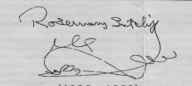

 ROSEMARY SUTCLIFF (1920-92)