
The Shining Company, the historical novel by Rosemary Sutcliff, was published to excellent reviews over twenty years ago, although it was awarded a major US award for children’s literature last year. This was the review in The Times newspaper, by Brian Alderson who was a pioneer of the study of children’s literature in Britain.
Y Gododdin is not a species of baby-talk, but a tale of bloody strife, said to have been written around the end of the 7th century by the Welsh bard Aneirin. It tells how the High Chief of the Gododdin, Mynyddog Mwynfawr, called a hosting of the Celtic tribes at Edinburgh. There, for the space of a year, he trained a war-band of 300 princes and then unleashed them on the invading Saxons at the Battle of Catterick. Everything went wrong, and only one hero returned from the fray. But his exploits and those of his companions were celebrated by Aneirin in ”the Great Song that others will sing for a thousand years”.
This Great Song is at the heart of Rosemary Sutcliff’sThe Shining Company, thus bringing Aneirin longer life than he expected. For as he gave elegiac voice to the deeds of hero after hero, so she has taken the names from his telling and has sought to imagine them back int historical reality. Speaking through the persona of Prosper, the son of a Welsh chieftain, and eventually shieldbearer to the knight who returned, she begins by establishing a sense of the closed tribal world of the time after the Romans, and then introduces unbardic perceptions of form and motive. Personal relationships and the countryside of the Dark Ages become vital ingredients in the renewed story, and as the episodes pile up the ride to Edinburgh, the welding of disparate forces into a single fighting group so the reader is made ready for the great setpiece of the battle and the long dying fall of its tragic aftermath.
Such a theme is natural to Sutcliff’s art. She is moved by simple concepts of loyalty and integrity that may be as foreign to today’s children’s literature as they were to the no-baby-talk Gododdin. But by admitting their possibility, while not shirking the real facts of ferocious woundings and pragmatic betrayals, she still persuades us that a bardic reading of the past is sustainable alongside an awareness of its squalor and its indifferent, but unpolluted, landscapes.
Source: The Times, June 9, 1990, Saturday by Brian Alderson
More on this blog about Rosemary Sutcliff’s The Shining Company


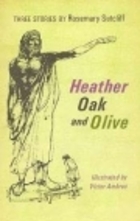
 In fact, it is the newer title of a book originally published as The Truce of the Games. The tale is of two athletes from different ways of life who discover the meaning of friendship as they compete against each other in the ancient Olympic games. A Crown of Wild Olive was published in the collection Heather, Oak, and Olive (1972).
 ROSEMARY SUTCLIFF (1920-92)