
May 11th Wednesday. Got a nearly full sized work day’s work done, which is quite something these days.
© Anthony Lawton 2012
Category: Autobiography & Biography
Posts on the rosemarysutcliff.com weblog about the life and thoughts of Rosemary Sutcliff, including what she wrote and said about writing and her own craft.
The young Rosemary Sutcliff had to endure a spinal carriage
Rosemary Sutcliff contracted juvenile arthritis at a very early age. Speaking to Roy Plomley on Desert Island Discs she spoke of how she was moved around, in a spinal carriage.
A spinal carriage… was rather like a wicker coffin. It was very uncomfortable and you lay flat out in this thing and of course all you could see were the branches of the trees or the roofs of the houses going by overhead and it was extremely boring. With any luck you were allowed perhaps to sit up on the way home from a walk.

Wonderful! Rosemary Sutcliff’s Desert Island Discs programme from 1983 now on BBC website
Do you want to hear what Rosemary Sutcliff sounded like, as well as some of her observations about her life and writing?The BBC has now made available the original recording of Rosemary Sutcliff on Desert Island Discs with Roy Plumley from October 1st, 1983. She talks about her career, about the difficulties caused by arthritis since she was a child and she chooses the eight records that she would take to the mythical island. They were:
- Antonin Dvorak: Symphony No. 9 in E minor ‘From the New World’
- Dykes/Whiting: Eternal Father Strong To Save
- Claude Debussy: Prélude à l’après midi d’un faune
- Richard Tauber: We’ll Gather Lilacs
- John D. Burgess: The Flowers Of The Forest
- Dylan Thomas: Under Milk Wood
- Ralph Vaughan Williams: The Lark Ascending
- Johann Sebastian Bach: Cantata No. 147: Herz und mund und Tat und Leben
Mind you, Charlotte Higgins, Chief Arts Writer of The Guardian, commented in a tweet:

Rosemary Sutcliff: a bibliography, compiled by Susan Elizabeth McMurray | National Library of Australia

King Arthur almost killed Rosemary Sutcliff, author of The Sword at Sunset | Letter to Helen Hollick
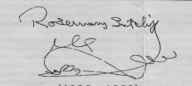 Rosemary Sutcliff was an inspiration for author Helen Hollick, who was well aware of the place of the dolphin signet-ring in Rosemary’s Roman novels, as well as the dolphin in her signature. In her novel Harold the King (entitled I am the Chosen King in the USA) captain of Harold II’s fleet was Eadric, later arrested and imprisoned by Duke William after the English defeat. In her acknowledgements she wrote: ‘The books by the late Rosemary Sutcliff, an historical fiction author sadly missed, have always been an inspiration to me. Her last novel brought the feel of the sea and those beautiful – but deadly – Viking longships to life. As a small personal tribute to her gift of storytelling, Eadric the Steersman’s ship, The Dolphin, is for her.’
I first encountered Rosemary Sutcliff at school when I was about 14. Our English mistress, Mrs Llewellyn, was a real dragon. We were, on the whole, terrified of her. It must have been towards the end of term, I assume she had covered the Curriculum (such as it was back in 1966/7) for we trooped into class and she announced, ‘Settle down, I am going to read you a story for the next few lessons’.
Sitting there, listening enraptured to that story (The Queen Elizabeth Story) my delight was complete. Until then I had basically only read pony stories (I so wanted a pony of my own) but Rosemary Sutcliff transported me into another world of the enchanted past. I had no idea a novel without a single equine in it could be so utterly engrossing.
…
I eventually plucked up courage to write to Rosemary to tell her I was working on an Arthurian novel, how her writing had inspired me, and how the character of Arthur was almost possessing me at times. To my delight I received a letter back, written in her own, somewhat unsteady handwriting – she did, after all have arthritic hands. This is part of what she wrote:“I do hope all goes well with your King Arthur – I know just how you feel about him, he almost killed me when I was writing “Sword at Sunset”. His demands made me take work to bed with me, work till the small hours, and wake up at 6 am still thinking about him and planning the day’s work. And when the book was at last finished, having spent two years thinking and feeling as a man, and that particular man, it took me six weeks to get back inside my own skin again.With all good wishes
 ROSEMARY SUTCLIFF (1920-92)