Dates mattered to Rosemary Sutcliff; they matter in history; and in excellent historical fiction like hers. (See post yesterday, building on an article in The Guardian). From year to year she carried foreword notes about addresses, key contacts and the dates of her books, usually in a blue Challenge notebook. This page records the little story books for children that she published with Hamish Hamilton. The notebook is here propped on her writing chair – a Captain’s chair.
Category: Autobiography & Biography
Posts on the rosemarysutcliff.com weblog about the life and thoughts of Rosemary Sutcliff, including what she wrote and said about writing and her own craft.
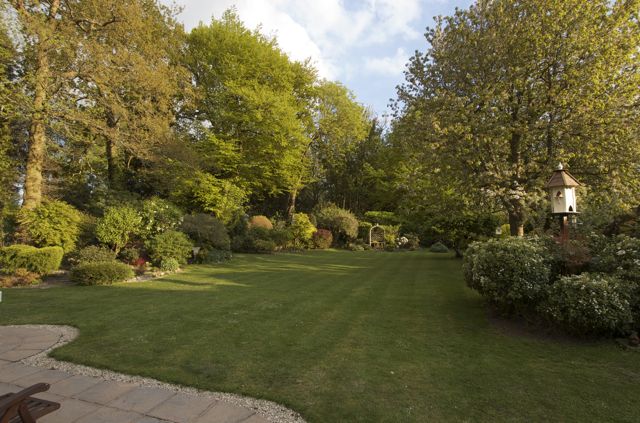
Rosemary Sutcliff’s garden and dovecote
Rosemary Sutcliff’s diary has many references to her carefully-tended garden. Neighbours visit for tea, fans and other writers come to talk and be photographed with her, and housekeepers come and go. Last year photographer Stephen Walby wrote to this blog with a photo of the garden, which stretches out behind the room that was her study where she would work all day, and the sitting room with french windows where she spent the evenings.
We live in Rosemary’s old house in the lovely Sussex village of Walberton. Rosemary lived here until she died in 1992. She is very fondly remembered here, having been an active member of village life. Our next door neighbours daughter remembers coming to the house to help out and many other villagers have stories to tell, we have heard how Rosemary would welcome groups of children from the village school for talks.
The cover photograph for Blue Remembered Hills was taken in the garden, last year we replaced the dovecote in her memory. The property includes a flint cottage which I think was once a barn/pigsty. In Rosemary’s day her housekeeper lived here.
In fact, as I noted at the time ” … her handyman-driver lived in the flint cottage … The housekeepers always lived in the house … so there was someone around if Rosemary (who was severely disabled) needed help.”
Rosemary Sutcliff’s lifelong constancy in love | W B Yeats ‘s The Song of Wandering Aengus
In the entry for today’s date in her 1992 personal diary, historical novelist and children’s writer Rosemary Sutcliff speaks of ‘her Australian Nun’. She might have known or had contact with the love of Rosemary’s life, Rupert. He emigrated to Australia in 1969.
I found on Rosemary Sutcliff’s writing desk in the days after her death in July 1992 her red-notebook diary. Encouraged by some who comment on this blog and the views of Facebook ‘likers’ of Rosemary Sutcliff, I am reproducing entries from 1992, the year of her death. I post them on the same date that she made them. To the extent that I can accurately transcribe her spidery but tidy hand, they are as accurate as I can make them. I shall not, however, post her notes about her loved one. She said what she chose to tell publicly of him in her autobiography Blue Remembered Hills.
Hidden in the notes were a pressed flower, a plastic cocktail stick, and a torn browned snippet from a newspaper. There was also a poem she wrote, I do not know when. Scar Tissue has, I suspect, never been published. The cutting was probably torn from from the Daily or Sunday Telegraph, the newspapers she read. There is no date on the bottom-corner page-fragment which derives from an article stimulated by the book cited at the end: ‘A World of Love, compiled by Godfrey Smith, published by Elm Tree Books at £4.95′. Google Books records the publishing date of the book as 28 January, 1982. So the article had probably caught Rosemary’s eye ten years before her death, and some thirteen years after she saw Rupert for the last time.
The writer speaks of ‘the lifelong constancy of love’, citing a verse of the poetry of W B Yeats – from Song of Wandering Aengus. Aengus is the Celtic god of love. I suspect Rosemary will have known the poem well: she surely knew her Yeats and she loved Celtic mythology .
Though I am old with wandering
Through hollow lands and hilly lands,
I will find out where she has gone
And kiss her lips and take her hands;
And walk among long dappled grass,
And pluck till time and times are done
The silver apples of the moon,
The golden apples of the sun.
- More about Rosemary Sutcliff’s autobiography Blue Remembered Hills
- Rosemary Sutcliff’s 1988 diary entries
I went out to the hazel wood,
Because a fire was in my head,
And cut and peeled a hazel wand,
And hooked a berry to a thread;
And when white moths were on the wing,
And moth-like stars were flickering out,
I dropped the berry in a stream
And caught a little silver trout.
When I had laid it on the floor
I went to blow the fire aflame,
But something rustled on the floor,
And someone called me by my name:
It had become a glimmering girl
With apple blossom in her hair
Who called me by my name and ran
And faded through the brightening air.
Though I am old with wandering
Through hollow lands and hilly lands,
I will find out where she has gone,
And kiss her lips and take her hands;
And walk among long dappled grass,
And pluck till time and times are done
The silver apples of the moon,
The golden apples of the sun.
William Butler Yeats
Rosemary Sutcliff ‘carried dates diary to diary with her, and hurt herself, womanwise’
Rosemary Sutcliff kept always with her in her diary notes about the love of her life. The notes cover sporadic events and periods from the 1940s to the end of the 1960s. After August 13th, 1969, she never saw him again: she spoke of him sometimes, and thought of him often. For, before the 1969 entries in her portable notes she writes (in brackets):
This is all in full in my 1968-9 diaries, but I take the dates down now, to be able to carry them from diary to diary with me and hurt myself, womanwise, with saying “A year ago today” or “Ten years ago today”.
Rosemary Sutcliff’s Sword at Sunset is in first-person singular
When I started writing Sword at Sunset I made at least three false starts, but I couldn’t think what was the matter. I knew exactly what the story was that I wanted to tell, but it wouldn’t come. Then suddenly the penny dropped: it had to be first-person singular. I had never done first-person singular before, but the moment I started doing it that way it came, like a bird. But I had problems with it: first-person singular is very different from third-person writing, and I had no experience of it at all. But it was the only way it could be written.
Source: Raymond Thompson | Taliesin’s Successors: Interviews with Authors of Modern Arthurian Literature