Dawn Wind (by historical novelist and children’s writer Rosemary Sutcliff) |Reprint reviewed in Historical Novels Review

Over at Twitter I am tracking down people who can say #Ireadsutcliff , and their favourite(s). Merrian Weymouth in Australia favours —possibly— Dawn Wind, which was recently reprinted. The Historical Novel Society had this to say of it:

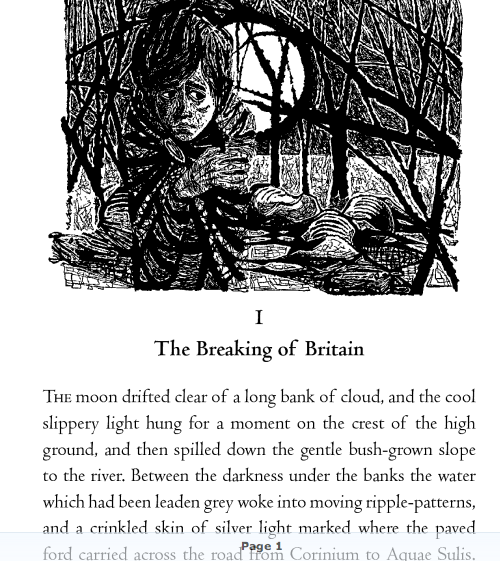
First published in 1961, this reprint keeps its original charm by reproducing the black and white illustrations by Charles Keeping. Dawn Wind represents historical fiction at its best. It was written by an author who delighted readers with her detailed and atmospheric stories. It is equally suitable for both young adult and adult readers. A thoroughly enjoyable book.

The novel starts:

The first paragraph of Rosemary Sutcliff’s Dawn Wind

Storytelling by Rosemary Sutcliff was ‘A dialogue of the imagination’ with ‘one of the minstrel kind’

Margaret Meek, who wrote a significant monograph about Rosemary Sutcliff in the 1960s  early in RS’s career, wrote about her again in 1990 on the publication of The Shining Company:

The sharing of storytelling that writers do with readers is the dialogue of imagination. Rosemary Sutcliff lives, grows and acts and suffers in her stories. The worlds created in her imagination have had to stand in for the world of much everyday actuality. From her therefore we can learn what the imagination does, and how it allows us all to explore what’s possible, the realm of virtual experience. In Rosemary Sutcliff‘s world, heroes, heroines and readers alike walk a head taller than usual, as heroic warriors, to confront, like Drem in Warrior Scarlet, fearsome events as rites of passage and thus discover what is worth striving for.

Readers have to expect to be spellbound in the tradition of storytelling that’s much older than reading and writing, when before the days of written records bards and minstrels were entrusted with the memory of a tribe. Rosemary Sutcliff is in this tradition; she says of herself that she’s `of the minstrel kind’. This in itself sets her apart from some of the more, apparently, throwaway casualness of some contemporary writing. In these days, when we’ve learned to look closely at the constructedness of narratives, she will still say that she knows when a story is `in’ her and `waiting to be told’.

Books for Keeps logo

Source: Issue 64 of Books for Keeps

Rosemary Sutcliff, a favourite author of Paul Maharg | “Often set in transitionary and tragic historical moments”

Paul Maharg is a law professor who writes an interesting eponymous blog. Reflecting upon a Mass Online Open Course about the hero in Greek Literature, he turned to musing about his time at boarding school, and its consequences for him, his preoccupations and his reading. First, Robert Graves’ The Siege and Fall of Troy…then:

What were we escaping?  A place where it had been determined for you that the conditions of school and home were forced together, and you wanted them desperately to be separate.  The situation of neither one condition nor the other fascinated a child who was drawn to the edge of things.  Other books read at that age revealed the same preoccupation.  The historical worlds of Rosemary Sutcliff, a favourite author, often set in transitionary and tragic historical moments, where home undergoes radical change; and the fantasy half-worlds of Alan Garner, were full of such liminal narratives.

… Much later I noted that as an adult I was drawn to narratives that dwelt on time’s passage or used time as a narrative device  …

I began to realise more clearly how for me in my childhood time and liminality had been linked; how generally our attitude to future time and time past affects what we enact in the present and how we represent it and explain it to ourselves.  In one sense, Achilles’ life-choice, so heroically stark and clear, is brutally selfish because it doesn’t involve thinking about relations with others or past or future generations.  All the tiny implicated choices and decisions we make every day of our lives are abolished – it’s a decision rendered heroic, iliadic, because stripped of quotidian time.

Thinking about the MOOC, maybe the real heroic struggle that’s at the core of what we were learning doesn’t involve physical prowess, victory or even logos, though that was there: the real test is how we negotiate failure, loss, time and death.

Source: Heroism, liminality, time — Paul Maharg.

Rosemary Sutcliff in German and Germany | With Verlag Urachhaus

From Rosemary Sutcliff’s  German publisher, Verlag Urachhaus, a brief biography:

Rosemary Sutcliff wurde am 14. Dezember 1920 in England geboren und starb am 23. Juli 1992.

Sie besuchte eine Kunstschule und arbeitete zunächst als Malerin, bis sie Mitte der vierziger Jahre zum Schreiben fand.

Trotz ihrer starken Behinderung durch die Still’sche Krankheit, an der sie seit ihrem zweiten Lebensjahr litt, pflegte sie von jedem ihrer Romane wenigstens drei handgeschriebene Entwürfe anzufertigen, ehe sie mit ihrer Arbeit zufrieden war.

Intensiv an Geschichte, besonders derjenigen Großbritanniens, interessiert und im Erzählen hoch begabt, hat sich Rosemary Sutcliff mit ihren Kinder- und Jugendbüchern zu historischen Themen weit über England hinaus einen Namen gemacht.

Ihre Bücher sind in vielen Sprachen erschienen und mehrfach ausgezeichnet worden. 1975 erhielt sie als geniale und kompromisslose Chronistin den Orden des British Empire für ihre herausragenden Verdienste um die Jugendliteratur.

Als die englische Originalausgabe vom Lied für eine dunkle Königin (Song for a Dark Queen) 1978 erschien, wurde sie mit dem feministischen Literaturpreis The Other Award ausgezeichnet.

Für Morgenwind (Dawn Wind) erhielt Rosemary Sutcliff den begehrten New York Herald Tribune Preis.

Im März 2000 stellte Jean-Claude Lin Rosemary Sutcliff in dem Lebensmagazin a tempo vor und im Februar 2009 schrieb Ute Hallaschka in  der Rubrik weiterkommen über Ein Leseleben mit Rosemary Sutcliff.

Source here: Verlag Urachhaus website