
Publishers Farrar, Straus and Giroux produced a teachers’ and readers’ guide about the books of Rosemary Sutcliff (that they pubished!). It is undated, covering ” the award-winning trilogy set in Roman Britain as well as Outcast, The Shining Company, Sword Song, Tristan and Iseult, and Warrior Scarlet”. The historical novels of Rosemary Sutcliff, it says:Read More »
Category: Novels, Stories & Books
Rosemary Sutcliff was an internationally renowned writer of historical novels, for children, young adults and adults. She also wrote stories for children. This category compiles the posts on this blog by title.
Rosemary Sutcliff was ‘Of the Minstrel Kind’, and a writer with a distinctive view of her readers

Rosemary Sutcliff was the subject of a fascinating, insightful article (‘Of The Minstrel Kind’) in the children’s literature magazine Books for Keeps. First published only in print form, it has for some time been reproduced online.
Margaret Meak was paying tribute to a seventy-year-old Rosemary.
I met Rosemary Sutcliff for the first time thirty years ago in a London hospital where she was recovering from an operation. Read More »
Historical novelist Elizabeth Goudge introduces Rosemary Sutcliff’s historical novel The Rider of the White Horse
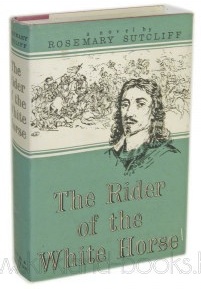
There can be nothing nicer than being asked to write an introduction to a favourite book, but at the same time it is a difficult task. It is like being asked to describe the charm of a face you love. If you did not love the face so much, and even more the person behind the face, it would be easy. But as things are, what can you possibly say? I can only say, baldly and inadequately, that I love this book. It may not be such a great book as Sword at Sunset but it has qualities of poignancy and gentleness that make it unforgettable.
A Rosemary Sutcliff historical novel which was written for adults was The Rider of the White Horse, set in the English Civil War, about Sir Thomas Fairfax and his wife. This is the first paragraph of the introduction by the renowned historical novelist Elizabeth Goudge. Read More »
The Economist reviewed Rosemary Sutclifff’s Black Ships Before Troy | Re-telling of Homer’s Iliad
One of the 20th century’s great writers of historical fiction for children died in 1992 from a disabling disease that had confined her to a wheelchair for much of her working life. (Blog editor’s note: actually, she did not die from Still’s disease!). Yet Rosemary Sutcliff produced many outstanding works of fiction over a 40-year-period — most notably her cycle of novels which dealt with the Roman occupation of Britain. The last two books that she completed were children’s versions of Homer.
The first of these, Black Ships Before Troy, her version of the Iliad, is now out. Like all her books, it is an intellectually-taxing read — but it also manages to sort out some of the complicated strands of Homer’s often digressive narrative. This helps children to see the characters of the great protagonists all the more clearly.
The illustrations by Alan Lee do the book a great service. At their best, they have the confident sweep and pomp of Victorian narrative painting.

- Source: The Economist, December 4, 1993
Source of the name Esca in The Eagle of the Ninth
This is news to me, although it is probably originally in her memoir Blue Remembered Hills: the name Esca for the slave in Rosemary Sutcliff’s The Eagle of the Ninth comes from Victorian novelist Whyte-Melville’s The Gladiators. Rosemary’s mother used to read her this aloud.

- Source: Talcroft, B. L. (1995). Death of the corn king: King and goddess in Rosemary Sutcliff’s historical fiction for young adults. Metuchen, N.J: Scarecrow Press.
 ROSEMARY SUTCLIFF (1920-92)