Eminent historical novelist Rosemary Sutcliff made big change to Tristan and Iseult story in 1971

Inside cover of retelling of Tristan and Iseult by Rosemary Sutcliff

Rosemary Sutcliff wrote in the foreword to her “starkly simple” retelling of the story of Tristan and Iseult (OUP, 1971) about “one big change” she made in the story:

… In its far-back beginnings, Tristan is a Celtic legend, a tale woven by harpers around the peat fire in the timber halls of Irish or Welsh or Cornish chieftains, long before the time of chivalrous knights and fair ladies and turreted castles in which it is generally set.

The medieval troubadours took it and enriched it, and dressed it in beautiful medieval clothes, but if you look, you can still see the Celtic story, fiercer and darker, ad (despite the changes) more real, underneath. In this retelling I have tried to get back to the Celtic original as much as possible, and in doing this I have made one big change in the story.

In all the versions that we know, Tristan and Iseult fall in  love because they accidentally drink together a love potion which was meant for Iseult and her husband King Marc on their wedding night. Now the story of Tristan and Iseult is basically the same as two other great Celtic love stories, Diarmid and Grania, and Deidre and the sons of Usna, and in neither of them is there any suggestion of a love potion. I am sure in my own mind that the medieval storytellers added it to make the excuse for being in love with each other when Iseult was married to somebody else. And for me, this turns something that was real and living and part of themselves into something artificial, the result of drinking a sort of magic drug.

So I have left out the love potion.

Because everybody else who has retold the tale in the past eight hundred years has kept it in, it is only fair to tell you this. I can only tell the story  in the way which feels right to me in my own heart of hearts.

1959 Carnegie Medal awarded to Rosemary Sutcliff for historical novel The Lantern Bearers

The Carnegie Medal for 2013  is awarded today. The Medal is awarded every year in the UK to the writer of an outstanding book for children. (2013 shortlist here).

The eminent Rosemary Sutcliff  (1920-92) won the (former) Library Association Carnegie Medal in 1959 for her historical novel for children The Lantern Bearers (she wrote for children”aged 8 to 88″, she said).  She was runner-up with Tristan and Iseult in 1972. Read More »

Wonderful historical novel Dawn Wind by Rosemary Sutcliff | Reprinted by OUP | At Sainsburys!

Good to find Rosemary Sutcliff’s historical novel Dawn Wind, recently reprinted by OUP, on sale with Sainsburys!

Cover of Rosemary Sutcliff's Dawnwind


Rosemary Sutcliff, historical novelist


Dawn Wind (1961) (from Tab at top of this blog – Stories)

The last Roman-British wearer of the dolphin ring, Owain is the only survivor of a Viking raid and the great battle of Aquae Sulis. Just fourteen years old, his father and brother die at the battle but he eventually makes his way to a peaceful Saxon settlement where he is made thrall to a Saxon family. Travelling there he meets a half-wild girl whom he cares for but is forced to leave behind when she falls ill. They meet up again after many years apart, still so in tune with each other that they are able to understand each other’s wordless messages. During his years of service he discovers understanding and even friendship, and loyalty for the people who were once his enemies. His freedom earned, he shoulders the weight of the Saxon household rather than betray a promise to his former master.


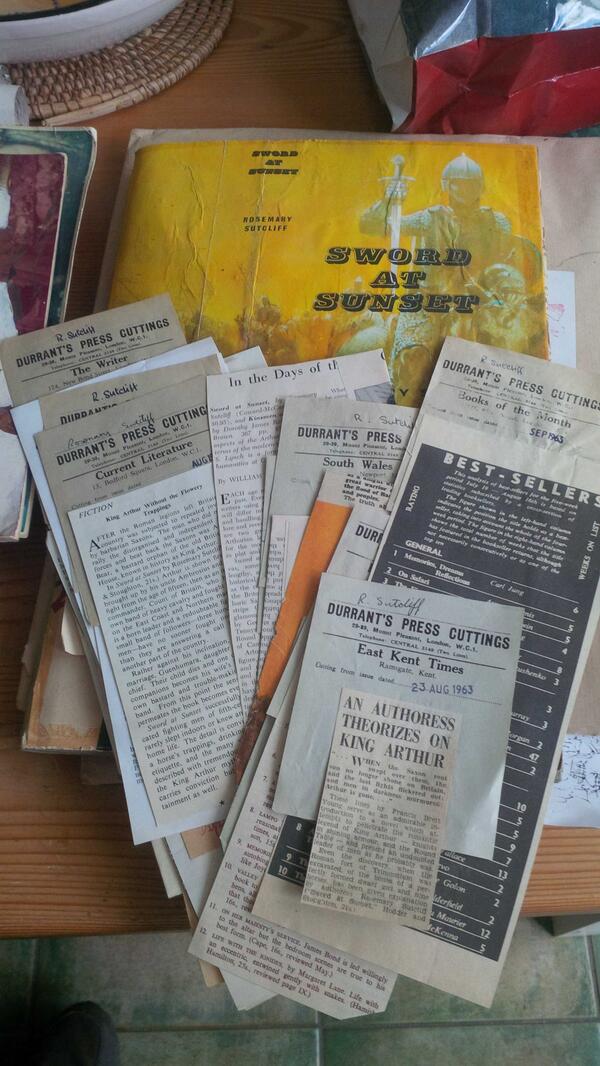
Rosemary Sutcliff’s press cuttings collection for 1963 best seller Sword at Sunset

Recent Twitter post @FurnissLawton (my daughter, a literary agent) commented  “How authors used to collect press cuttings @rsutcliff‘s ‘Sword at Sunset’ 1963″ with a picture pic.twitter.com/ZzpHjur2ay

Image

Historical and children’s novelist Rosemary Sutcliff’s Brother Dusty Feet excerpt chosen in collection of adventure stories for ten year olds

Good morning, and Happy Father’s Day , at least in the UK…

I have been sorting my shelves of books connected with historical novelist and children’s writer Rosemary Sutcliff –  from her research library, the collection of titles and books which I inherited from her, and those I have acquired since her death in my role as her literary executor. (It it must be done, for we are moving house.)

Adventure Stories for Ten Year Olds, chosen by Helen PaibaAdventure Stories for Ten Year Olds ( Macmillan Children’s Books, 2001) was ‘compiled’ by Helen Paiba, and illustrated by Douglas Carrel. According to the blurb, Helen Paiba was “known as one of the most committed, knowledgeable, and acclaimed children’s booksellers in Britain.” For “more than twenty years she owned and ran the Children’s Bookshop in Muswell Hill, London, which under her guidance gained a superb reputation for its range of children’s books and for the advice available for its customers.” In 1995 she was awarded the Eleanor Farjeon Award, given for distinguished service to the world of children’s books.The story from Rosemary is an extract from Brother Dusty Feet (Oxford University Press, 1952, pp  23-33). It begins Read More »