“The Men went to Catraeth” becomes more and more complex by the day now … (Rosemary Sutcliff Diary, 29/8/88)

June 29th Wednesday. Very hot and sultry after the chilly past few days. Geraldine for tea. Long phone call from Dai Evans with the information I asked him to get me about Catreath, the photostats to be posted off to me tomorrow. “The Men went to Catraeth” becomes more and more complex by the day now.

‘Catraeth’ has featured several times in diary entries. “The Men went to Catraeth” is perhaps the provisional title for the chapter Rosemary Sutcliff was writing at this point. In the final version of her award-winning historical novel The Shining Company,which was published in 1990, there is a chapter – this chapter? – called “The Road to Catraeth”.  Set in A.D. 600, the novel was based on Y Gododdin, one of the earliest surviving examples of Welsh poetry. It was transcribed in the twelfth century but commemorated an event in the sixth: “an elegy for slain heroes and a eulogy of their excellence and bravery as fighting men” (in the words of one commentator, here). The poem begins with a fragment of poetry which speaks of Catraeth as the site of a great battle.

Gwyr a aeth Gatraeth gan wawr …
Men went to Catraeth with the dawn,

Their fears disturbed their peace,
A hundred thousand fought three hundred
Bloodily they stained spears,
His was the bravest station in battle,
Before the retinue of Mynyddog Mzvynfawr.

The story Rosemary Sutcliff tells in The Shining Company is this.

In northern Britain, Prosper becomes a shield bearer with the Companions, an army made up of three hundred younger sons of minor kings and trained to act as one fighting brotherhood against the invading Saxons. Life is secure until Prince Gorthyn arrives with his hunting party to kill the white hart. Prosper tries to save the unusual beast and, when found out, is surprised to learn that Prince Gorthyn admires his daring. Prosper asks to serve the prince, but it is not until two years later that he receives a summons: King Mynyddog is raising a war host of three hundred younger sons to fight the invading Saxons, and Gorthyn needs a second shieldbearer. Answering the call, Prosper sets out immediately to meet the prince and travel to King Mynyddog’s fortress at Dyn Eidin. For a year the three hundred men – the Companions – and their shieldbearers train until they can think and act as one fighting brotherhood. And when word reaches them that the Saxon leader has taken yet another kingdom, they set out to attack the Saxon stronghold at Catraeth. It is here that Prosper must face his greatest challenge, as treachery strikes the Companions from an unexpected source.
Rosemary Sutcliff’s ancient Olympics | 1972 not 2012

It was early in the day but already it was growing hot; the white dry heat of the Greek summer; and the faint off-shore wind that made it bearable had begun to feather the water, breaking and blurring the reflections of the galleys lying at anchor in Piraeus harbour.

Half Athens, it seemed, had crowded down the to the port to watch the Paralos, the State Galley, sail for the Isthmus, taking their finest athletes on the first stage of their journey to the Olympics.

Every fourth summer it happened; every fourth summer for three hundred years. Nothing was allowed to stand in the way, earthquake or pestilence or even war – even the long and weary war which, after a while of uneasy peace, had broken out again last year between Athens and Sparta

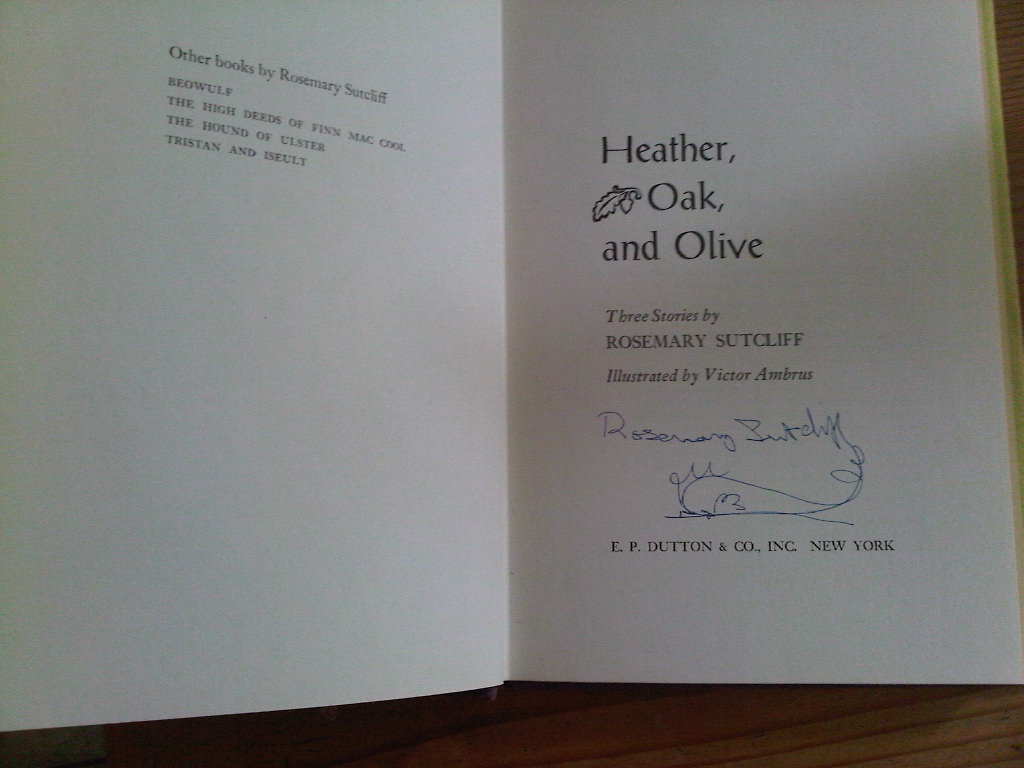
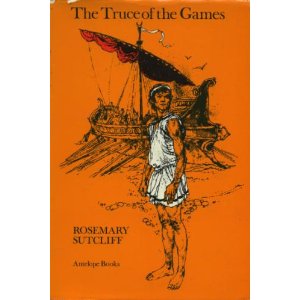
Writer for children and (young) adults, Rosemary Sutcliff,  published in 1971 The Truce of the Games which was her short story for children about the Olympics. Two athletes from different ways of life and backgrounds discover the meaning of friendship as they compete against each other in the ancient Olympic games. With a changed title –  A Crown of Wild Olive  – this story was collected with two others – The Chief”s Daughter, and A Circlet of Oak Leaves –  into Heather, Oak, and Olive  (1972).

Reviewing the three stories, reader Joy on GoodReads said:

For fans of historical fiction, Rosemary Sutcliff ranks among the divine. Her prose is easy and fluid, and these three short stories, hard to find, are beautifully written and worth tracking down. This is the second book of Sutcliff‘s that I read, after I fell head over heels for her remarkable re-telling of Tristan and Iseult. A great book for those interested in ancient Britain, the Roman occupation of those islands, or anyone who delights in a well-told story set in the past.

Cover of The Truce of the Games by Rosemary Sutcliff (Antelope Books)Cover of Heather, Oak and Olive (1972) by Rosemary Sutcliff

The frontispiece of Rosemary Sutcliff’s personal copy of her own book has her distinctive dolphin signature.

Author Rosemary Sutcliff's personal copy of the Heather, Oak and Olive.

The Girl I Kissed at Clusium | Roman legion marching Song by Rosemary Sutcliff | Quoted by Falco novelist Lindsey Davis

Lindsey Davis writes detective novels set in classical Rome, featuring the world of maverick private eye and poet Falco. On the publication in 2009 of the nineteenth of what became a bestselling series of novels known for their meticulous historical detail, she chose Rosemary Sutcliff’s The Eagle of the Ninth as one of her top ten Roman books. (See here for previous post).

Regular commenter here  and Rosemary Sutcliff enthusiast Anne has reminded me (via the You Write tab above) of this, and alerted me to some intriguing homage, newly paid. For Anne was ‘tickled’ when reading Lindsey Davis’s  latest novel, Master and God, to find a nod to Rosemary Sutcliff when a soldier mentions a legionary marching song. It appears again in the acknowledgements at the back: “The Girl I Kissed at Clusium”’: The Legionary Song in The Eagle of the Ninth by Rosemary Sutcliff.

In Rosemary Sutcliff’s novel the snatches of song are:

Oh when I joined the Eagles
(As it might be yesterday)
I kissed a girl at Clusium
Before I marched away
A long march, a long march
And twenty years in store
When I left my girl at Clusium
Beside the threshing-floor

The girls of Spain were honey-sweet,
And the golden girls of Gaul:
And the Thracian maids were soft as birds
To hold the heart in thrall.
But the girl I kissed at Clusium
Kissed and left at Clusium,
The girl I kissed at Clusium
I remember best of all

(Thank you Anne)

Odysseia (2012) | Rosemary Sutcliff in Turkey

Published this year  in Turkey, a version of The Wanderings of Odysseus by Rosemary Sutcliff!

Odysseia | The Wanderings of Odysseus, by Rosemary Sutcliff, in Turkish

A Little Dog Like You by Rosemary Sutcliff | “After Pippin, a beloved chihuahua, dies … “

A Little Dog Like You by Rosemary SutcliffToday’s diary entry about her dog Barny put me in mind of the little book Rosemary Sutcliff published a years earlier, in 1987, A Little Dog Like You. Kirkus reviews wrote at the time of publication in the USA in 1990:

After Pippin, a beloved Chihuahua, dies, he begs St. Francis to let him go back to his beloved mistress, Mammie–who, hoping that her faithful friend will return, manages to puzzle out the time and place of their joyful reunion. Though the plot sounds trite, Sutcliff’s skillful pen turns the story to gold–an unsentimental portrait of an affectionate bond that will be familiar to any dog lover, while the difficulty posed by the painful discrepancy between the life spans of dog and human is resolved with a reincarnation that is both metaphorical and realistic: the new dog is not precisely Pippin–he has new markings and is given a new name–but he does represent a continuation of love. The format is as engagingly diminutive, as Pippin himself; Johnson’s precise, gentle  illustrations add just the right touch. A well-wrought charmer.