
The Eagle of the Ninth lives in its atmosphere. Sutcliff powerfully catches both everyday Roman life and the beauty of ancient Britain. Her use of detail is effective, and her descriptive prose is powerful and suggestive. Reading the book, I was caught again and again by glinting moments of terrible beauty; by her ability to conjure up vistas of ruined fortresses and mist-covered landscapes. At different times, and for different reasons, I found myself thinking of first Tolkien, and then, oddly, Robert E. Howard.
Source: Black Gate | Blog Archive | Some Notes on The Eagle of the Ninth.
Category: Novels, Stories & Books
Rosemary Sutcliff was an internationally renowned writer of historical novels, for children, young adults and adults. She also wrote stories for children. This category compiles the posts on this blog by title.
Dogs in the historical novels of Rosemary Sutcliff
 Thinking of both historical fiction and dogs put Katherine Langrish, author of fantasy novels for young adults, in mind of Rosemary Sutcliff. Katherine believes that dogs in books are a “Good Thing”. She also believes that Rosemary Sutcliff “must easily win the title of Britain’s most loved writer of junior historical fiction”.
… Rosemary Sutcliff, whose books I devoured as a child … loved dogs, and there is a noble dog in many of her books: Whitethroat in Warrior Scarlet, Argos in Brother Dusty Feet. But for me the most iconic is Dog in Dawn Wind, the young war-hound that the boy Owain finds by moonlight on the ruins of the battlefield:
…it was something alive in the cold echoing emptiness of a dead world. It stood with one paw raised, looking at him, and Owain called, hoarsely, with stiff lips and aching throat: ‘Dog! Hai! Dog!’ … [It] came, slowly and uncertainly… once it stopped altogether; then it finished at the run and next instant was trembling against his legs. He was a young dog; the beautiful creamy hair of his breast-patch was stained and draggled, and his muzzle bloody in the moonlight… ‘Dog, aiee, dog, we are alone then. There’s no one else. We will go together, you and I.’
The brilliance of the writing is to show us, in the lonely and innocent terror of the dog and what he has been made to do, the full dreadfulness of war.
Source: Seven Miles of Steel Thistles
This is used with Katherine’s permission (thank you!). She wonders also in an email to me if “perhaps Rosemary wrote about dogs as a way of owning them …”. Actually, Rosemary always owned dogs.
(Original post in March, 2010 First Revision 14 Feb 2012. List below added 10 March 2014))
- Brother Dusty-Feet: Hugh runs away from home to protect Argos.
- The Eagle of the Ninth: Cub is Esca’s tame wolf cub.
- The Silver Branch: Curoi’s hound is called Cullen.
- Outcast: Canog is a mistreated mongrel owned by Beric, whose childhood dog was Gelert.
- The Lantern Bearers: Artos’s dog Cabal.
- Warrior Scarlet: Whitethroat; Fand the Beautiful.
- The Bridge-Builders: Math, a Hibernian wolfhound.
- Knight’s Fee: Joyeuse.
- Dawn Wind: Dog, a survivor of Owain’s Last Stand.
- Blood Feud: Brindle is a cattle dog.
- Bonnie Dundee: Caspa.
- The Shining Company: Gelert.
- Sword Song: Bjarni murders a man for kicking Astrid, and Hugin follows him home from Dublin.
The Eagle of the Ninth | Rosemary Sutcliff | Library of Libation review
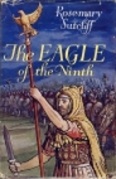
David Urbach (a ‘liker’ over at Rosemary Sutcliff’s Facebook page – do join him and click the like button there!) alerted me to a 10/10 review by someone he considers “perceptive”, of Rosemary Sutcliff‘s classic of historical fiction and children’s literature, The Eagle of the Ninth. It makes interesting reading, and I am intrigued to learn of the reaction of others who know Rosemary’s work well. Read More »
Schoolgirls argue for Cottia, who lived only in The Eagle of the Ninth
Thinking of readers, I remember, with gratitude and some pain, a class of girls in a London secondary school in the early seventies. The parents of most of them had come from the Caribbean; I guess their own children are now in school. Then they were the first of their kind to speak out their awareness of the complications we now call `multi-cultural’. They were reading with their gifted teacher, Joan Goody, The Eagle of the Ninth (by Rosemary Sutcliff). On this particular day they ignored the dashing young Roman hero, recovering from a battle wound in his uncle’s house in Bath, and concentrated on the girl next door, Cottia, a Briton. Cottia’s uncle and aunt were taking her to the games, and in their hankering after Roman ways had tried to insist that she wear Roman clothes and speak Latin. Cottia protested, and so did the readers, on her behalf. I’ve never heard a more spirited discussion than that one, when those girls spoke indirectly of their nearest concerns in arguing on behalf of Cottia, who existed only in a book.
Hunting for Rosemary Sutcliff stories and plays
Rosemary Sutcliff’s work was documented and examined by Sandra Garside-Neville for the Historical Novels’ Society. She refers to several stories and plays which I have not documented here, I realise. I do not have copies. Can anyone supply them?
1964 The Fugitives (in Miscellany One, edited by Edward Blishen)
1966 The New Laird (radio play script)
1967 The Man Who Died at Sea (in The House of the Nightmare and other Eerie Stories, edited by Kathleen Lines)
1970 The Making of an Outlaw (in Thrilling Stories from the Past for Boys edited by Eric Duthie)
1970 Swallows in the Spring (in Galaxy edited by Gabrielle Maunder)
1986 Mary Bedell (play)
1992 The Eagle of the Ninth: Play (with Mary Rensten)
 ROSEMARY SUTCLIFF (1920-92)