Here at SF our first instinct was to quietly ignore the overblown sentimentality of Saint Valentine’s Day but a handful of romantic souls have suggested we mark the occasion in some way, and give a nod to love in this month’s newsletter. Thus we present Rosemary Sutcliff’s heart-breaking account of falling in – and out – of first love from her memoir Blue Remembered Hills.
… As a child Rosemary suffered from the juvenile arthritis known as Still’s Disease, which burned its way through her, leaving her permanently disabled, yet Blue Remembered Hills is the very opposite of a misery memoir. It is a record of the growing up and making of a writer, and it is full of humour, affection, joy in people and the natural world, and the kind of deep understanding that can come out of hard experiences. In some ways, hers was an enchanted childhood, lived among the vivid sights and sounds of the dockyards, which would later feed into her books.
… After the war was over, in the summer before the great freeze of 1947, along came Rupert, the son of a recently arrived neighbour, invalided out of the RAF, glamorous with darkly flaming red hair and ‘blazingly-golden hazel eyes’, who spoke to her as an equal – ‘the first person to whom it ever occurred that I could be asked out without my parents’. They grew closer and closer, but then Rupert clearly took fright, and eventually had to tell her that he had fallen in love with someone else, breaking her heart.
Fortunately for us, however, Rosemary had just begun to discover writing and before long her first book for children, The Queen Elizabeth Story – ‘written out of heartache, but also out of something set free within myself ’ by that searing experience was accepted by the Oxford University Press.
Blue Remembered Hills
Once he took me to the pictures. It was Roger Livesey and Wendy Hiller in I Know Where I’m Going. But mostly we just wandered round the country. We saw a kingfisher blue-flashing upriver on the tawny reed-rustling fringe of Fremington Marshes, read Hassan to each other at the top of Dark Ham woods. On the afternoon beyond all afternoons – it must have been fairly early summer, because the elder blossom was heavy and rank-sweet scented over the whole countryside – we came upon the mouth of a tiny lane turned almost into a tunnel by the hazel bushes arching over it. We were almost past before we saw it, and Rupert said, ‘Ha! The Golden Road to Samarkand!’ and swung the nose of the car round into it at the last instant. Mercifully there was nothing on our tail at the time. And we went on and on, the grassgrown lane leading us, and we following, dazzled by the dapple of sun through the nut leaves overhead, and came out at the gate of a little secret meadow sloping down to the Torridge. Elder-flowers drooped over the gateway; the riverbank was afroth with pink and white balsams; and Rupert found a tiny emerald frog in the grass, and caught it to show me, just for a moment, sitting on his thumb, then let it go again. We had thermos-flask tea, and talked, holding hands, and shared the water-sounds and the elder-scent of the little secret meadow; and nothing else happened, all the long sunshiny, shadow-dappled afternoon. But if it was given me to live over again one afternoon of my life, that would be the one that I should choose.
The odd thing is that neither of us thought of what was happening to us as Falling in Love. We thought that it was something different and special. Everybody in love thinks that their love is special, an experience which nobody else has had before. But we did not think of it as being in love at all, only as being two halves of the same thing. From the first we had a strong sense of relationship, though in the early days it might as well have been a sibling relationship as any other. In those days we both believed in reincarnation, as I rather think I still do, so we tried to rationalise the thing as a link formed in other lives. Perhaps we had been brothers, sisters, lovers, comrades in arms. ‘There is only one love,’ Rupert said, trying to work it out as he went along. ‘All the different kinds of love are just facets of it’…
… Rupert was getting married. Rupert sent me a book. It was only Joan Grant’s latest novel; he and I were both keen readers of her books at that time. That was the final straw. My father, still with a bleak unhappy face, said nothing. My mother did all the talking. Of course I must send the book back, I must, must, must break with Rupert completely. No use protesting, as I did protest, that Rupert and I were friends and one did not break with one’s friends because they got married. She understood too much of the truth to be bought off by that. In the end she cried and told me that she could not desert me, and so, because of her efforts to take my part, I was tearing a gulf between her and my father.
I sent back the book. I wrote to Rupert explaining the whole sorry situation. In a vacuum we might have managed some kind of threefold relationship. In a world full of other people, it could not be done. At least by me.
Then I had a reconciliation with my father. I sat on his knee like a little girl again, his arms round me; even wept a few difficult tears on his Harris tweed shoulder. It was so lovely not to have that silent barrier of ice between us any more. Such a relief to lay down my weapons, not that I had ever had many weapons – only my little wooden sword – and stop fighting. For the moment it almost outweighed all the rest.
Rupert wrote me a last parting letter, accepting my decision – only it was not a decision, just a capitulation to circumstances too strong for me – but insisting, ‘This isn’t the end, even this time round, it isn’t the end, for you and me.’ He was right, too, though except for one very glancing encounter, it was more than twenty years before I saw him again. ‘But that,’ as Kipling would have said, ‘is another story.’ …
… Because of what had happened between Rupert and me, I was a fuller and richer person than I would otherwise have been. I knew that if a pantomime fairy in a gauze ballet skirt had appeared, and offered, with one wave of her tinsel wand, to wipe out the last two years, and with them the grey ache of loss that they had left behind, I would not for one moment have considered accepting her offer. Because of those two years, something in me which, without them, would probably have remained green and unawakened, had had a chance to flower and fruit and ripen. Because of those two years I was going, in some odd way, to be able to write as I would not otherwise have been able to do.
© Rosemary Sutcliff 1983, 2008, 2012

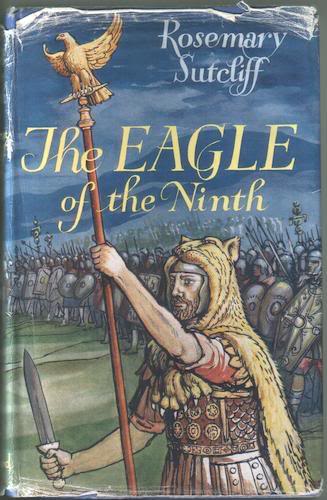


 ROSEMARY SUTCLIFF (1920-92)