

Category: Novels, Stories & Books
Rosemary Sutcliff was an internationally renowned writer of historical novels, for children, young adults and adults. She also wrote stories for children. This category compiles the posts on this blog by title.
The Eagle of the Ninth | Rosemary Sutcliff Review of the Week
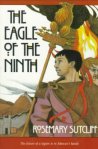 Rosemary Sutcliff’s historical novel The Eagle of the Ninth (now also a film movie) is a ‘masterpiece’, thinks Carmen Ferreiro Esteban. Born in Galicia in Spain and now living in the USA, Carmen wrote the young adult novel Two Moon Princess. She wrote on her blog:Read More »
Not quite what Rosemary Sutcliff had in mind for education?
Found by Google alert this morning, this despairing question related to a Rosemary Sutcliff Arthurian novel which itself made me despair about modern education. “I’m researching for my critical literary reasearch paper over (sic) The Light Beyond the Forest by Rosemary Sutcliff. I’ve used search engines such as Google and I can’t seem to find anything useful. The reviews I do find require payment to view the whole article. I’m sure there is information out there or I wouldn’t have been assigned this book. (My italics). I just need some help finding it.”
This is what education-as-schooling has reduced students to – Read More »
Fantasy writer Victoria Strauss writes about Rosemary Sutcliff historical novel for children and young adults, The Lantern Bearers The Lantern Bearers
 Rosemary Sutcliff ‘s The Lantern Bearers won the Carnegie Medal for children’s literature. It is a historical novel for children and young people. One American reviewer, Victoria Strauss, a writer of fantasy fiction, thought Sutcliff’s The Lantern Bearers a ‘wonderful book’, having discovered Rosemary ‘s books in her early teens.
I discovered Rosemary Sutcliff in my early teens, and she quickly became one of my favorite authors. I can still vividly recapture the magic of reading her books. It was a real pleasure to return to The Lantern Bearers, which I first read when I was about thirteen, and find the magic still intact.
Published in 1959 and reprinted several times since, The Lantern Bearers is set in the seventh century A.D., at the close of the Roman period in Britain. When the last Roman troops are recalled to Italy, Aquila, the young commander of a troop of cavalry, discovers that his love of his native Britain is stronger than his loyalty to a distant empire he has never seen. He deserts, and returns home. But the Saxon threat is looming, and soon after his return, Aquila’s home is overrun by Saxon raiders. His father is killed and his sister Flavia kidnapped, and he himself is captured and made a thrall in a Saxon household. Three years later, he and Flavia meet again in a Saxon camp, and Aquila discovers that she has married a Saxon and has had a child. Though she helps Aquila to escape, he cannot forgive her for what he sees as a profoundly dishonorable surrender to the enemy.
Bitter at Flavia’s betrayal and consumed with hatred for the Saxons, Aquila travels north to offer his service to Ambrosius, a Celtic prince who is the last inheritor of Roman authority in Britain. Over the fifteen years that follow, Aquila takes part in the long battle to throw the Saxon invaders back into the sea–years of suffering and sacrifice but also of love and friendship, in the course of which Aquila learns to relinquish his bitterness, and to better understand his sister’s choice. In the end, the decisive victory is won, and Ambrosius is crowned High King of Britain–a final defiant lifting of the light of Romano-Celtic civilization against the encroaching barbarian dark.
The Lantern Bearers is a wonderful book. Sutcliff possesses a unique gift for character and description, evoking a sense of place and person so intense that the reader can almost see her characters and the world in which they move. She has a matchless ability to establish historical context without a surfeit of the “let’s learn a history lesson now” exposition that mars many historical novels for young people. Her books are never less than meticulously researched, but her recreation of the past is so effortless that one has no sense of academic exercise, but rather of a world as close and immediate as everyday.
The Lantern Bearers isn’t truly a fantasy novel, but it does touch upon one of the great fantasy themes: Arthur, future High King of Britain, whom Aquila first encounters as a child in Ambrosius’s camp. The Arthurian theme was one of Sutcliff’s favorites: she produced several young adult books on the subject, as well as a beautiful adult novel, Sword at Sunset, to my mind one of the best ever written in this genre. But the Sutcliff’s Arthur is rooted as much in history as in myth–not just the tragic king of Le Morte d’Arthur or the heroic/magical figure of traditional Arthurian fantasy, but a man who might actually have existed, heir both to the memory of Rome and to the last great flowering of Celtic power in Britain.
In the course of her career, Sutcliff wrote nearly forty books (Poster’s note: Actually over 60.) Many of them are still in print, testifying to her enduring popularity. It is richly merited: she is, quite simply, one of the best.
Used with permission of Victoria Strauss
Knight’s Fee | Rosemary Sutcliff Story of the Week

Rosemary Sutcliff’s Knights Fee – a historical novel for children and young adults – is set against the violent and turbulent backdrop of Norman England. It tells the story of a young ill-treated dog-boy Randall who is wagered and won in a game of chess between a lord and
 ROSEMARY SUTCLIFF (1920-92)