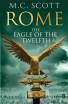
Manda Scott is the author of the
Boudica: Dreaming novels and the
Rome series. The third book in that series,
The Eagle of the Twelfth, was published recently. The History Girls (she is one such) are ‘a group of best-selling, award-winning writers of historical fiction’ with an intriguing
blog of the same name. Today they post an interview with Manda Scott, who was questioned first about a title which “inevitably recalls
Rosemary Sutcliff’s seminal
The Eagle of the Ninth”. “What”, she was asked,”would you say was so unique and inspiring about it – and do you think the current literary love affair with Rome is to some extent part of her legacy?” She replied:
The Roman era, particularly the early empire, is one of those historical time periods, rather like the Tudors, that seems to be perennial in its attraction and I’ve never worked out why. Other periods have strong characters, and surviving dynasties. Other periods had empires that attempted to conquer the world. Other periods have the dichotomy between order (the Empire) and wildness (the unconquered natives of the provinces) and the constant friction between them, but the first century is one of the most deeply and extensively mined periods in fictional history and I have to think that Rosemary Sutcliff has played an overwhelming role in that. Every time I stand on a stage at a book festival or a reading and say that I was inspired by her work, heads nod throughout the audience. When I say the same about Mary Renault or Dorothy Dunnett (the Alexander trilogy and ‘King Hereafter’ respectively) there’s a buzz, but not the same wave of memory and affection.
I’m not sure if it’s simply people of our age, who grew up with The Eagle of the Ninth as our introduction to historical fiction, or whether she genuinely spans the generations, but there’s no doubt that she’s had a huge impact.
Defining exactly why she’s had that impact, is harder than knowing that it exists. Partly, she was the only one: nobody else brought the legions to life as she did, nobody else asked the questions of our identity before the Roman occupation. (She never answered them, at least not for me: trying to find out what the Seal People were doing when the Romans weren’t looking has occupied a large part of my spiritual and writing life and the Boudica series is a direct result of that). She had the capacity to engage men and women, girls and boys across the genders, which was one part of her charm: nobody has ever suggested to me that she lost readers because they knew she was a woman: her writing was too strong for that. And she was an imperialist at heart, a girl brought up in the dying days of the Empire by a father who was a Naval Officer, her writing fuses that same effortless superiority and innate sexism that propelled Enid Blyton to such massive success: there’s a level at which it resonates with the part of us that wants security; now as much as then. Her world was ordered. Her Romans were benevolent, if strict. Her natives were noble savages, but they respected their Roman over-lords.
I don’t think that was how it was, but it’s a very safe kind of fiction (and just because I think it’s factually inaccurate doesn’t stop me from regarding her as a master of her art and the progenitor of everything I’ve done.)So either Sutcliff made Rome the attraction that it is, or it’s a hangover from our Imperial past, when the Victorians rediscovered Rome and used it as a fictitious model for their own dreams of empire: the entire ‘white man’s burden and the Pax Britannia’ are modelled on Augustus’ concepts of the Roman Empire – Either way, there’s nowhere near the same kind of interest in the US, for instance, or other European nations. Our love of Rome is uniquely British and, in the same way that it’s possible to divide all those around us into natural Roundheads or natural Cavaliers, so are we all natural Romans or natural Britons. It’s part of our native psyche.
Actually, although I agree with some of her analysis, I am not sure I concur entirely with this take on Rosemary Sutcliff. I would certainly have wished to hear Rosemary’s own response. For example: she would, I believe, have resisted being labelled and (pace, Marshall McLuhan) libelled “innately sexist” whilst being determinedly not a feminist. She would have rejected the assertion that what “propelled her to success” was what she had in common with Enid Blyton (whose work she was not a fan of!). She did not consider the “natives” of Britain “nobel savages”.


 ROSEMARY SUTCLIFF (1920-92)