 The prestigious Carnegie Medal was once won by Rosemary Sutcliff, as well as multiple award-winning Geraldine McCaughrean (who has written more than 160 books, from picture books to adult novels). Interviewed at Red House, the web-based, self-styled ‘home of (buying) children’s books’, she spoke of the influence on her of Rosemary Sutcliff’s historical fiction.
Did you have any favourite children’s authors when you were a child and have they influenced your writing at all?
I loved Elyne Mitchell’s Brumby books because I loved all things horsey. One day I shall write a horse book and then all those pony and horse books I read as a child will come into their own.
I also loved Rosemary Sutcliff’s historical fiction – The Eagle of the Ninth, Brother Dusty Feet … – They taught me how a book could take you time travelling to a different age. That must be why I have written so many books set in the past. Adventure is so much easier to come by there.
Source: Geraldine McCaughrean | My Red House.
Rosemary Sutcliff won the Carnegie Medal in 1959, not for either of the books mentioned by McCaughrean, but for The Lantern Bearers. She was runner-up in 1972 with Tristan and Iseult. The Medal is perhaps the UK’s most prestigious prize for writing for children, awarded every year in the UK to the writer of an outstanding book for children. The Library Association started to award the prize in 1936, in memory of the Scottish-born philanthropist Andrew Carnegie (1835-1919), a great supporter of reading and libraries. The medal is now awarded by the Chartered Institute of Library and Information Professionals.
Rosemary Sutcliff also won the Boston-Globe Horn Book Award for Tristan and Iseult in 1972; was highly commended by the Hans Christian Andersen Award in 1974; won The Other Award for Song for a Dark Queen in 1978; and won The Phoenix Children’s Book Award for The Mark of the Horse Lord in 1985, and The Shining Company in 2010

 Yesterday’s article by Imogen Russell Williams in The Guardian about monks in children’s fiction sent me back to my copy of Rosemary Sutcliff’s The Witch’s Brat, which features Imogen Russell’s favourite, Rahere. I was reminded that the historical novel is dedicated to “Margaret” – my mother, I believe, who trained and work at Barts, the modern Saint Bartholomew’s hospital. Rosemary Sutcliff’s foreword points out that you can visit the tomb of Rahere in the Church of Saint Batholomew the Great, in Smithfield, London.
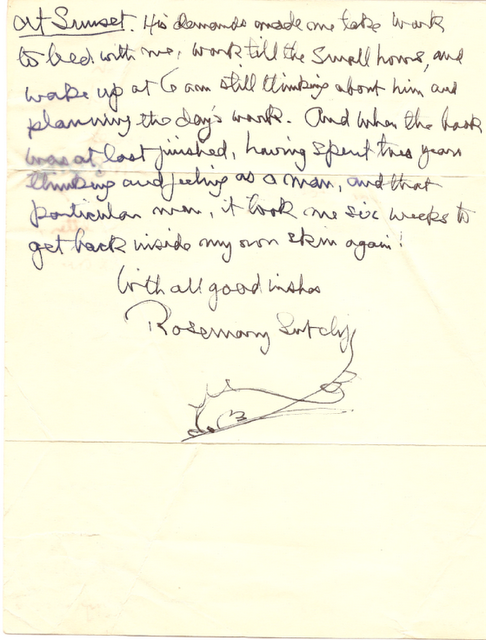
 ROSEMARY SUTCLIFF (1920-92)