Life will go on and is well worth the struggle | Faith from Rosemary Sutcliff

Responding to an earlier post quoting Margaret Meek on  in her eponymous monograph about historical novelist and doyen of children’s literature  Rosemary Sutcliff, reader and regular commenter Anne (much more knowledgeable than me about the details of Rosemary’s work. and commentary upon it) posted:

It seems appropriate to add this piece from another critical essay, this one by May Hill Arbuthnot and Zena Sutherland:

The theme of all (Sutcliff’s) stories, as Margaret Meek points out, is “the light and the dark. The light is what is valued, what is to be saved beyond one’s own lifetime. The dark is the threatening destruction that works against it.” In The Lantern Bearers… the blackness of despair is concentrated in the heart of Aquila, a Roman officer….

No briefing of these stories can give any conception of their scope and power, and when young people read them they live with nobility… Nevertheless, these are difficult books, not because of vocabulary problems, but because of the complexities of the plots in which many peoples are fighting for dominance.

Fortunately, Dawn Wind …, one of the finest of the books, is also the least complex. Chronologically it follows The Lantern Bearers, but it is complete in itself and will undoubtedly send some readers to the trilogy. For the fourteen-year-old hero Owain, the light of the world seems to have been extinguished. He finds himself the sole survivor of a bloody battle between the Saxons and the Britons in which his people, the Britons, were completely destroyed. In the gutted remains of the city from which he had come, the only life the boy finds is a pitiable waif of a girl, lost and half-starved. At first Owain and Regina are bound together in mutual misery, but eventually they are united in respect and affection. So when Regina is sick and dying, Owain carries her to a Saxon settlement, even though he knows what will happen to him. The Saxons care for the girl but sell Owain into slavery…. After eleven years, he is freed and sets out at once to find his people and Regina, who has never doubted he would come for her.

So life is not snuffed out by the night. A dawn wind blows and two people start all over again with those basic qualities that have always made for survival…. Rosemary Sutcliff gives children and youth historical fiction that builds courage and faith that life will go on and is well worth the struggle.

Source: May Hill Arbuthnot and Zena Sutherland, “Historical Fiction: ‘The Lantern Bearers’ and ‘Dawn Wind’,” in their “Children and Books”, pub. Scott, Foresman and Company, 1972, pp. 508-9
Rosemary Sutcliff on Wroxeter in Roman Times | Scholarship transmuted into artistry

In her monograph on historical novelist and children’s writer Rosemary Sutcliff, Margaret Meek, commented that “the standard of accredited detail is so high in historical novels, writers have their research material carefully scrutinized by critics”. But, she said, “it is one thing to be accurate about costume and cooking pots, and quite another to make an organic whole in which the accumulated research is assimilated by the reader because of its essential rightness in the situation. Here is Wroxeter when the Romans had left it and later the British warhost had finally been defeated.

‘Owain found himself at the Forum Gate, with its proud inscription to the Emperor Hadrian, and halted there, staring dazedly about him, while Dog stood watching him expectantly and wagging his tail. It was growing dusk, and he thought suddenly—it was a thought that made the sick laughter rise in his throat—that he could sleep in the Basilica tonight, he could sleep in the Palace of Kyndylan the Fair, if he chose, he was free of all Viroconium. But the little low-browed shops in the Forum colonnade seemed to offer a deeper and darker refuge to crawl into. One or two near the gate still had their roofs on them and he turned into the nearest of these. It looked to have been a basket-maker’s shop; everything that could be of use to marauders had been stripped from it, but a broken pigeon basket and a bunch of withies still lay in one corner. The light was going fast, and the back of the shop was already lost in the shadows of the rainy twilight.’

Meek wrote: “Weather and the ruined town all serve to increase Owain’s desolation. The scholarship is transmuted into artistry”.

(Source: “The Historical Novelist: The Light and the Dark.” In Rosemary Sutcliff, pp. 31-50. New York, N.Y.: Henry Z. Walck, Incorporated, 1962.)

Forest Fairies | For World Book Day

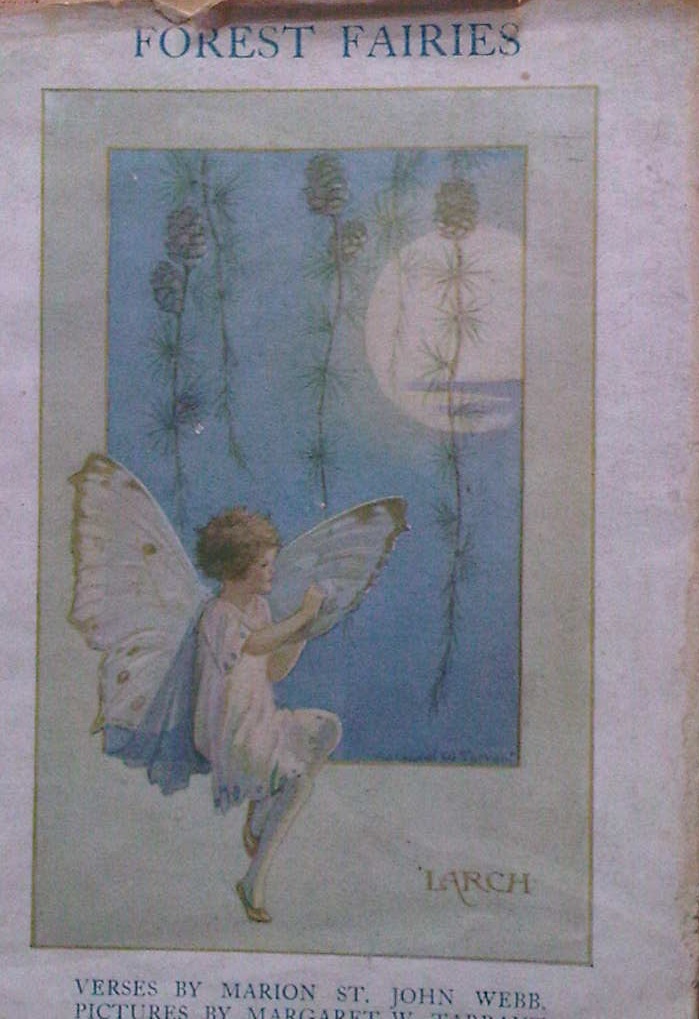
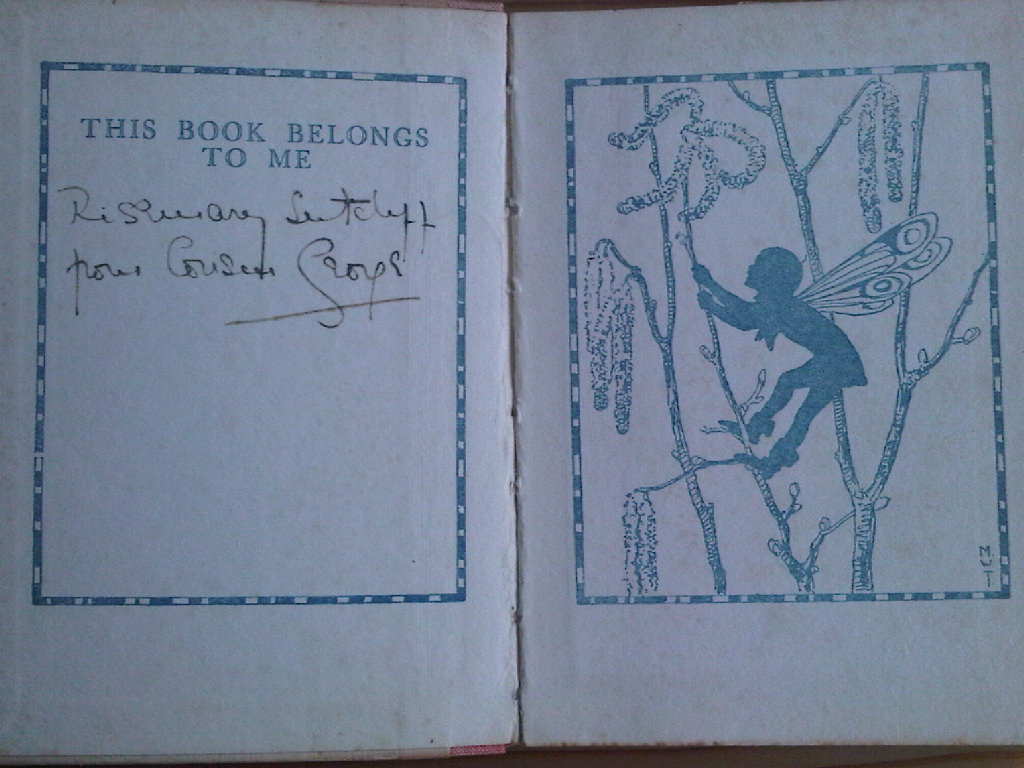
Some books form Rosemary Sutcliff‘s library as we head for World Book Day. First, today, Forest Fairies, verses by Marion St John Webb, pictures by Margaret W Tarrant. Published by the Modern Art Society.

Forest Fairies cover from Rosemary Sutcliff's library

Forest Fairies in Rosemary Sutcliff's library.

C Walter Hodges was Illustrator of early Rosemary Sutcliff historical novels

Frontispiece Rosemay Sutcliff's The Eagle of the NinthC. Walter Hodges who illustrated some of Rosemary Sutcliff‘s early novels, including The Queen Elizabeth Story (1950), The Eagle of the Ninth  (1954), and The Shield Ring (1956) died in 2004. I recently came across  his obituary in The Independent newspaper. Some sections spoke in particular of his illustration work.

One of the outstanding author-illustrators of his time, C. Walter Hodges was also a leading scholar of the Shakespearean theatre. Hard-working to the point of perfectionism, he had a gentle demeanour and unfailingly sweet temper that brought him universal popularity in addition to well-earned professional respect. Illustrating over a hundred books while also writing a number of them himself, he played an important part in the general renaissance of children’s literature since 1945. Read More »

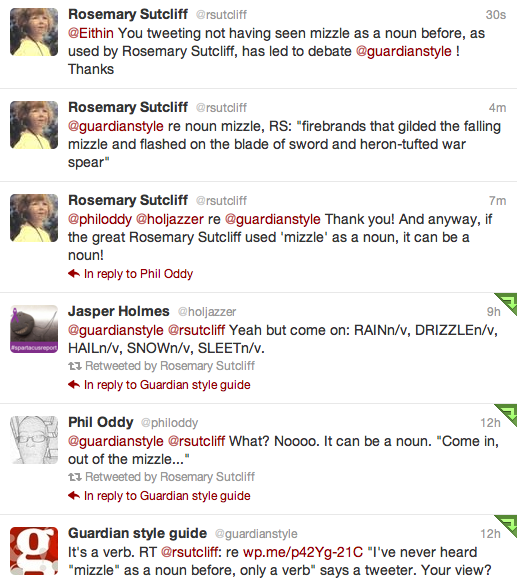
Can mizzle be a noun as well as a verb? | Twitter debate!

As highlighted by Charlotte Higgins in the Guardian last year, Rosemary Sutcliff once wrote  in her great historical novel and classic of children’s literature The Eagle of the Ninth about a ‘ battle fought through the grey drizzle of a west country dawn (which) is illuminated by “firebrands that gilded the falling mizzle and flashed on the blade of sword and heron-tufted war spear” ‘. I drew attention to this article once again with a post last week. Someone tweeted in response that they were surprised to come across ‘mizzle’ as a noun. Hence this set of tweets  in the  last 24 hours (read from the bottom):

On Mizzle in Rosemary Sutcliff's writing