Colm Tóibín dislikes being called a storyteller

Rosemary Sutcliff used to describe herself, happily, as a teller of stories. I frequently speak of her as a story-teller, and sometimes as story-maker; and I have assumed that any writer would be pleased to be called a storyteller. But I was wrong: this is Colm Tóibín in The Guardian last week.

I dislike being called a storyteller, and resent the implication that I come from a world where the oral tradition, something primitive and unformed, remained strong or intact. This was not true; the oral tradition was not strong in the place where I grew up. I was brought up in a house where there was a great deal of silence. When my father died, his name was hardly ever mentioned again. It was too much that he had died, too hard; his absence was too palpable, too sad. So it entered the realm of what you thought about and did not speak of, a realm I remain very comfortable in to this day.

Source: Colm Tóibín: writers and their families | The Guardian.
Rosemary Sutcliff had the eye of a painter of miniatures

Rosemary Sutcliff crafted her historical novel The Eagle of the Ninth from two starting points: a small bronze eagle found at Silchester, which is now in Reading Museum; and the unknown fate of the Roman Ninth Legion, which, based in York, had apparently vanished from the historical record in the early years of the 2nd century. Written, as always, “for children aged 8 to 88” The Eagle of the Ninth is about a young centurion, Marcus Aquila, who takes up his first command on the edges of the Roman empire in south-west Britain. Severely injured during a fight with local warriors who have been inflamed by a travelling druid, he has to give up his military career. However, he  hears rumours of sightings of  the standard of his father’s lost legion – the eagle of the ninth –  north of Hadrian’s wall. He realises that if he can find it, he will restore the honour of his disgraced father and the legion he commanded.

Last year, at the time of the release of the film The Eagle, Charlotte Higgins, chief arts writer of The Guardian newspaper, wrote a long, affectionate article about her children’s favourite.

… In an interview in 1992, the year she died, she said: “I don’t write for adults, I don’t write for children. I don’t write for the outside world at all. Basically, I write for some small, inquiring thing in myself.” I have read The Eagle of the Ninth dozens of times; and as the reading self changes, so does the book. When I last read the story, it was the quality of the prose that delighted, the rightness with which Sutcliff gives life to physical sensation. A battle fought through the grey drizzle of a west country dawn is illuminated by “firebrands that gilded the falling mizzle and flashed on the blade of sword and heron-tufted war spear”. Read More »

The New York Public Library recommends historical fiction by Rosemary Sutcliff

Regular commenter on this blog about historical fiction and children’s literature great, Rosemary Sutcliff, Anne finds it “a pleasant surprise to see Rosemary Sutcliff’s novels recommended as cool teenage reads in the New York Public Library’s Stuff For the Teen Age blog”. (Thank you, Anne, for pointing to this at the You Write! tab and page). It starts:

Who says that all historical fiction is dull and boring? If done correctly, historical fiction is not dull at all. It’s time travel in a book. Who hasn’t imagined being transported back through time to experience what life was like during a different period in history? I particularly love reading stories that are completely out of my realm of knowledge and experience and have a sense of the romantic about it—novels about war, warriors and (ahem) gladiators tend to fit that bill.

One of the more well known authors of this type of historical fiction is Rosemary Sutcliff, a British author who primarily wrote stories set during Roman-occupied Britain circa 1st-5th centuries. Despite being set almost 2000 years ago, her books are still filled with ideas that we can all relate to today: belonging, honor, family, loyalty and pride. More interesting for us, her books are also filled with plenty of bloody battles, dirty fights, searing betrayal and love.

Source: Historical Fiction Part 1: Gladiators, Roman Soldiers and Slaves | The New York Public Library

Hallucinations of Rosemary Sutcliff

Sandra Garside-Neville has written an insightful appreciation of Rosemary Sutcliff. She notes that as a child Rosemary Sutcliff had Still’s Disease, a form of juvenile arthritis, and spent much of her youth in hospital for painful operations. Drawing on Rosemary’s own autobiography, she also notes that as a very young girl, the arsenic in Rosemary’s medicine caused her to hallucinate: she saw a panther, wolves and snakes despite not knowing what they were. Years later, she came across them in Kipling’s books.

Another effect of illness that Garside-Neville draws attention to was that Rosemary Sutcliff spent much time sitting still looking, rather than moving around and investigating which meant that she developed an acute eye for observation. In fact, again as Garside-Neville points out, author Alan Garner has commented that children’s authors often have two things in common – they were deprived of the usual primary schooling, and they were ill and left to their own company. Certainly true of Sutcliff.

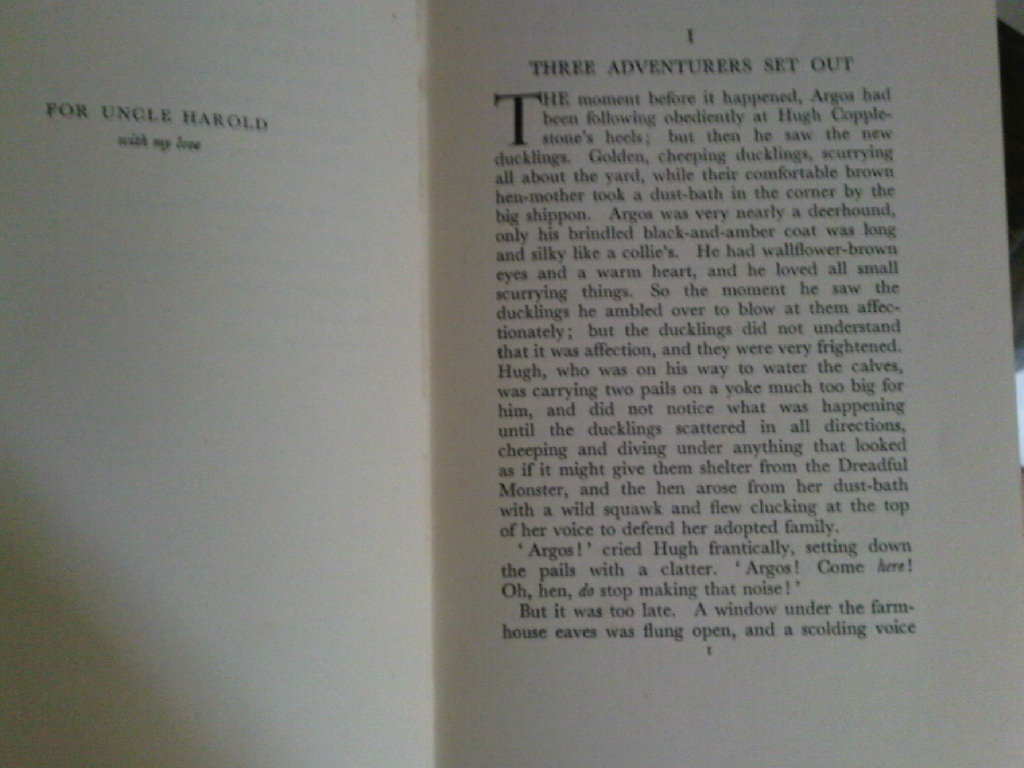
Dedication of Brother Dusty Feet by Rosemary Sutcliff

Rosemary Sutcliff dedicated Brother Dusty Feet (on BBC Radio 4 extra, starting this week) to my grandfather, Harold Lawton, who lived in Parkstone, Dorset.

Brother Dusty Feet by Rosemary Sutcliff inside cover